India Breathes Easy As Over 90 Cities Record Minimal Air Pollution
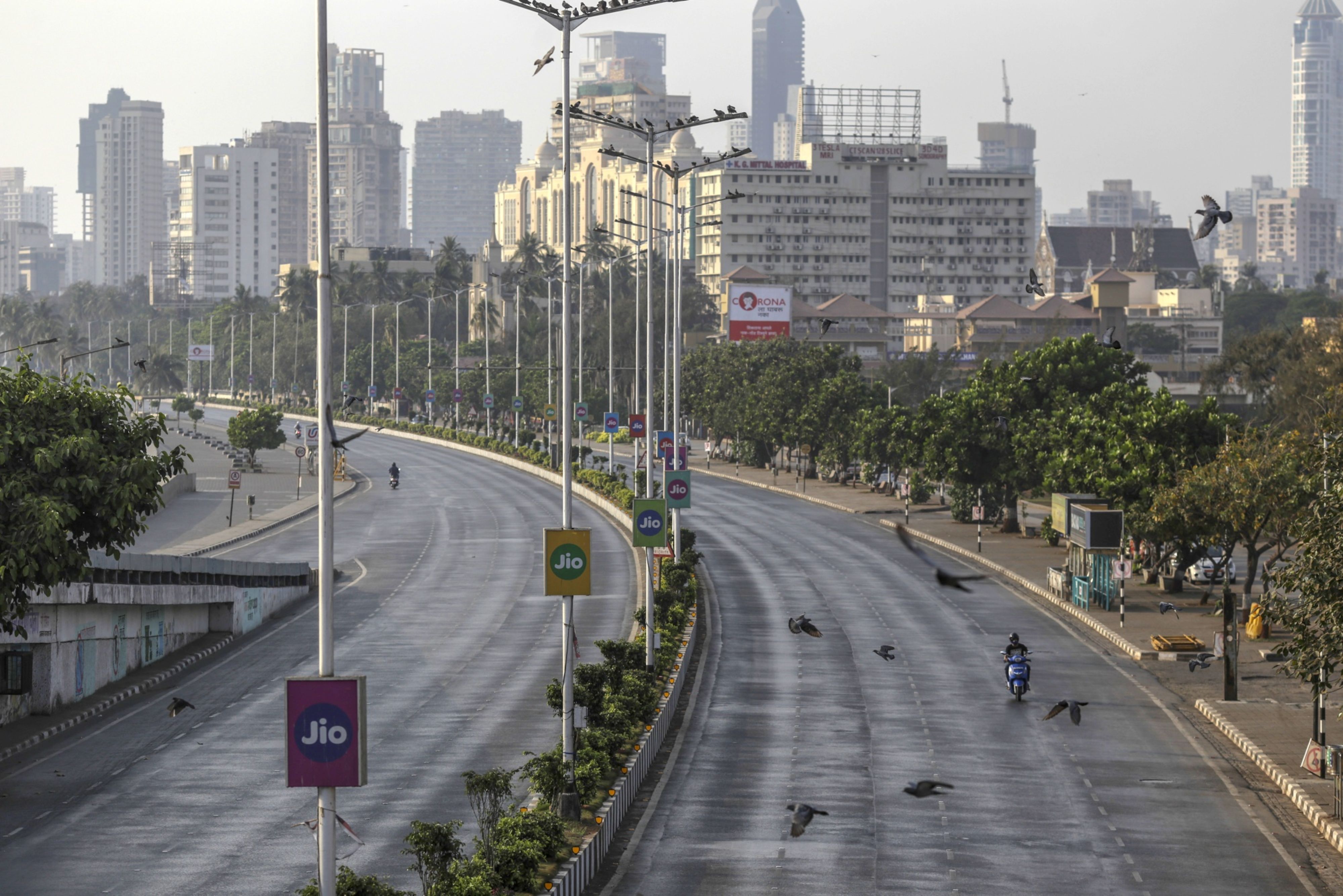
With a nationwide lockdown in place, over 90 cities, including Delhi, have recorded minimal air pollution in the last few days.
Welcoming the reduction in pollution, environmentalists urged the government to treat this as a ‘wake-up call' and stop its obsession with development at the cost of the environment.
India is currently under the biggest lockdown with around 130 crore people asked to stay home in view of the coronavirus outbreak, which has claimed 25 lives and infected over 950 people in the country.
The government has urged people to avoid unnecessary travelling, significantly reducing the traffic movement across the country.
According to the centre-run System of Air Quality and Weather Forecasting and Research (SAFAR), the impact of the measures taken due to the coronavirus outbreak has resulted in a drop in PM2.5 (fine particulate pollutant) by 30 percent in Delhi and by 15 percent in Ahmedabad and Pune.
The level of Nitrogen Oxide (NOx) pollution, which can increase the risk of respiratory conditions, has also reduced. NOx pollution is mainly caused due to a high motor vehicle traffic. In Pune, NOx pollution has reduced by 43 percent in Mumbai, and by 50 percent in Ahmedabad.
Gufran Beig, a scientist at SAFAR, said that pollution in March is generally in the ‘moderate' category (Air Quality Index range: 100-200) while presently, it is in the ‘satisfactory' (AQI 50-100) or ‘good' (AQI 0-50) category.
“It is the lockdown impact. Local factors like shutting down of industries and construction and traffic have contributed in improving the air quality. Rain is also helping, but the curbs on local emissions are playing a significant role,” he said.
Under the ‘good' category, pollution is considered to be at the lowest and the air is believed to be the healthiest to breathe.
According to the data of the Central Pollution Control Board (CPCB), the air quality in the national capital is presently in the ‘good' category. In Kanpur, which has high pollution levels, it is in the ‘satisfactory' category. Moreover,92 other cities with CPCB monitoring centres have recorded minimal air pollution, with the air quality in the range of ‘good' to ‘satisfactory.'
As many as 39 cities have recorded ‘good' air quality and 51 cities have recorded ‘satisfactory' air quality in the last few days, the CPCB data showed.
An AQI between 0-50 is considered good, 51-100 is satisfactory, 101-200 is moderate, 201-300 is poor, 301-400 is very poor and 401-500 falls under the severe category.
Environmentalists believe that the reduced pollution levels should act as a wake-up call for the government.
Jyoti Pande Lavakare, co-founder, Care for Air NGO, said the low AQI and the blue skies proved beyond doubt that a lot of the polluted air was “anthropomorphic, that is, man-made.”
“Obviously, slowing down the economy to such a degree is not the ideal way to bring down air pollution, but at least it proves that it can be done. We can achieve the same outcome by doing this mindfully, using technology and low-emission alternatives,” she said.
Lavakare emphasised on the need to realise that air pollution weakens the lungs, so countries like India with higher pollution and lower nutrition levels will be more affected by COVID-19, and morbidity and deaths are likely to be higher.
Ravina Kohli, environmentalist and part of the #MyRightToBreathe campaign, said it was a huge wake-up call for governments obsessed with development at the cost of the environment.
“We the people are the problem. Our communication on solutions now also includes how to reduce pollution at a personal level by being able to understand our behaviour and its consequences on our environment. For the first time, I believe our present generation will discover the critical importance and need for a focus on public health and the quality of air we breathe,” she said.
Jai Dhar Gupta, environmentalist and founder of Nirvana Being that sells masks and purifiers to combat pollution, said humans need to figure out if they wish to go back to the normal that was there before or find a more sustainable normal.
“This has been a fantastic wake-up call and I think we had a reality check and we need to figure out a new normal. This is an opportunity, a chance to find a new sustainable life,” he said.

-
Talking Points This Week: Tech Nerves, FII Buying, And A Faraway Banking Shock

The global markets are not shining this Diwali. The exception in the large markets is, India.
-
Midterm Rally Lasted A Day. The Hard Reality Of A Divided US May Last Two Years | Opinion
Between a contested AI boom, a debt ceiling that arrives in 2027 and a president with every incentive to act alone, the next two years may prove more volatile than the first day's rally suggests.
-
Blue Wave Will Derail the AI Trade but Won't Dismantle the AI Era | Unhedged Position
The Democrats' sweep of the US Congress will see politics collide with economic forces both over the long and short term.
-
It's Time To Take The GST Council's Bet On Trust Global
Payment records can prove India's services exports, and clear, proportionate rules can bring foreign digital sellers into the tax net.
-
Opinion | India at 38: From Innovation Overperformer to Innovation Powerhouse
India now has 453 VC-backed deep science startups, 18 of them late-stage, after 117 percent growth since 2020. Laurus Labs, at USD 9.3 billion, is the most valuable deep science company in any middle-income economy outside China.
-
Navigating Energy Crossroads: S Jaishankar's Call For Diversified Supply Chains At G20 Ministerial Meeting
As geopolitical fault lines continue to test maritime trade routes and commodity flows, Jaishankar's message remains pertinent: true economic resilience requires open markets, protected transit lines, and a genuine commitment to multilateral cooperation rather than coercion.
-
Indians Are Travelling, But Not Every Journey Is A Holiday | The Week In Whys
Pilgrims, patients and working women are the real travellers, and the system hasn't quite caught up with them.
-
Getting To Work Costs Women More | The Reason Why
It is not just about women paying more than men. It is about women paying much more in cities than in villages.
-
AI Bias In Investing Cannot Be Eliminated, But It Can Be Governed
Framing is a particularly important example as identical financial information presented in terms of gains rather than losses can lead an LLM to reach a different assessment.