Jats Call Off Quota Agitation After Government Truce
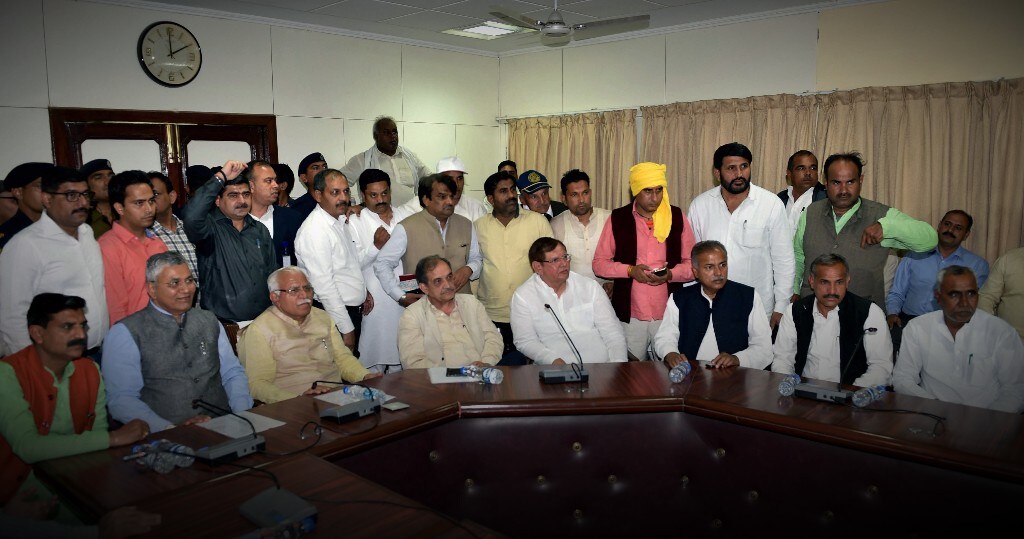
Members of the Jat community on Sunday called off their quota agitation scheduled for Monday, in the national capital, following a truce that was reached after a meeting between their leaders and the Haryana government.
Jat leaders decided to call off their agitation after a marathon four-hour meeting with Haryana Chief Minister Manohar Lal Khattar and two union ministers Birender Singh and PP Chaudhary, who are both Jats.
“Centre and state will soon begin the process of giving reservation, following the Delhi High court order," Khattar told reporters in a joint press conference along with All India Jat Aarakshan Sangharsh Samiti (AIJASS) Chairperson Yashpal Malik.
He also appealed to people in the state to cooperate in maintaining peace and harmony.
“Now Jats are not coming to Delhi. We have called off our agitation and march towards Delhi. The state government has agreed to our demands,” Malik told reporters after the meeting.
He added that the community will call off its protest from most of the places in the state, barring few where it will continue with symbolic protests.
Besides quotas, the Jats have been demanding release of people jailed during last year's agitation, withdrawal of cases slapped during the protests and government jobs for the kin of those killed and injured while taking part in the stir.
The Jats have been sitting in protest in various parts of Haryana since January 29.
PP Chaudhary, who is the minister of state for law and justice, said the government will now work according to the law.
“The government will now work according to the law and will undertake a survey and check ground realities so that the decision that we finally take will stand in court.PP Chaudhary, Minister of State for Law and Justice
He added, “The reservation process will expedite after appointment of National Commission of Backward Classes (NCBC) chairperson and we want to ensure reservation for the community which is not stuck anywhere due to legal issues”.
A Haryana ministerial panel led by senior minister Ram Bilas Sharma had held talks with the Jats in Panipat on March 16, after which the minister had said that an agreement had been reached with the community and the deadlock could end soon.
Around 30 people were killed and more than 300 people injured when a similar agitation by the Jats had resulted in large-scale violence in Haryana in February last year.
In view of the planned march tomorrow, prohibitory orders had been clamped in Delhi, Haryana, Uttar Pradesh and Rajasthan to stop the Jat protesters from entering Delhi.
About 24,700 paramilitary personnel had been mobilised to maintain peace. Metro and road transport has been curtailed and several schools have been closed in the national capital.
Khattar said the two sides firmed up the latest decisions with a “consensus” arrived between them.
He added that as part of the decisions made, the Haryana government will “re-assess cases registered between 2010-17 on the protesters and Jats will get full justice”.
“The next of kin of the killed and handicapped during these protests will be provided permanent jobs. Also, all those who were injured during protests will be provided their compensation quickly.
“The role of the officers will also be probed and we will take strict action against the guilty after investigation. All this will be done quickly and in a time-bound manner so that Jats gets justice. This is our desire and we believe that this issue will get resolved,” he said.
He added that as soon as the Chairman and members of the National Commission for Backward Classes (NCBC) are appointed, the process of reservation for Jats will be initiated at the Centre.
“With regard to Haryana, the bill for reservation is pending in the High Court and as soon as the decision comes, we will begin the process to include them in the 9th Schedule of the Constitution,” he added.

-
High US Salaries, No Green Card Certainty: The Financial Calculation Facing Indian H-1B Families

The suspension of PERM processing at eight technology employers does not cancel existing H-1B visas. What it does is force a question many Indian families have been avoiding: is the US salary worth tying your career and family plans to one employer?
-
Unhedged Position: Can India See An Indonesia-Style Time Correction?
The Nifty is trading below levels it first clocked in 2024. Is there, then, as I have suggested in the headline, potential that the current time correction drags on painfully for the next three-five, even ten years?
-
Navigating Friction And Energy Realities: An Analysis Of Marco Rubio's October Visit To India
Occurring at a critical juncture marked by stalled trade negotiations and escalating geopolitical pressures over global energy supplies, the visit offers a profound window into modern US-India relations.
-
India Exports Capital. Why Not Export Trusteeship?
The big question, then, is whether India can build an institution that global borrowers, investors, banks, and lawyers can trust, even without an Indian connection.
-
France's Economy & Politics Are In Crisis | The Reason Why
Let's look at how the French economy and politics evolved under Nicolas Sarkozy, Franois Hollande and Emmanuel Macron.
-
You May Inherit The Business. You Must Earn Its Credibility.
Succession tests the founder's ability to share authority as much as it tests the next generation's readiness to assume it.
-
Signing Deals Is One Thing; Making Them Work Is Another | The Week In Whys
Sometimes, things don't turn out as planned. Indian companies have lost some bids to rivals, some projects won't produce until 2030.
-
FOMC Wall, PERM Suspension, Hospital Stocks | Talking Points This Week
A PERM suspension would directly affect green-card sponsorship rather than H-1B visas, so the near-term earnings impact could remain relatively limited. The key question is whether this marks a new phase in US scrutiny of Indian IT.
-
Everything, Everywhere, All At Once: Dalal Street's Week To Forget | Joining The Dots
Visa curbs, a Starlink spat and cancer drug caps: what connects this week's shocks for Indian markets
-
India Is Going Abroad For Critical Minerals. But It May Take Years To Pay Off | The Reason Why
Although India's steps are in the right direction, they remain modest compared with India's growing dependence.









