India First to Land Near Moon South Pole After Russia Fails
(Bloomberg) --
India became the first country to land a spacecraft near the moon's south pole after Russia's attempt at a lunar touch down in the same area ended in failure following an engine malfunction.
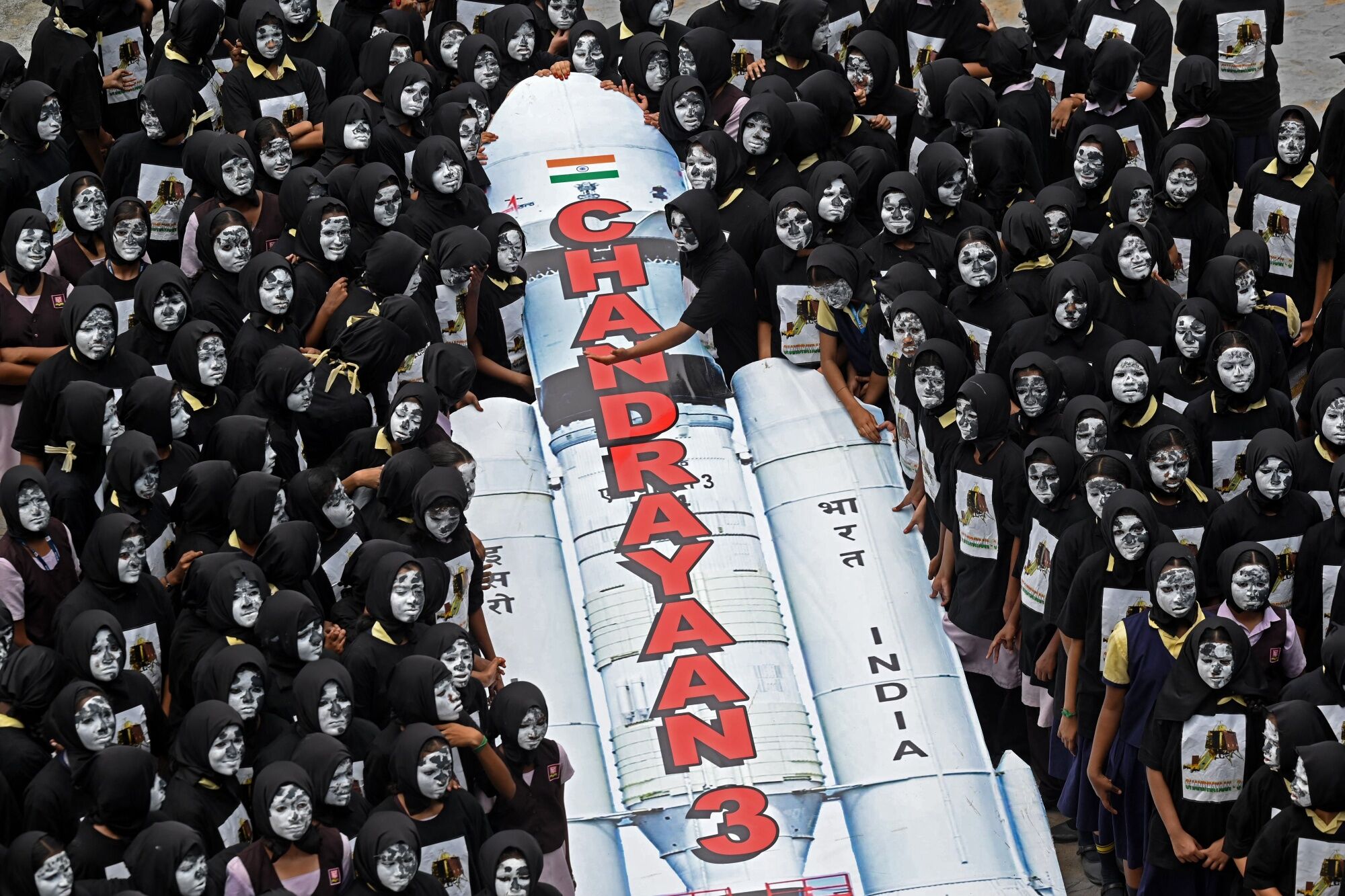
Chandrayaan-3 — India's spacecraft that launched last month — achieved a soft landing at 6:04 p.m. local time on Wednesday, after Russia's Luna-25 crashed into the moon on Sunday. A rover, named Pragyan, or , is set to analyze the chemical makeup of the moon's surface and search for water over the course of one lunar day, which is equivalent to 14 days on Earth.
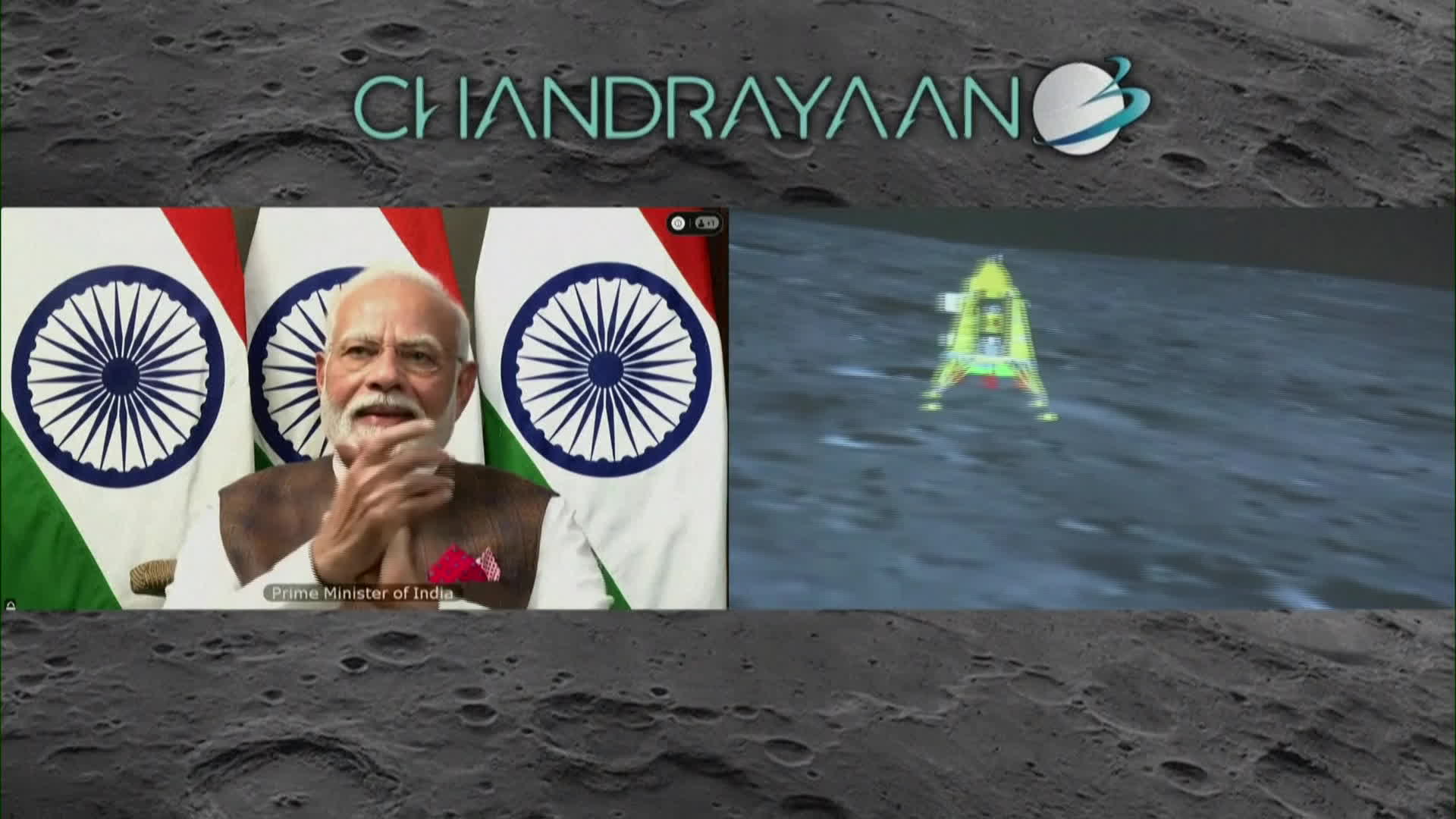
India is the second country, along with China, to have an operating rover on the moon.
A successful touch down lifts India's prestige in the global space race, after the country suffered a setback from a failed moon mission in 2019. Prime Minister Narendra Modi wants to bolster the country's place among the world's space faring nations and in June India signed the Artemis Accords, a US-backed initiative with more than two dozen other countries to govern joint missions and civilian space exploration.
Read More: Russia's Moon Failure a Dent to Its Space Partnership With China
Vikram, Chandrayaan-3's lander, had been trending on X, formerly known as Twitter, as billionaire industrialists and Bollywood actors eagerly awaited the historic moment. Schools urged students across the world's most-populous nation to watch the live event and commemorate the landmark mission, while some prayed in mosques and temples for a successful landing.
Shares of 13 Indian space-sector companies, including PTC Industries Ltd., Zen Technologies Ltd. and Centum Electronics Ltd., rallied and added more than $2.5 billion in market value this week, according to data complied by Bloomberg.
The water ice present in the moon's unchartered south pole has also piqued the interest of space voyaging countries, including the US and China. It could be a crucial drinking, breathing and rocket fuel resource to advance human space exploration deeper into the solar system.
In a social media post, NASA Administrator Bill Nelson congratulated India on being “the 4th country to successfully soft-land a spacecraft on the Moon.”
The US plans to send the first humans to explore the area near the south pole in 2025, in a mission called Artemis III. China is also seeking to build a research station near the region and place astronauts on the moon by 2030. Japan has an uncrewed mission planned for launch on Aug. 26.
India has other space efforts slated. The country will soon launch a mission, called Aditya L1, for a detailed solar study. A Venus mission is also on the Indian Space Research Organisation's agenda, Modi said after the landing. The agency plans to demonstrate human spaceflight capability through its Gaganyaan mission, which will launch crew members into an orbit of 400 kilometers (249 miles) for three days before bringing them back safely to Earth.
India's space agency and NASA have agreed to send an Indian astronaut to the International Space Station. The South Asian nation is also in discussions with Japan to work on a moon mission together.
--With assistance from Debjit Chakraborty.
(Updates with NASA Administrator statement, paragraph 8)
More stories like this are available on bloomberg.com
©2023 Bloomberg L.P.

-
Unhedged Position | Blue Wave Will Derail the AI Trade but Won't Dismantle the AI Era

The Democrats' sweep of the US Congress will see politics collide with economic forces both over the long and short term.
-
It's Time To Take The GST Council's Bet On Trust Global
Payment records can prove India's services exports, and clear, proportionate rules can bring foreign digital sellers into the tax net.
-
Opinion | India at 38: From Innovation Overperformer to Innovation Powerhouse
India now has 453 VC-backed deep science startups, 18 of them late-stage, after 117 percent growth since 2020. Laurus Labs, at USD 9.3 billion, is the most valuable deep science company in any middle-income economy outside China.
-
Navigating Energy Crossroads: S Jaishankar's Call For Diversified Supply Chains At G20 Ministerial Meeting
As geopolitical fault lines continue to test maritime trade routes and commodity flows, Jaishankar's message remains pertinent: true economic resilience requires open markets, protected transit lines, and a genuine commitment to multilateral cooperation rather than coercion.
-
Indians Are Travelling, But Not Every Journey Is A Holiday | The Week In Whys
Pilgrims, patients and working women are the real travellers, and the system hasn't quite caught up with them.
-
Getting To Work Costs Women More | The Reason Why
It is not just about women paying more than men. It is about women paying much more in cities than in villages.
-
AI Bias In Investing Cannot Be Eliminated, But It Can Be Governed
Framing is a particularly important example as identical financial information presented in terms of gains rather than losses can lead an LLM to reach a different assessment.
-
Joining The Dots | Dark Skies, Steady Diya: Why Hope Holds This Diwali
With war, a weak rupee and foreign outflows weighing on sentiment, policymakers at the NDTV World Summit and market veterans at NDTV Profit Ignite: Diwali Edition offered the same advice: stay invested and filter out the noise.
-
The Curious Case of Equitas Small Finance Bank And A CEO Who Quit For Stock
PN Vasudevan believes persistent investor concerns over a perceived conflict of interest had become a governance overhang on Equitas Small Finance Bank's stock, even as the lender improved profitability and asset quality.










