India-Russia Ties Enjoy ‘Special Privileged Strategic Partnership’, Modi Tells Putin
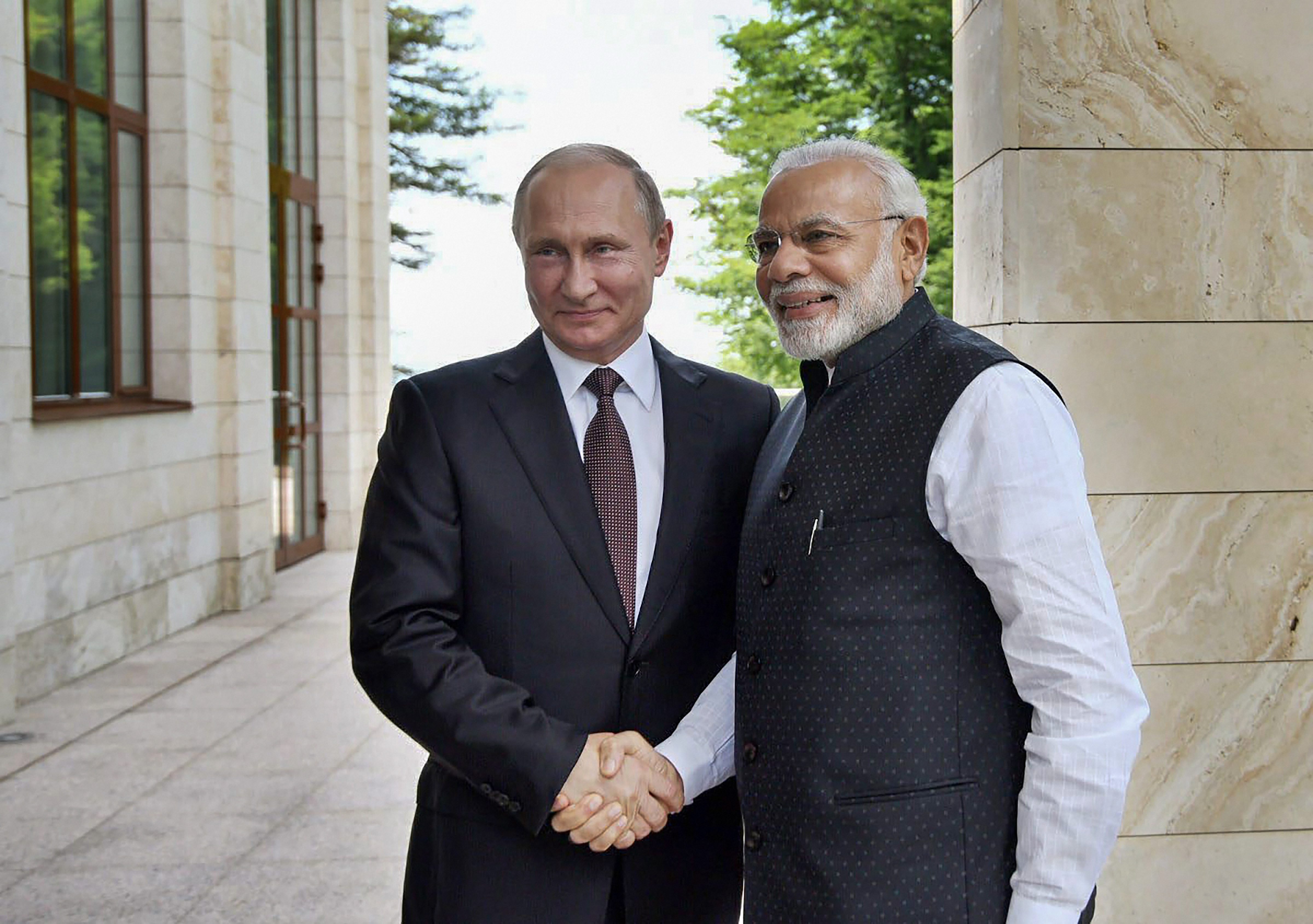
Prime Minister Narendra Modi today said the strategic partnership between India and Russia has now been elevated into a “special privileged strategic partnership” as he met President Vladimir Putin in this Black Sea coastal city for their first informal summit.
In his opening remarks, Prime Minister Modi said India and Russia have been friends for a long time and they have enjoyed an unbreakable friendship. “I am grateful to President Putin who invited me for an informal meeting and hence, in the long friendship of ours, this is a new aspect that has been attached to our relationship,” Modi said.
"You have added a new aspect of informal summit in the bilateral relationship which I think is a great occasion and creates trust," he added.
Modi recalled his first visit to Russia with then Prime Minister Atal Bihari Vajpayee in 2001 and said Putin was the first world leader whom he met after becoming the chief minister of Gujarat.
"In my political career also, Russia and you [Putin] are very significant...As the chief minister of Gujarat, it was my first meeting with a foreign leader. Hence, the beginning of my international relations started from you and Russia," Modi said.
"Since then it has been 18 years, I have got several opportunities to meet you, to deliberate upon issues, and try to take the relations of India and Russia forward," he added.
He said the seeds of the 'strategic partnership' sown by then Prime Minister Vajpayee and President Putin have now grown into a "special privileged strategic partnership" which is a "very big achievement" in itself.
Modi thanked Russia for playing a major role in helping India get a permanent membership in the Shanghai Cooperation Organisation – an eight-nation bloc which aims at military and economic cooperation between the member states. India and Pakistan were admitted last year into the organisation.
"We are working together on International North-South Transport Corridor (INSTC) and BRICS," Modi said.
He also congratulated Putin for becoming the President for the fourth time with overwhelming majority. "It's my pleasure that I had got an opportunity to talk to you over phone and soon met you to congratulate you personally," he said.
Welcoming Prime Minister Modi to Bocharev Creek in Sochi ahead of the delegation-level talks, Putin said his visit would give a fresh impetus to bilateral ties. He added that Russia and India maintain a high strategic level of partnership, with close cooperation between the two countries' defense ministries.
"Our defense ministries maintain very close contacts and cooperation. It speaks about a very high strategic level of our partnership," Putin said.
He also hailed joint activities of the two countries in the area of foreign politics, in particular within the United Nations, BRICS (an association of Brazil, Russia, India, China and South Africa) and the SCO.
Putin also said that last year there was a considerable increase in mutual trade and this year for the first several months it was an increase of more than 17 percent.
Official sources said the aim of the informal summit is to use the friendship and trust between the two countries to create convergence on key global and regional issues. The two leaders will meet for around four to six hours for the "agendaless" talks, they added.
The issues on the table may include economic impact on India and Russia in the wake of the U.S. withdrawal from the Iran nuclear deal, situation in Afghanistan, Syria, threat of terrorism and matters relating to upcoming SCO and BRICS summits.
The sources said possible impact of the US sanctions against Russia under Countering America's Adversaries through Sanctions Act (CAATSA) on Indo-Russia defence cooperation may also figure during the talks between Modi and Putin.
There have been apprehensions that the US decision on Iran deal may adversely impact New Delhi's oil import from the Persian Gulf nation as well as on the Chabahar port project. Iran is the third largest supplier of crude oil to India after Saudi Arabia and Iraq.
Watch this conversation with Salman Haider, former foreign secretary and Neelam Deo, former diplomat and director of Gateway House.

-
A New Samvat Wishlist: Inclusive Prosperity And Human Development

India has strengthened its economic foundations through infrastructure, digital access and enterprise. Its next growth chapter must deepen productivity, create better livelihoods and widen participation in prosperity.
-
Love, Sex Aur Dhokha: The Audacious Plot To Spy On Jensen Huang
A Taipei dinner, a Singapore chip buyer and a suspected Chinese asset: inside the alleged spy operation that got close to NVIDIA's Jensen Huang.
-
Ten Things I Learnt This Samvat
Patience can be a trap. Cheap stocks can stay cheap. Leverage can wipe you out. What did Samvat 2082 teach us? Niraj Shah writes on 10 lessons from the year gone by.
-
Talking Points This Week: Tech Nerves, FII Buying, And A Faraway Banking Shock
The global markets are not shining this Diwali. The exception in the large markets is, India.
-
Midterm Rally Lasted A Day. The Hard Reality Of A Divided US May Last Two Years | Opinion
Between a contested AI boom, a debt ceiling that arrives in 2027 and a president with every incentive to act alone, the next two years may prove more volatile than the first day's rally suggests.
-
Blue Wave Will Derail the AI Trade but Won't Dismantle the AI Era | Unhedged Position
The Democrats' sweep of the US Congress will see politics collide with economic forces both over the long and short term.
-
It's Time To Take The GST Council's Bet On Trust Global
Payment records can prove India's services exports, and clear, proportionate rules can bring foreign digital sellers into the tax net.
-
Opinion | India at 38: From Innovation Overperformer to Innovation Powerhouse
India now has 453 VC-backed deep science startups, 18 of them late-stage, after 117 percent growth since 2020. Laurus Labs, at USD 9.3 billion, is the most valuable deep science company in any middle-income economy outside China.
-
Navigating Energy Crossroads: S Jaishankar's Call For Diversified Supply Chains At G20 Ministerial Meeting
As geopolitical fault lines continue to test maritime trade routes and commodity flows, Jaishankar's message remains pertinent: true economic resilience requires open markets, protected transit lines, and a genuine commitment to multilateral cooperation rather than coercion.









