India, France Sign Strategic Pact On The Use Of Military Bases
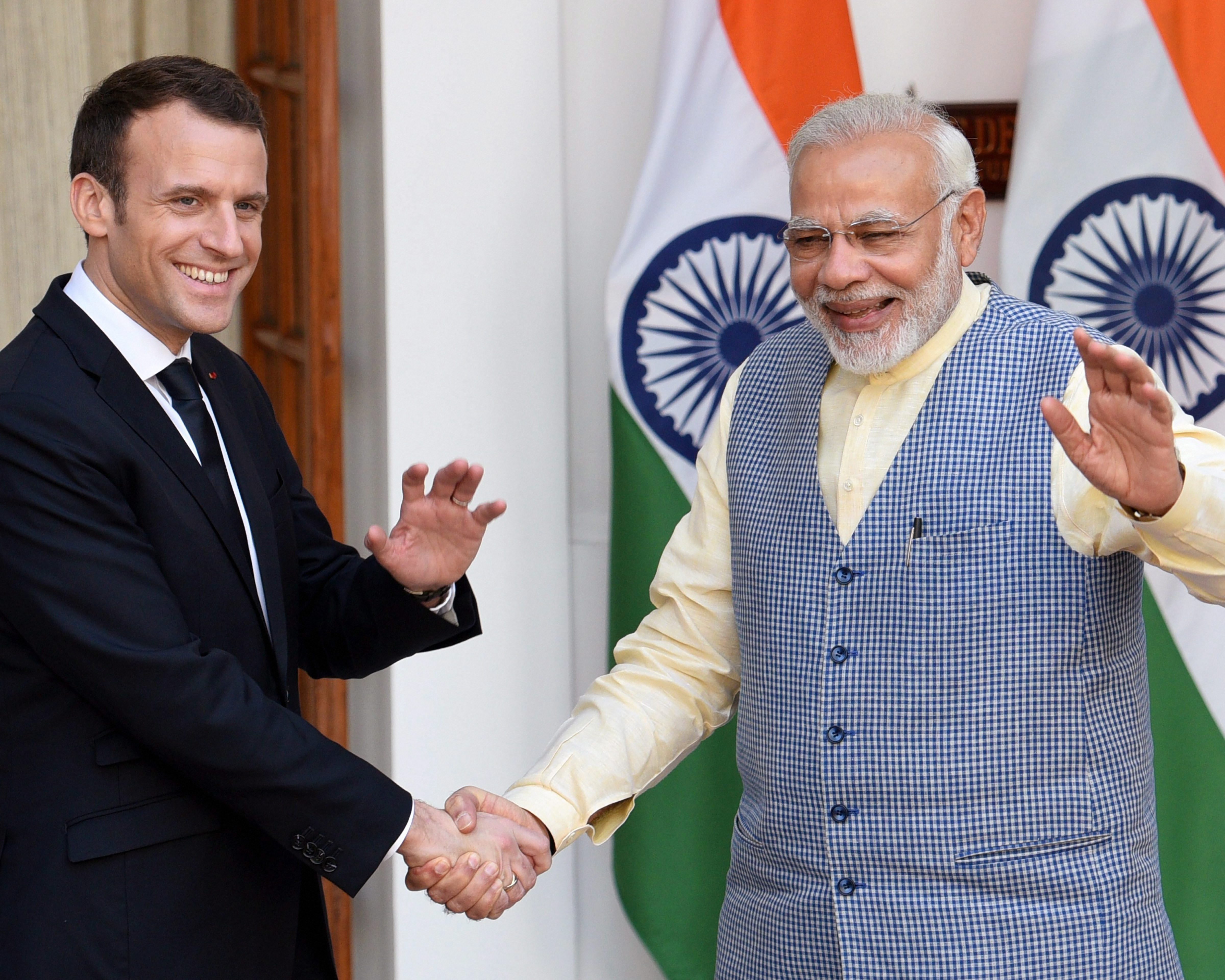
Reflecting a growing depth in defence ties, India and France inked a strategic pact today providing for the use of each other's military facilities including opening naval bases to warships. The agreement comes amid China's growing military expansionism in the Indo-Pacific region.
Prime Minister Narendra Modi and French President Emmanuel Macron held wide-ranging deliberations during which they also decided to create an annual defence dialogue at the ministerial level to explore ways to further deepen defence and strategic ties.
The two countries signed a pact on exchange and reciprocal protection of classified or protected information which came in the backdrop of the Indian government refusing to divulge details of the multi-billion dollar Indo-French Rafale fighter jet deal.
On ties in the maritime security sphere, the French President said both the countries will have ‘unprecedented' level of cooperation to ensure peace and stability in the Indian Ocean and in Pacific.
Also Read: Reveal ‘Ballpark' Cost Of Rafale Jets, Not Specifics, Say Defence Experts
He said that space agencies of both countries will have joint monitoring mechanism for developments in the maritime sphere, while navies of the two nations will share intelligence and call their respective military bases for any requirement.
Separately, Defence Minister Nirmala Sitharaman and her French counterpart Florence Parly held talks during which detailed discussions on specific projects including on the Scorpene submarine programme for the Indian Navy was discussed.
A joint statement issued after the talks said the pact on protection of classified information reflected the high level of “strategic trust” between the two countries.
According to the statement, Modi and Macron noted the “on-schedule” progress in the implementation of acquisition related agreements, with satisfaction, including the Rafale aircraft deal and the construction of six Scorpene submarines in India, in collaboration with French shipbuilder Naval Group.
Also Read: India, France Ink 14 Pacts In Boost To Defence, Nuclear Energy Cooperation
“They looked forward to continue their discussions to expand and deepen the ongoing defence manufacturing partnerships,” the joint statement read.
The Indo-French agreement on reciprocal logistics support for armed forces came nearly two years after India signed a similar pact with the U.S. on use of each other's land, air and naval bases.
Officials said the agreement will facilitate the reciprocal provision of logistic support, supplies and services between the armed forces of the two countries during authorised port visits, joint exercises and joint training among others.
“The agreement is symbolic of the strategic depth and maturity reached in India-France defence ties,” the joint statement said.
The two sides inked the pact amid China's growing assertiveness in the Indian Ocean and the Pacific region.
Referring to maritime security cooperation, Modi and Macron reiterated that it will be crucial in order to maintain the safety of international sea lanes for unimpeded commerce and communications.
“Our defence cooperation is very strong and we consider France among the most trusted defence partners,” Modi said in a statement to the media, in the presence of Macron.
Also Read: What Macron's Win In France Means For Emerging Markets And India
He said the pact on reciprocal logistic support between the armed forces is a ‘golden step' in defence relations.
Noting that defence cooperation between the two countries now has a ‘new significance,' Macron talked about the Scorpene submarine project for the Indian Navy and the fighter jet deal for the Air Force.
India had made a sovereign decision in this respect (Rafale fighter jet) and we are monitoring the progress in the field. We very much want to continue the programme. It is a long-term contract which is mutually beneficial. I personally consider it as the heart of the strategic partnership.Emmanuel Macron, French President
India had signed a government-to-government deal with France in 2016 to buy 36 Rafale fighter jets at a cost of about the Rs 58,000 crore. The Congress has been demanding details of the deal, alleging that the deal negotiated under its rule was much cheaper then the contract signed by the Modi government.
The joint statement said both sides also emphasised the importance of the joint military exercises and affirmed their intention to enhance the level of exercises.
It said both sides acknowledged that the Make in India initiative offers a valuable opportunity for Indian and French defence enterprises to enter into co-development and co-production projects in the defence sector, including through transfer of technologies.
Also Read: Macron Says France, India to Work Together on Climate Change

-
High US Salaries, No Green Card Certainty: The Financial Calculation Facing Indian H-1B Families

The suspension of PERM processing at eight technology employers does not cancel existing H-1B visas. What it does is force a question many Indian families have been avoiding: is the US salary worth tying your career and family plans to one employer?
-
Swiggy vs Eternal: Food Delivery's Two Rivals Are No Longer In The Same Race
Eternal is building a private AI assistant, dark.ai. Swiggy is still working out how to make Instamart pay, with an operating loss of Rs 895 crore in the July-September quarter while Blinkit stayed profitable.
-
Where You Live Shapes How You Get To Work | The Reason Why
Two-wheelers are the most popular way to get to work in India, accounting for nearly 43% of workplace commutes.
-
Unhedged Position: Can India See An Indonesia-Style Time Correction?
The Nifty is trading below levels it first clocked in 2024. Is there, then, as I have suggested in the headline, potential that the current time correction drags on painfully for the next three-five, even ten years?
-
Navigating Friction And Energy Realities: An Analysis Of Marco Rubio's October Visit To India
Occurring at a critical juncture marked by stalled trade negotiations and escalating geopolitical pressures over global energy supplies, the visit offers a profound window into modern US-India relations.
-
India Exports Capital. Why Not Export Trusteeship?
The big question, then, is whether India can build an institution that global borrowers, investors, banks, and lawyers can trust, even without an Indian connection.
-
France's Economy & Politics Are In Crisis | The Reason Why
Let's look at how the French economy and politics evolved under Nicolas Sarkozy, Franois Hollande and Emmanuel Macron.
-
You May Inherit The Business. You Must Earn Its Credibility.
Succession tests the founder's ability to share authority as much as it tests the next generation's readiness to assume it.
-
Signing Deals Is One Thing; Making Them Work Is Another | The Week In Whys
Sometimes, things don't turn out as planned. Indian companies have lost some bids to rivals, some projects won't produce until 2030.
-
FOMC Wall, PERM Suspension, Hospital Stocks | Talking Points This Week
A PERM suspension would directly affect green-card sponsorship rather than H-1B visas, so the near-term earnings impact could remain relatively limited. The key question is whether this marks a new phase in US scrutiny of Indian IT.









