India Continues To Dominate List Of Cities With World's Most Toxic Air
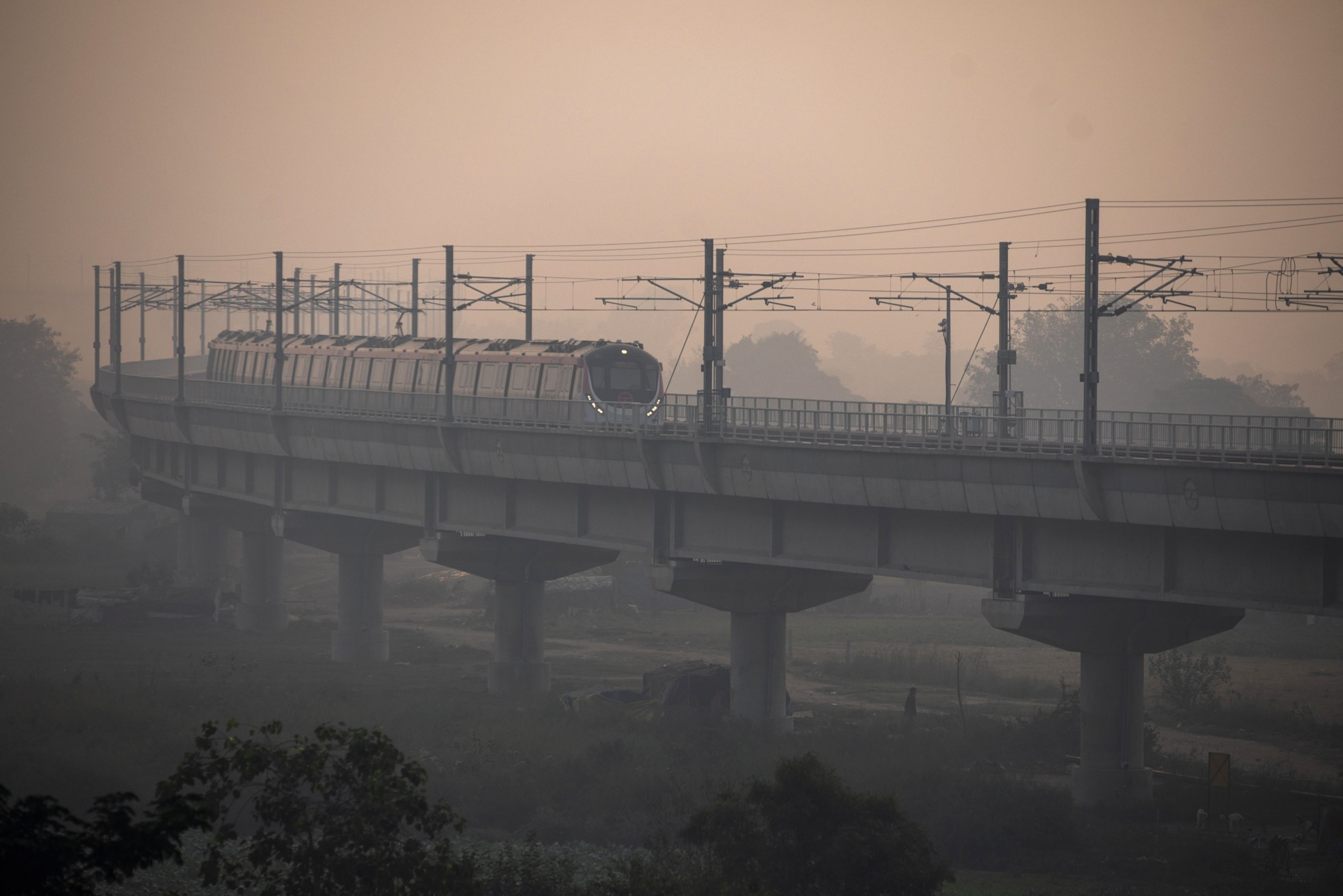
The pandemic-induced illusion of blue skies has ended. As the economy recovers, a large number of Indians living in cities are again breathing the most toxic air in the world.
India was home to 35 of 50 most-polluted cities in the world in 2021, according to the annual air quality report by Swiss firm IQAir. New Delhi remained the most polluted capital city for a fourth year running. Bhiwadi, Rajasthan and Ghaziabad, Uttar Pradesh were the top two cities with worst average air quality in the world.
The year marked a revival for the Indian economy from a devastating second wave of Covid-19 pandemic. That also means improved air quality the country saw during the lockdowns is now over.
In 2021, the average particulate matter 2.5 concentrations in India reached 58.1 micrograms—higher than 51.9 micrograms the year before. This was the first time in three years that India's average air quality has actually worsened.
But that's only half the story. Even the lower figure from 2020 is more than ten times higher than what is deemed safe for breathing by the World Health Organization. Of the 128 cities for which IQAir collected the data, none met the level.
None of this is a surprise in a country that has been grappling with toxic air for years now. Air pollution is the second biggest risk factor contributing to India's disease burden. Each year, over a million people die in India due to bad air, according to Health Effects Institute. It is also responsible for inflicting severe economic damage with the Indian Council of Medical Research estimating that in 2019 alone, deaths due to air pollution caused losses of $36.8 billion.
Yet, year after year the country finds itself in the infamous list of most polluted cities. Its National Clean Air Programme, to cut emissions in cities, lacks any meaningful progress on the ground. Urban local bodies tasked with implementing the programme remain ill-equipped, funds remain underutilised and the air quality monitoring network is much smaller than needed.
"The continuous dominance of India in the world's most polluted cities is a reminder that even though we have started moving on the journey towards clean air through formulation of policies like NCAP, there remains a big gap in their actual implementation," Sunil Dahiya, analyst at the Centre for Research on Energy and Clean Air, told BloombergQuint.
Unless India takes an emission-capping approach and limits combustion of fossil fuels, it will be "impossible to provide breathable air" to citizens, he said. "Till then, our cities will keep making it into such lists of most polluted cities."
Globally, too, the annual report paints a grim picture. Not a single city managed to meet the WHO's air quality standard in 2021. While India had among the most polluted cities, the average air quality of Bangladesh, Chad, Pakistan and Tajikistan was worse.

-
High US Salaries, No Green Card Certainty: The Financial Calculation Facing Indian H-1B Families

The suspension of PERM processing at eight technology employers does not cancel existing H-1B visas. What it does is force a question many Indian families have been avoiding: is the US salary worth tying your career and family plans to one employer?
-
Swiggy vs Eternal: Food Delivery's Two Rivals Are No Longer In The Same Race
Eternal is building a private AI assistant, dark.ai. Swiggy is still working out how to make Instamart pay, with an operating loss of Rs 895 crore in the July-September quarter while Blinkit stayed profitable.
-
Where You Live Shapes How You Get To Work | The Reason Why
Two-wheelers are the most popular way to get to work in India, accounting for nearly 43% of workplace commutes.
-
Unhedged Position: Can India See An Indonesia-Style Time Correction?
The Nifty is trading below levels it first clocked in 2024. Is there, then, as I have suggested in the headline, potential that the current time correction drags on painfully for the next three-five, even ten years?
-
Navigating Friction And Energy Realities: An Analysis Of Marco Rubio's October Visit To India
Occurring at a critical juncture marked by stalled trade negotiations and escalating geopolitical pressures over global energy supplies, the visit offers a profound window into modern US-India relations.
-
India Exports Capital. Why Not Export Trusteeship?
The big question, then, is whether India can build an institution that global borrowers, investors, banks, and lawyers can trust, even without an Indian connection.
-
France's Economy & Politics Are In Crisis | The Reason Why
Let's look at how the French economy and politics evolved under Nicolas Sarkozy, Franois Hollande and Emmanuel Macron.
-
You May Inherit The Business. You Must Earn Its Credibility.
Succession tests the founder's ability to share authority as much as it tests the next generation's readiness to assume it.
-
Signing Deals Is One Thing; Making Them Work Is Another | The Week In Whys
Sometimes, things don't turn out as planned. Indian companies have lost some bids to rivals, some projects won't produce until 2030.
-
FOMC Wall, PERM Suspension, Hospital Stocks | Talking Points This Week
A PERM suspension would directly affect green-card sponsorship rather than H-1B visas, so the near-term earnings impact could remain relatively limited. The key question is whether this marks a new phase in US scrutiny of Indian IT.









