How BJP Trumped SP-BSP With Congress’ Help In Uttar Pradesh
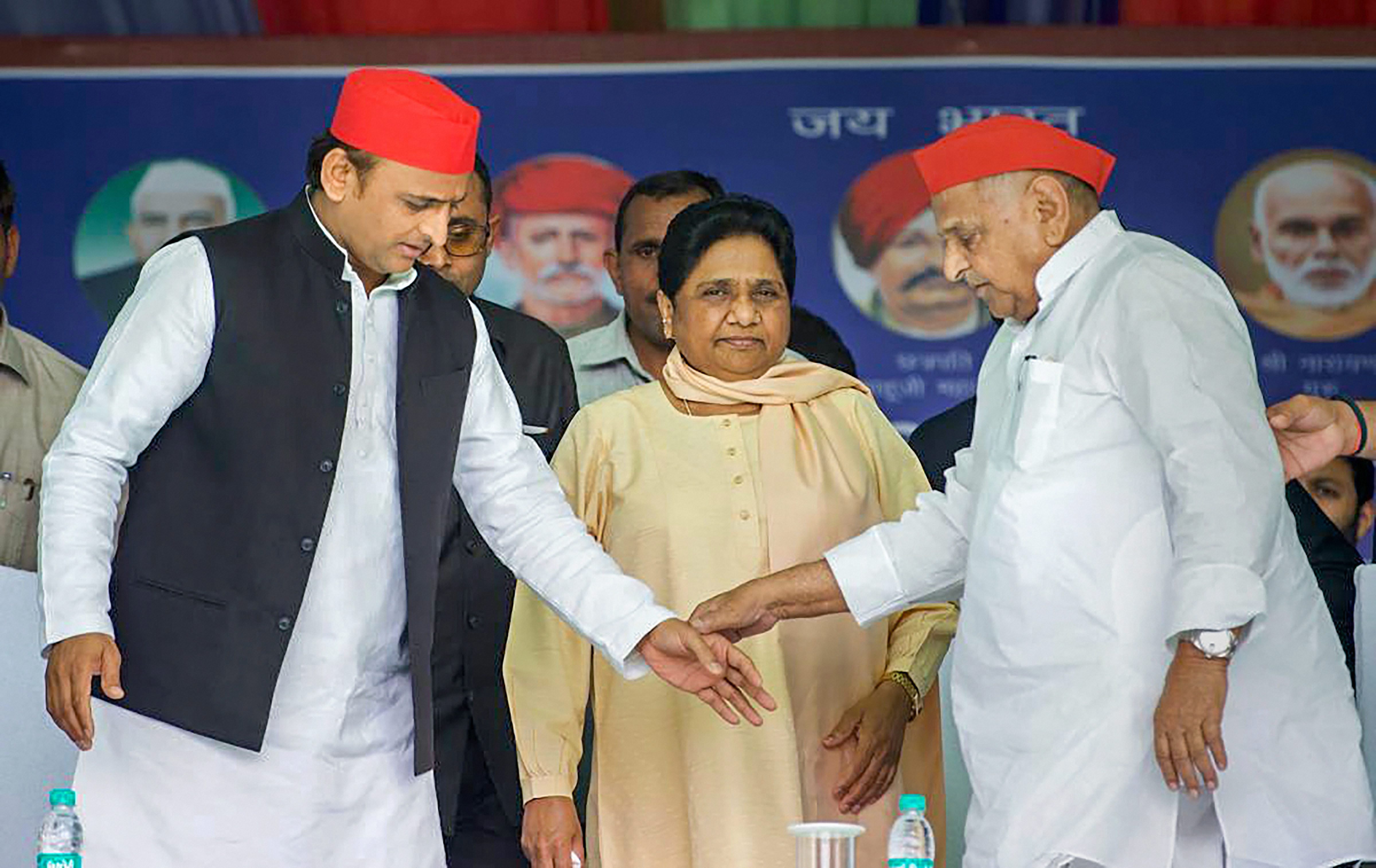
The Bharatiya Janata Party scored a resounding victory in Uttar Pradesh, despite the SP-BSP-RLD mahagathbandhan which was expected to make a dent in the NDA tally riding on support of Dalits, Muslims, Yadavs and Jats.
The vote share break-up of the three alliances helps us unravel what happened.
The BJP's Math

- The party consolidated its position among the upper castes. Thakurs and Brahmins supported the party in even larger numbers (up 8 percent) as it became an election of ‘agda versus pichda'.
- BJP retained the support of a majority of Jats despite Ajit Singh tying up with the SP-BSP. The father-son duo of Ajit and Jayant both lost the elections. Jats may not have forgotten their tensions with Muslims during the riots of 2013.
- BJP further consolidated its position among Non-Yadav Other Backward Classes (gain of 15 percent). The inclusion of the Nishad party and Kurmi support from the Apna Dal helped in this endeavour. OP Rajbhar leaving the alliance had no impact.
- BJP tightened its hold on the Non-Jatav Scheduled Caste communities. Their support for the party has increased by 15 percent. This way, the BJP reduced Mayawati's influence.
SP-BSP Unable To Consolidate

The mahagathbandhan managed to consolidate Yadav, Jatav and Muslim votes, however, the MGB partners failed to seamlessly transfer votes to each other, lowering its index of alliance chemistry. This is measured as the ratio of an alliance's post-poll vote share to the sum of the vote share of its constituents in the previous election.
The SP-BSP-RLD alliance's index of chemistry was about 90 percent. In other words, leakages were to the tune of 10 percent. In 2015, the JD(U)-RJD-Congress alliance notched up a score in excess of 95 percent.
What harmed the mahagathbandhan more was its inability to expand the social base and on-board new social groups from the non-Yadav OBC community like Nishads, Rajbhars. The loss of Nishad party was a big blow in Eastern UP.
The Rashtriya Lok Dal suffered from a credibility factor and failed to win over Jats. Mayawati couldn't pull back Non-Jatavs, her party is essentially reduced to Jatav Samaj Party . SP also couldn't stop young Yadav voters from backing Modi. Leaving the Congress out of the alliance turned out to be costly.
The Congress damaged the MGB in 10 seats, splitting Muslim votes.
Congress Loses Ground Across The Board

Not only did the Congress register its lowest tally winning just one seat (Sonia Gandhi in Rae Bareli), its vote share plunged further, by 2 percent. The party lost support across most voter groups in the range of 5 percent. Only among Muslim voters did it hold on to its support. The Congress received 10 percent Muslim votes leading to a 2 percent vote share.
In the build-up to the election, some positioned the Congress as a potential challenger to the BJP's upper-caste vote base. The party failed to make inroads here.
The Priyanka factor has had zero impact. She held rallies in 31 constituencies where party lost in all save one, her mother's.
Clearly, the Congress was not seen as the major challenger to BJP in Uttar Pradesh, and instead played the role of a vote-cutter.
Congress Trips 10 MGB Candidates
Although some commentators expected Congress to damage BJP by cutting its upper caste votes, it actually damaged the mahagathnabdhan more.

I have previously flagged the likelihood of this happening. As the campaign was drawing to a close, Priyanka Gandhi Vadra claimed, “We have carefully chosen candidates so that either Congress wins or they cut into BJP votes. Congress is not at all cutting into votes of the UP Gathbandhan.” Well, that's not what happened.
Congress ensured that the mahagathnabdhan lost in 10 seats, where it notched up more votes than margin of victory. The same can be said of NDA losses in only two seats.

The Young Aspirational Voter And Woman Voter
The BJP victory would not have been possible without the backing of young and first-time voters. They believed their aspirations could be fulfilled by the BJP. The nationalism factor also resonated more with the young as they voted for a strong leader.
While unemployment was the top issue in the pre-election opinion polls, 43 percent of the youth voted for Modi because they thought he is in a better position to create jobs.
Women are increasingly voting on their own due to increasing literacy and awareness. The party has created a loyal vote base through schemes like Swachh Bharat (toilets), Ujjwala (gas cylinder), PM Awas (house) and beti bachao beti padhao (education).
Women turnout has also increased over the years. In UP, the turnout of men outnumbered the women, but there was an increase in the number of female voters, narrowing the gap.
What Went Wrong With The Mahagathbandhan?
Many factors contributed to the failure of the mahagathbandhan in UP.
- The SP-BSP duo played their cards too early giving BJP a lot of time to prepare and counter. As early as last year, buoyed by the victory in by-polls, they hinted they would come together to stop the BJP juggernaut.
The surprise attack element was missing.
- The basic premise of coming together was the victory in by-polls in three seats of Gorakhpur, Kairana and Phulpur. By-polls are contested on hyper local issues. When voters went to cast their vote in the 2018 by-polls, they had they were merely being asked to choose a member of Parliament. The Prime Minister and the central government were already in place. Modi didn't even campaign in the by-polls.
- The MGB parties had nothing to offer, except a personal call of survival. Many people saw it as an opportunistic alliance just to grab power.
Just because the party bosses kissed and made up, didn't necessarily mean workers shed their inhibitions. The SP-BSP past still haunted them.
- The mahagathbandhan had nothing going for it except caste. While caste still plays a big role, new voting patterns are emerging which negated the advantage of the mahagathbandhan. It failed to recognise these new trends and take corrective action.
- The mahagathbandhan led to a polarisation among the Hindu voters. Mayawati's call to Muslims to not waste their vote by backing Congress led to Yogi Aditanath's ‘Ali - Bajrang Bali' retort.
The BJP's neatly crafted victory will go down in electoral history as a case study of smart electioneering strategy.
Amitabh Tiwari is a political commentator, strategist and consultant advising political parties and leaders. He was a corporate and investment banker.
The views expressed here are those of the author and do not necessarily represent the views of BloombergQuint or its editorial team.

-
High US Salaries, No Green Card Certainty: The Financial Calculation Facing Indian H-1B Families

The suspension of PERM processing at eight technology employers does not cancel existing H-1B visas. What it does is force a question many Indian families have been avoiding: is the US salary worth tying your career and family plans to one employer?
-
Unhedged Position: Can India See An Indonesia-Style Time Correction?
The Nifty is trading below levels it first clocked in 2024. Is there, then, as I have suggested in the headline, potential that the current time correction drags on painfully for the next three-five, even ten years?
-
Navigating Friction And Energy Realities: An Analysis Of Marco Rubio's October Visit To India
Occurring at a critical juncture marked by stalled trade negotiations and escalating geopolitical pressures over global energy supplies, the visit offers a profound window into modern US-India relations.
-
India Exports Capital. Why Not Export Trusteeship?
The big question, then, is whether India can build an institution that global borrowers, investors, banks, and lawyers can trust, even without an Indian connection.
-
France's Economy & Politics Are In Crisis | The Reason Why
Let's look at how the French economy and politics evolved under Nicolas Sarkozy, Franois Hollande and Emmanuel Macron.
-
You May Inherit The Business. You Must Earn Its Credibility.
Succession tests the founder's ability to share authority as much as it tests the next generation's readiness to assume it.
-
Signing Deals Is One Thing; Making Them Work Is Another | The Week In Whys
Sometimes, things don't turn out as planned. Indian companies have lost some bids to rivals, some projects won't produce until 2030.
-
FOMC Wall, PERM Suspension, Hospital Stocks | Talking Points This Week
A PERM suspension would directly affect green-card sponsorship rather than H-1B visas, so the near-term earnings impact could remain relatively limited. The key question is whether this marks a new phase in US scrutiny of Indian IT.
-
Everything, Everywhere, All At Once: Dalal Street's Week To Forget | Joining The Dots
Visa curbs, a Starlink spat and cancer drug caps: what connects this week's shocks for Indian markets
-
India Is Going Abroad For Critical Minerals. But It May Take Years To Pay Off | The Reason Why
Although India's steps are in the right direction, they remain modest compared with India's growing dependence.









