Don't Panic: Here's What Depositors Of New India Cooperative Bank Should Do
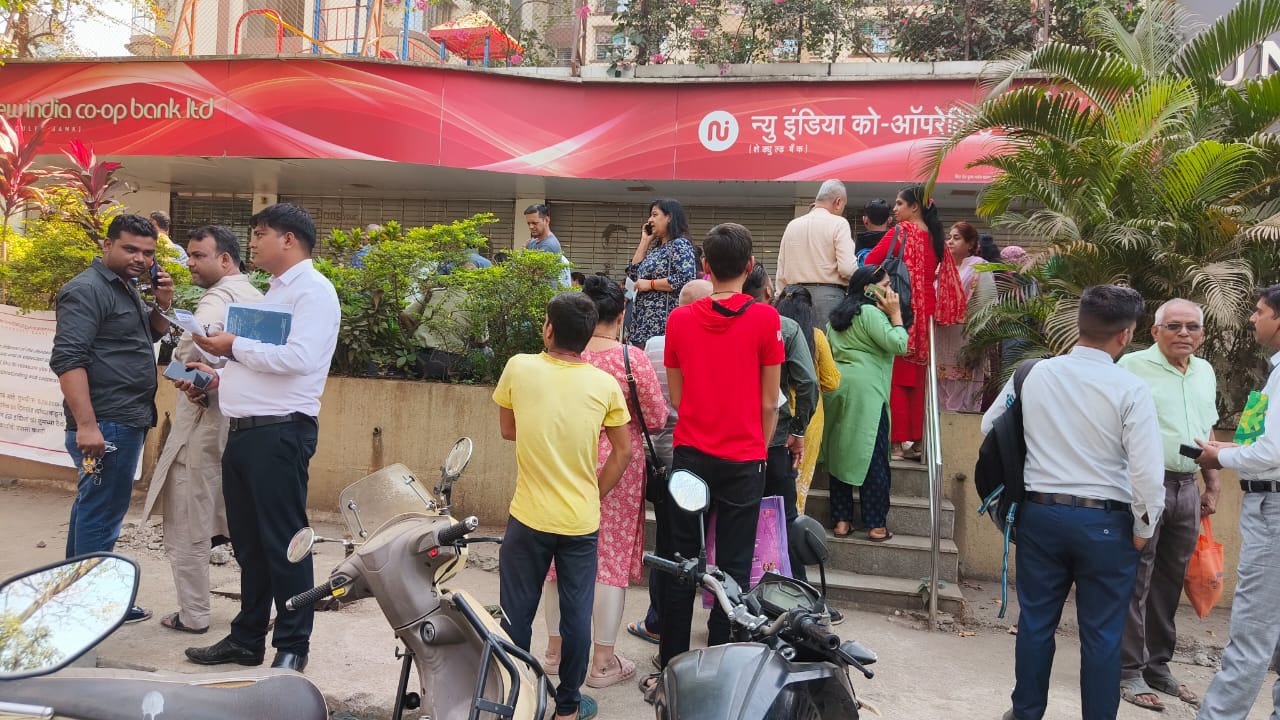
Hundreds of customers of New India Cooperative Bank lined up to get access to their deposits across Mumbai on Friday after the Reserve Bank of India ordered for the bank in the previous day to stop daily operations with immediate effect.
The regulator ordered that from the close of business on Thursday, the bank shall not grant or renew any loans and advances, nor make any investment. The bank shall not incur any liability including borrowing of funds and accept fresh deposits. The RBI also barred the lender from disbursing or agreeing to disburse any payments, unless specifically approved by the regulator.
"These directions are necessitated due to supervisory concerns emanating from the recent material developments in the bank, and to protect the interest of depositors of the bank," the RBI said in its statement on Thursday.
Later on Friday, the regulator superseded the bank's board for 12 months and appointed an administrator to run affairs at the lender. A two-member advisory committee was created to support the administrator.
While the regulator has been actively trying to curb poor governance practices at cooperative banks, the customers of such lenders have often had to face severe emotional duress for the period in which such restrictions were placed.
People in the know said that 90% of the 1.3 lakh depositors of New India Cooperative Bank are fully covered under the deposit insurance scheme and will be duly paid within the stated timeline of 90 days. Under the deposit insurance scheme, all deposits up to Rs 5 lakh are fully covered.
So when faced with such restrictions, what should an average depositor do? Here's a primer from NDTV Profit.
Don't Panic
As the banking sector regulator, the RBI is empowered to take strict action against lenders when it is determined that activities by them are not in the interest of depositors. Section 35A of the RBI Act allows RBI to take any action necessary to protect depositors.
Previously too, the regulator has temporarily stopped withdrawal of deposits at cooperative banks and even universal banks. In March 2020, the regulator had paused deposit withdrawals for two weeks at Yes Bank. However, depositors were eventually allowed complete access to their funds.
To ensure that depositors are not hassled during such actions, the Union government passed the Deposit Insurance And Credit Guarantee Act in 2021. This allows depositors to gain access to deposits up to Rs 5 lakh whenever the regulator takes coercive action against a lender. The timelines for availability of insured deposits is detailed in the act and are followed intently in such cases.
Claiming Your Insured Deposits
Under deposit insurance, all RBI regulated lenders are required to pay annual insurance premium to the Deposit Insurance Credit Guarantee Corporation. The DICGC is an RBI subsidiary that pays out eligible depositors of banks under any moratorium. The eligibility is a proven deposit of up to Rs 5 lakh in every bank.
The Deposit Insurance And Credit Guarantee Act details how depositors of banks under similar RBI action can claim their deposits. The act has specific timelines for each activity, which are closely followed in such cases. This typically takes up to 90 days.
Within the first 45 days of the RBI placing a bank under moratorium, a list of all eligible depositors is created.
Once the list is shared with the DICGC, it has 30 days to verify the data and ascertain whether the depositor would like to immediately receive the insured funds, through an online portal or any other method it deems fit.
After the confirmation process is completed, it has 15 days to make the payments directly to the depositor or transferred to any bank account of their choice.
If the RBI were to introduce any scheme of amalgamation or reconstruction for the stressed bank within the 90 day repayment period, the repayment period gets extended by another 90 days, according to the amendment.
Moreover, if the RBI were to remove its restrictions and the insured bank is capable to paying depositors their full dues, before the repayment period runs out, the DICGC will be free from any payment liabilities.
Does DICGC Have Enough To Pay?
As of March 2024, the DICGC's deposit insurance fund stood at Rs 1.98 lakh crore, up 17% from a year before. This is the fund where insurance premium collected from all eligible banks are placed. The funds can then be used to settle claims of depositors of banks placed under moratorium.
Before the 2021 Act was passed, depositors were expected to wait for eight to 10 years to get their insured deposits. However, the new law ensures a complete payout of up to Rs 5 lakh per depositor within 90 days.
According to data provided in New India Cooperative Bank's annual report, the lender had deposits worth Rs 2,436 crore as of March 31, 2024. This included Rs 681 crore worth savings account deposits, Rs 103 crore worth current account deposits and Rs 1,652 crore worth term or fixed deposits.
As of March 31, 2024, the DICGC has paid out Rs 5,396 crore to over 3.7 lakh eligible depositors.
Watch

-
High US Salaries, No Green Card Certainty: The Financial Calculation Facing Indian H-1B Families

The suspension of PERM processing at eight technology employers does not cancel existing H-1B visas. What it does is force a question many Indian families have been avoiding: is the US salary worth tying your career and family plans to one employer?
-
Swiggy vs Eternal: Food Delivery's Two Rivals Are No Longer In The Same Race
Eternal is building a private AI assistant, dark.ai. Swiggy is still working out how to make Instamart pay, with an operating loss of Rs 895 crore in the July-September quarter while Blinkit stayed profitable.
-
Where You Live Shapes How You Get To Work | The Reason Why
Two-wheelers are the most popular way to get to work in India, accounting for nearly 43% of workplace commutes.
-
Unhedged Position: Can India See An Indonesia-Style Time Correction?
The Nifty is trading below levels it first clocked in 2024. Is there, then, as I have suggested in the headline, potential that the current time correction drags on painfully for the next three-five, even ten years?
-
Navigating Friction And Energy Realities: An Analysis Of Marco Rubio's October Visit To India
Occurring at a critical juncture marked by stalled trade negotiations and escalating geopolitical pressures over global energy supplies, the visit offers a profound window into modern US-India relations.
-
India Exports Capital. Why Not Export Trusteeship?
The big question, then, is whether India can build an institution that global borrowers, investors, banks, and lawyers can trust, even without an Indian connection.
-
France's Economy & Politics Are In Crisis | The Reason Why
Let's look at how the French economy and politics evolved under Nicolas Sarkozy, Franois Hollande and Emmanuel Macron.
-
You May Inherit The Business. You Must Earn Its Credibility.
Succession tests the founder's ability to share authority as much as it tests the next generation's readiness to assume it.
-
Signing Deals Is One Thing; Making Them Work Is Another | The Week In Whys
Sometimes, things don't turn out as planned. Indian companies have lost some bids to rivals, some projects won't produce until 2030.
-
FOMC Wall, PERM Suspension, Hospital Stocks | Talking Points This Week
A PERM suspension would directly affect green-card sponsorship rather than H-1B visas, so the near-term earnings impact could remain relatively limited. The key question is whether this marks a new phase in US scrutiny of Indian IT.









