From Real-Life Phunsuk Wangdu To Activist Under Scrutiny — All You Need To Know About Sonam Wangchuk
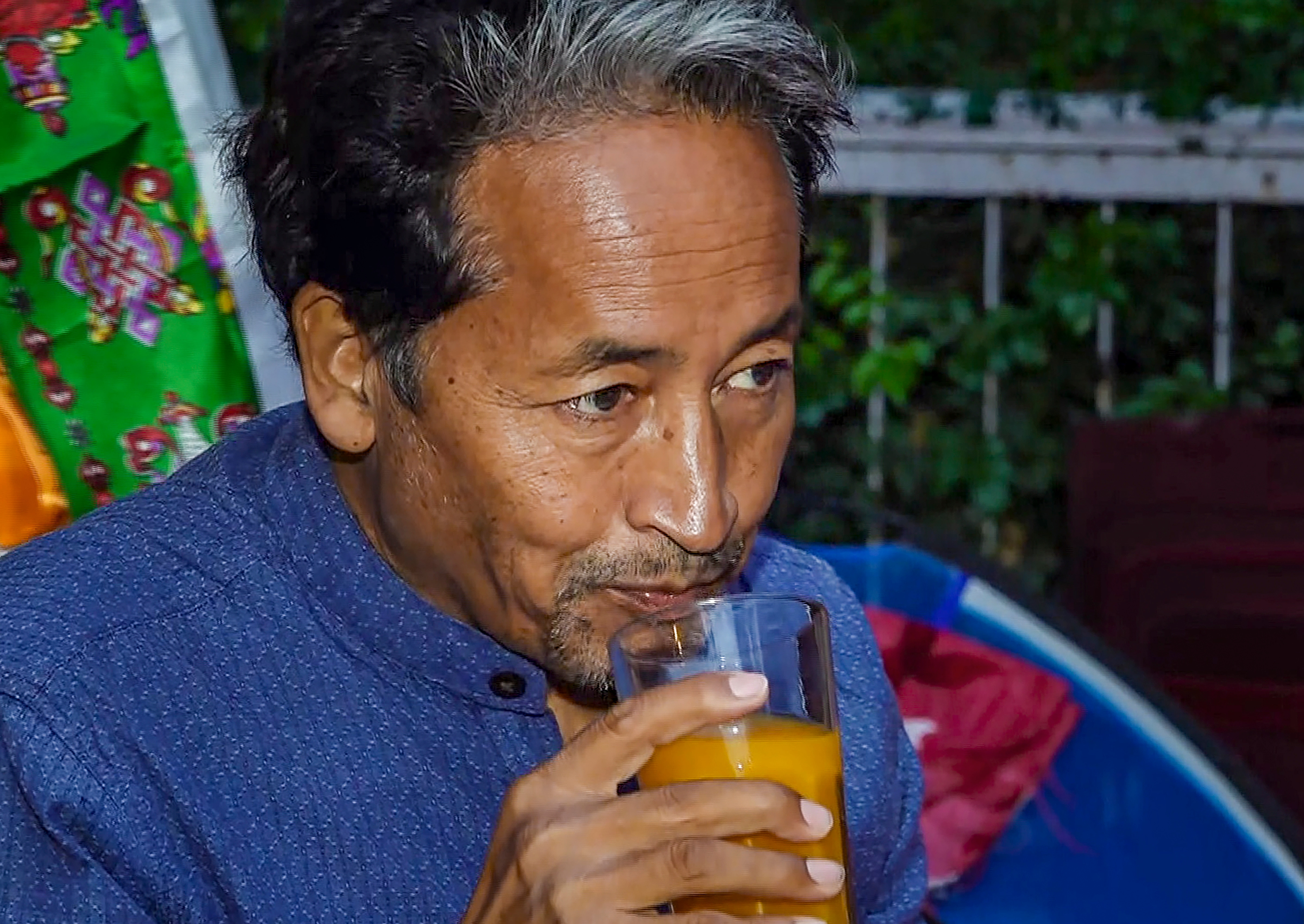
Once seen as the inspiration behind '3 Idiots' lead character Phunsuk Wangdu, statehood and climate activist Sonam Wangchuk finds himself under a reckoning amid the ongoing upheaval in Ladakh.
Wangchuk was arrested on Friday, two days after Ladakh witnessed unrest as the stir over statehood demand turned violent.
The arrest comes two days after four persons were killed in widespread clashes between protesters supporting the movement for statehood to Ladakh and security personnel, amid a shutdown in Leh.
On Thursday, Wangchuk alleged that the government was building a case against him to put him behind bars for at least two years. The activist, who has been leading the peaceful agitation for statehood and constitutional safeguards for Ladakh, also raised the alarm over his personal safety.
Who Is Sonam Wangchuk?
The 59-year-old activist was born in a village near Leh, called Uleytokpo, where he was reportedly home-schooled till the age of nine due to the absence of schools in the village.
In 1975, he moved to Srinagar along with his family, after his father Sonam Wangyal became a minister in the Jammu and Kashmir government, and there he studied in a Srinagar-based school. However, he could not comprehend any of the three languages — Hindi, Urdu or English — that the school used as mediums to teach.
Wangchuk has, in later interviews, admitted to having suicidal thoughts because of receiving differential treatment from teachers who humiliated him for not knowing Hindi or English.
After three difficult years, Wangchuk took a train to Delhi by himself and got himself enrolled in Vishesh Kendriya Vidyalaya in Delhi after pleading with the principal.
He then returned to Srinagar to pursue his engineering. He then collaborated with his brothers and five others and went on to set up the Students' Educational and Cultural Movement of Ladakh, or SECMOL, which later bagged the International Terra Award for the best building in 2016 for its earthen construction. The SECMOL functioned entirely on year-round sunlight the area receives.
Wangchuk is also known and accredited for conceiving the Ice Stupa, an artificial glacier project aimed to address the water crisis faced by Ladakhi farmers.
From Climate Activism To Ladakh Statehood Protests
In 2023, Wangchuk announced a fast at Khardungla Pass to underline the impact of climate change on Ladakh's fragile ecosystem, and to demand that the Union Territory be provided safeguards under the Sixth Schedule of the Constitution.
In March last year, he again held a fast, demanding constitutional safeguards for the Union Territory. Last September, he marched from Ladakh to Delhi to push for his demand.
Most recently, Wangchuk started his 35-day long fast to demand statehood for Ladakh, which was bifurcated from Jammu and Kashmir and made into a separate Union Territory after the Centre, in 2019, abrogated Article 370, which hitherto gave Jammu & Kashmir its special status.
Wangchuk ended the fast on Wednesday, after massive violence broke out in Leh. He was, on Friday, arrested by the Ladakh Police. The authorities have reportedly charged him under the stringent National Security Act, and shifted him to Jodhpur.
The Union home ministry blamed Wangchuk, a senior member of Leh Apex Body (LAB) which along with Kargil Democratic Alliance (KDA) is spearheading the agitation in Ladakh, for provocation leading to the violence, news agency PTI reported.

-
Opinion | India at 38: From Innovation Overperformer to Innovation Powerhouse

India now has 453 VC-backed deep science startups, 18 of them late-stage, after 117 percent growth since 2020. Laurus Labs, at USD 9.3 billion, is the most valuable deep science company in any middle-income economy outside China.
-
Navigating Energy Crossroads: S Jaishankar's Call For Diversified Supply Chains At G20 Ministerial Meeting
As geopolitical fault lines continue to test maritime trade routes and commodity flows, Jaishankar's message remains pertinent: true economic resilience requires open markets, protected transit lines, and a genuine commitment to multilateral cooperation rather than coercion.
-
Indians Are Travelling, But Not Every Journey Is A Holiday | The Week In Whys
Pilgrims, patients and working women are the real travellers, and the system hasn't quite caught up with them.
-
Getting To Work Costs Women More | The Reason Why
It is not just about women paying more than men. It is about women paying much more in cities than in villages.
-
AI Bias In Investing Cannot Be Eliminated, But It Can Be Governed
Framing is a particularly important example as identical financial information presented in terms of gains rather than losses can lead an LLM to reach a different assessment.
-
Joining The Dots | Dark Skies, Steady Diya: Why Hope Holds This Diwali
With war, a weak rupee and foreign outflows weighing on sentiment, policymakers at the NDTV World Summit and market veterans at NDTV Profit Ignite: Diwali Edition offered the same advice: stay invested and filter out the noise.
-
The Curious Case of Equitas Small Finance Bank And A CEO Who Quit For Stock
PN Vasudevan believes persistent investor concerns over a perceived conflict of interest had become a governance overhang on Equitas Small Finance Bank's stock, even as the lender improved profitability and asset quality.
-
Talking Points This Week: AI Cash Burn, A Tiger Comeback And An India That Still Finds Its Own Path
India is not immune to higher oil or tighter global liquidity, yet its earnings base is broader, its domestic policy levers are still available.
-
Foreign Investors Own Half Of HDFC Bank and ICICI Bank. An LTCG Cut Could Matter Most Here
Foreign portfolio investors have US$115 billion parked in HDFC Bank, ICICI Bank. If the government cuts long-term capital gains tax, Jefferies says returning foreign money could land here first.










