Finance Ministry To Initiate Budget Exercise Next Week
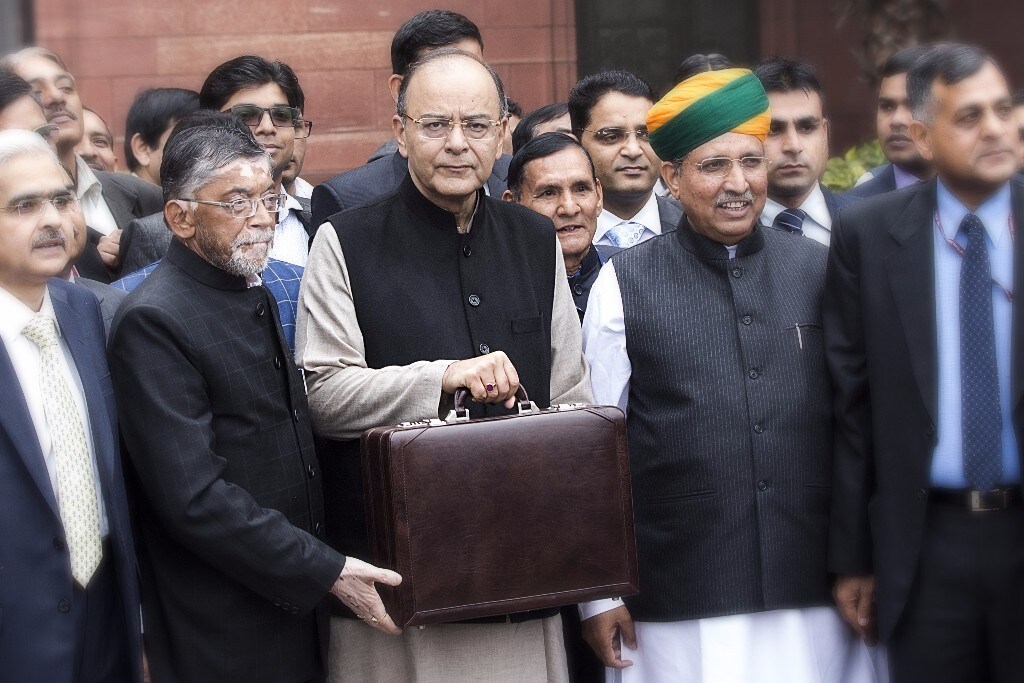
Work on India's first post-GST Union Budget 2018-19 will start next week with the finance ministry issuing timelines for different processes that will culminate with its presentation in February.
It may also be the current government's last full-fledged Budget as general elections are due in 2019.
Even though independent India's biggest tax reform, the Goods and Services Tax, was implemented from July 1, the Budget for 2017-18 (April- March), had followed the practice of tax revenue projections under the heads of customs duty, central excise and service tax alongside direct tax numbers.
With excise duty and service tax being subsumed in the GST, the classifications will undergo change, an official said.
While a new classification for revenues to be accrued from GST will be included in the Budget for next financial year, for the current year two sets of accounting may be presented—one for actual accruals during April-June for excise, customs and service tax, and the other for July-March period for GST and customs duty.
The official said that since the GST rates are decided by a GST Council, headed by Union Finance Minister and comprising of representatives of all states, the Budget for 2018-19 will not have any tax proposals concerning excise and service tax levies.
Only proposals for changes in direct taxes—both personal income tax and corporate tax, besides customs duty—are likely to be presented in the Budget along with new schemes and programmes of the government.
This will be Finance Minister Arun Jaitley's fifth Budget in a row. As per practice, a vote-on-account or approval for essential government spending for a limited period is taken in the election year and a full-fledged budget is presented by the new government.
While P Chidambaram had presented the previous UPA government's vote-on-account in February 2014, Jaitley had presented a full budget in July that year.
The official said the finance ministry will next week issue the Budget circular and start consultations with other ministries from October for Revised Estimates (RE) of expenditure for the current financial year.
The Budget Circular contains the timelines for submission of information of budget requirements to the Ministry of Finance along with prescribed formats.
The ministries will have to provide the actual money spent in 2016-17 along with the budget estimates and Revised Estimates for current fiscal.
Along with this, they have to give the Budget they are expecting for 2018-19 as well, the official added.
With the pre-ponement of Budget, ministries are now allocated their budgeted funds from the start of the financial year beginning April.
This gives government departments more leeway to spend as well as allow companies time to adapt to business and taxation plans.
Previously, when the Budget was presented at the end of February, the three-stage Parliament approval process used to get completed some time in mid-May, weeks ahead of onset of monsoon rains.
This meant government departments would start spending on projects only from August-end or September, after the monsoon season ended.
Besides advancing the presentation date, the Budget scrapped the Plan and non-Plan distinction and merged the Railway Budget with it, ending a nearly century-long practice.

-
Where You Live Shapes How You Get To Work | The Reason Why

Two-wheelers are the most popular way to get to work in India, accounting for nearly 43% of workplace commutes.
-
High US Salaries, No Green Card Certainty: The Financial Calculation Facing Indian H-1B Families
The suspension of PERM processing at eight technology employers does not cancel existing H-1B visas. What it does is force a question many Indian families have been avoiding: is the US salary worth tying your career and family plans to one employer?
-
Unhedged Position: Can India See An Indonesia-Style Time Correction?
The Nifty is trading below levels it first clocked in 2024. Is there, then, as I have suggested in the headline, potential that the current time correction drags on painfully for the next three-five, even ten years?
-
Navigating Friction And Energy Realities: An Analysis Of Marco Rubio's October Visit To India
Occurring at a critical juncture marked by stalled trade negotiations and escalating geopolitical pressures over global energy supplies, the visit offers a profound window into modern US-India relations.
-
India Exports Capital. Why Not Export Trusteeship?
The big question, then, is whether India can build an institution that global borrowers, investors, banks, and lawyers can trust, even without an Indian connection.
-
France's Economy & Politics Are In Crisis | The Reason Why
Let's look at how the French economy and politics evolved under Nicolas Sarkozy, Franois Hollande and Emmanuel Macron.
-
You May Inherit The Business. You Must Earn Its Credibility.
Succession tests the founder's ability to share authority as much as it tests the next generation's readiness to assume it.
-
Signing Deals Is One Thing; Making Them Work Is Another | The Week In Whys
Sometimes, things don't turn out as planned. Indian companies have lost some bids to rivals, some projects won't produce until 2030.
-
FOMC Wall, PERM Suspension, Hospital Stocks | Talking Points This Week
A PERM suspension would directly affect green-card sponsorship rather than H-1B visas, so the near-term earnings impact could remain relatively limited. The key question is whether this marks a new phase in US scrutiny of Indian IT.
-
Everything, Everywhere, All At Once: Dalal Street's Week To Forget | Joining The Dots
Visa curbs, a Starlink spat and cancer drug caps: what connects this week's shocks for Indian markets









