Crackdown On YouTubers: SEBI's Investigation Looks Solid, Experts Say

Take positions in stocks, peddle misinformation, get gullible investors to buy, wait for the share price to increase, dump stocks. This is an age-old play to manipulate the markets. Only when done on a social media platform with lakhs of followers, the impact is manifold.
In the case of Sharpline Broadcast Ltd., a 116% increase in share price occurred as the plan unfolded. For Sadhna Broadcast Ltd., it was a 161% jump in share price.
Enough for the regulator to go after the finfluencer economy.
At the centre of this were four YouTube Channels, viz., Midcap Calls, Profit Yatra, The Advisor, and Moneywise.
The ruling really stands out in the sophistication of SEBI's investigative power, said Sandeep Parekh, managing partner at Finsec Law Advisors.
"How links were made through call records, asking Google for information, and connecting all the people through common addresses. It's not a very long order, but it shows the hard work that has gone into it. The business model is quite different, unlike the previous cases. It shows how they spent huge amounts on advertising—over Rs 7 crores—on AdSense alone," he added.
Here's how SEBI went about connecting the collusion and manipulation by 24 entities in the case of Sharpline and 31 entities in the case of Sadhna.
Who's Behind The Channel
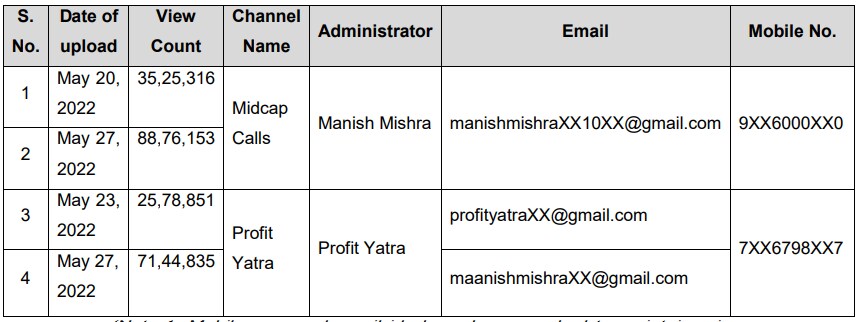
The first step in unravelling the plan was to figure out the channel creators. For this, SEBI sought information from Google LLC, the holding company of YouTube. Google shared information regarding the accounts, including phone numbers, email ids, date of upload of the videos, and viewership numbers.
The phone numbers were later found to be registered with Manish Mishra and Manjari Tiwari. While Mishra managed Midcap Calls, The Advisor, and Moneywise, Tiwari was managing Profit Yatra.
The videos, uploaded in May and July, garnered a viewership of over 2 crore and 3 crore, respectively, for Sharpline and Sadhna.
The creators also went to great lengths in marketing these videos, according to SEBI. Mishra alone spent over Rs 4 crore on advertising and promotion for these videos. His bank accounts reflect an expense of nearly Rs 4.72 crore towards Google AdSense, a tool that delivers targeted ads to its audience.
The Manipulation
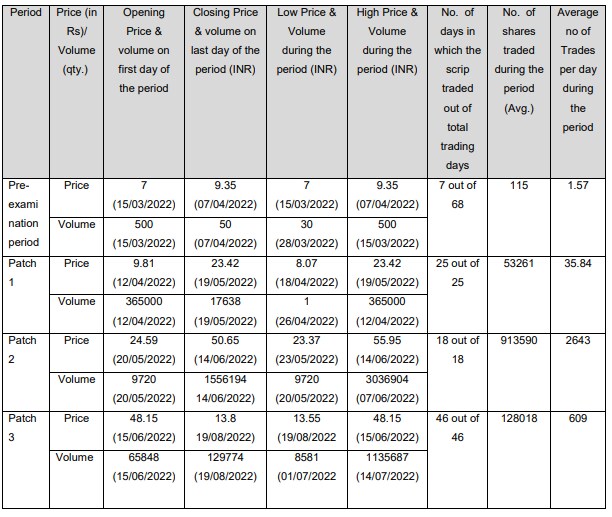
During the investigation period in both the scrips, SEBI noted a steep jump in share prices and trading volumes.
It identified three sets of people who made it possible:
MMDs or Misleading Message Disseminators—refers to the creators of YouTube channels.
NSs or Net Sellers—denote persons who held shares prior to the period under SEBI scrutiny and who traded in the shares during the period.
VCs or Volume Creators—signifying persons who bought or sold shares during the period.
MMDs actively engaged in spreading the misinformation. They spread false information regarding the future prospects of the company.
For instance, in one of the videos, it was claimed that the Adani Group would buy out Sharpline. False claims were also made about Sharpline's impending deals with Zee and Sony.
Similar stories were woven about Sadhna. A Rs 1,100 crore deal with an American company was supposed to improve the condition of the company, according to MMDs.
The channel creators also took efforts to make sure the videos were not discussed publicly. They disabled the comments section and disallowed public viewing subsequently.
These claims were later revealed to be untrue by the companies in stock exchange disclosures.
After the videos went live, Sharpline, which was trading at Rs 23.42 before the recommendation, increased to Rs 50.65 within weeks—an almost 116% increase. The daily traded volume also increased substantially, from 53,261 to over nine lakhs during the period.
A similar pattern was visible in the shares of Sadhna after the video was uploaded. The prices spiked by 161%, from Rs 12.68 to Rs 33.15, in a matter of weeks. Daily traded volume too showed a spike from 2.6 lakh shares to 18.9 lakhs over such a period.
Soon, as per SEBI's order, large shareholders dumped their shares. NSs and VCs used this opportunity to offload their shares and artificially create volume in the market. This lured more and more individual shareholders to the company.
The number of large shareholders in Sharpline declined to 10 from 26, while the number of small shareholders significantly increased from 517 to 20,009. The shareholding pattern of Sadhna showed the number of small shareholders increasing from 2,167 to 55,343 over the period under investigation. – SEBI's Interim Order
Connection Between Manipulators
SEBI relied on a plethora of evidence to determine the connections between all the entities involved. It examined call data records, KYC details, bank statements, and documents from the Ministry of Corporate Affairs.
The way in which SEBI mapped these connections is laudable, according to Shruti Rajan, a partner at Trilegal. SEBI has taken an effort to individually connect each noticee (MMDs, NSs, VCs) with the other. They have used multiple records to back up the connection, she said.
Rather than relying on one odd phone call, multiple evidences are put forward to validate the connection. Phone calls, bank transfers, and other corporate relationships are tracked and relied on by the regulator. This is important, as the basis of connection often gets challenged in the appellate stage.Shruti Rajan, Partner, Trilegal
Finfluencers, Beware!
Though the regulator has built a solid case in these two orders, a lot of the facts here were black and white, experts BQ Prime spoke with said.
For instance, there were no disclaimers around the positions the creators hold in the stocks being recommended. Also, the information was patently false.
In cases where the facts are gray, the regulator's enforcement ability will truly be tested, Rajan said.
As the frauds get more sophisticated, cases are not going to remain black and white. There are going to be a lot of grey areas for the regulator to tackle. So, in addition to the enforcement of existing regulations, there should be some kind of peacetime rule on what finfluencers could do, she opined.
The regulator can mandate disclaimers if finfluencers are receiving any upfront commission. Some rules around how finfluencers conduct their business are something the regulator can come up with.Shruti Rajan, Partner, Trilegal
These cases show the lengths the regulator has gone to track down the people behind the manipulation, said Parekh of Finsec Law Advisors, while emphasising that there isn't really a need for a new law.
We don't need a 500-page law to outlaw fraud. For instance, in the United States, Rule 10b-5, a provision commonly used to tackle fraud and introduced in 1934, has not been modified at all, even after 90 years. SEBI's powers are quite extensive. They have a wide enough arm to catch the digital footprint, from retrieving phone records to obtaining bank statements.Sandeep Parekh, Managing Partner, Finsec Law Advisors
Listen to the full conversation here:
YouTubers in line of SEBI's fire! SEBI details how #YouTube Channels misled investors.
March 2, 2023
How will its order change the finfluencer economy?
Tune in to @Shrutirajan & @SandeepParekh's conversation with @PayaswiniLLB now!https://t.co/QSFf1BcHJ2

-
Where You Live Shapes How You Get To Work | The Reason Why

Two-wheelers are the most popular way to get to work in India, accounting for nearly 43% of workplace commutes.
-
High US Salaries, No Green Card Certainty: The Financial Calculation Facing Indian H-1B Families
The suspension of PERM processing at eight technology employers does not cancel existing H-1B visas. What it does is force a question many Indian families have been avoiding: is the US salary worth tying your career and family plans to one employer?
-
Unhedged Position: Can India See An Indonesia-Style Time Correction?
The Nifty is trading below levels it first clocked in 2024. Is there, then, as I have suggested in the headline, potential that the current time correction drags on painfully for the next three-five, even ten years?
-
Navigating Friction And Energy Realities: An Analysis Of Marco Rubio's October Visit To India
Occurring at a critical juncture marked by stalled trade negotiations and escalating geopolitical pressures over global energy supplies, the visit offers a profound window into modern US-India relations.
-
India Exports Capital. Why Not Export Trusteeship?
The big question, then, is whether India can build an institution that global borrowers, investors, banks, and lawyers can trust, even without an Indian connection.
-
France's Economy & Politics Are In Crisis | The Reason Why
Let's look at how the French economy and politics evolved under Nicolas Sarkozy, Franois Hollande and Emmanuel Macron.
-
You May Inherit The Business. You Must Earn Its Credibility.
Succession tests the founder's ability to share authority as much as it tests the next generation's readiness to assume it.
-
Signing Deals Is One Thing; Making Them Work Is Another | The Week In Whys
Sometimes, things don't turn out as planned. Indian companies have lost some bids to rivals, some projects won't produce until 2030.
-
FOMC Wall, PERM Suspension, Hospital Stocks | Talking Points This Week
A PERM suspension would directly affect green-card sponsorship rather than H-1B visas, so the near-term earnings impact could remain relatively limited. The key question is whether this marks a new phase in US scrutiny of Indian IT.
-
Everything, Everywhere, All At Once: Dalal Street's Week To Forget | Joining The Dots
Visa curbs, a Starlink spat and cancer drug caps: what connects this week's shocks for Indian markets