Congress Says Credit For GST Rate Cuts Goes To Rahul Gandhi
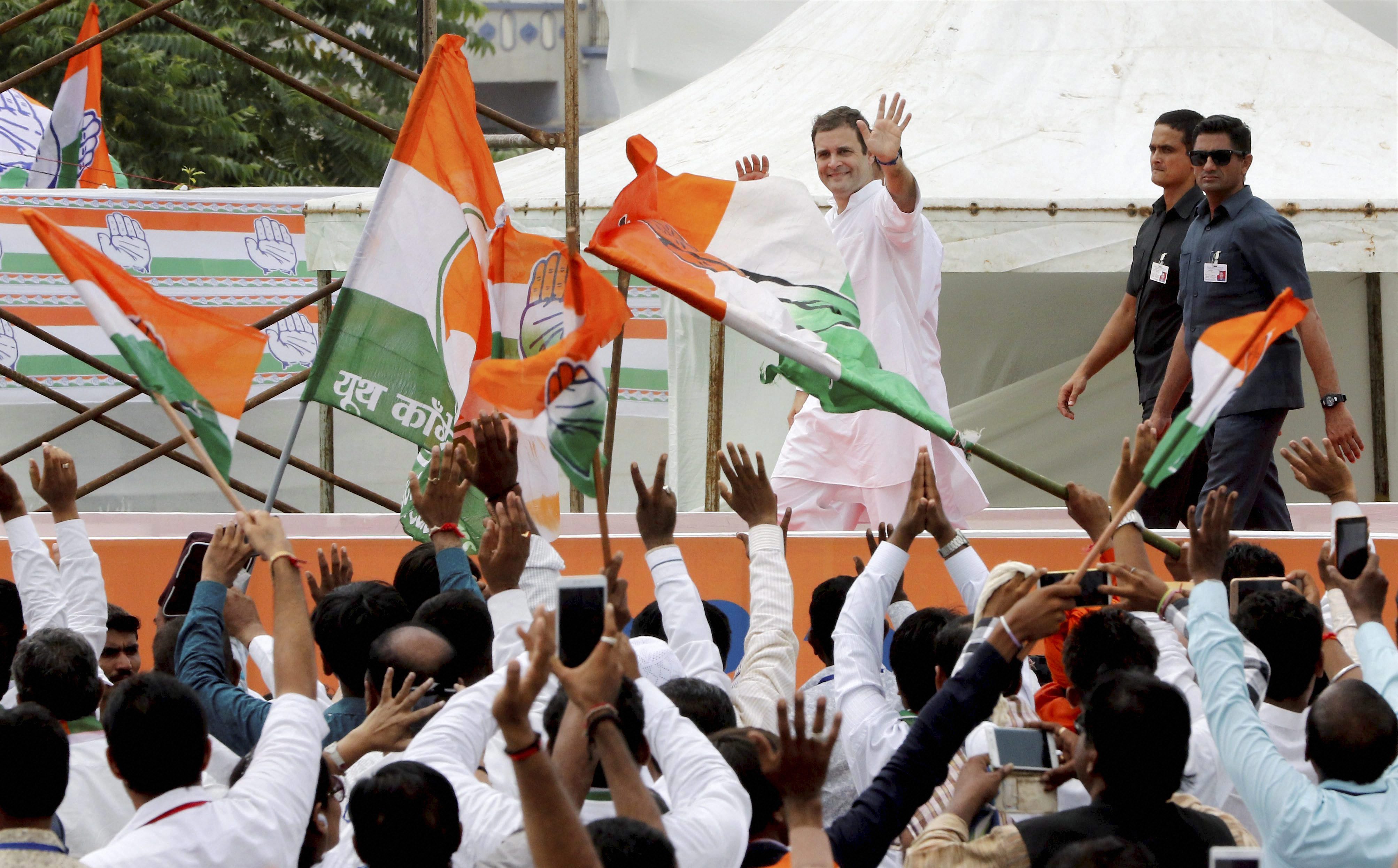
The Congress today claimed credit for the Goods and Services Tax Council's decision to cut tax rates on 178 items of daily use, saying the government was forced to do so due to the pressure mounted by party Vice-President Rahul Gandhi.
Leading the charge against the government on GST, Gandhi said the Congress would continue to fight for an 18 percent cap on the highest GST slab instead of the current 28 percent, and vowed that the party would get the job done “if the ruling BJP doesn't”.
He also reiterated that India needed a simple tax and not the “Gabbar Singh Tax” as he had been describing the tax regime to target the Modi government.
Congress General Secretary in-charge of Gujarat, Ashok Gehlot told PTI that the GST Council yesterday decided to cut the tax rates due to the pressure mounted by Gandhi and the “huge response” he had been receiving in poll-bound Gujarat.
Also Read: GST – A Reboot
Gujarat, the home state of Prime Minister Narendra Modi and BJP president Amit Shah, has been under the BJP's rule for over two decades and the Congress is trying to oust it from power. Congress leaders, particularly Gandhi, have made the GST and demonetisation as key issues of their campaign.
Gehlot claimed the GST Council brought about the changes in tax rates with an eye on votes in Gujarat. The state goes to poll in two phases on December 9 and December 14.
Congress' Chief Spokesperson Randeep Singh Surjewala termed the GST Council's move “installment-based tinkering” which he said underscored the “chaos within and adhocism” of the BJP-led central government.
Accusing Finance Minister Arun Jaitley and the government of “paying lip service and creating havoc”, Surjewala said the Congress was determined to make the tax regime “flawless”.
“India needs a simple tax, not Gabbar Singh Tax. The Congress and people have got 28 percent tax abolished on several items fighting for it. Our fight for 18 percent cap with one rate will continue. If the BJP doesn't do it, the Congress will,” Gandhi tweeted.
India does not need a Gabbar Singh Tax. We want a true GST. Congress, along with the people of India, fought for and ensured reduction in items in 28% bracket. Next we will fight for one rate, with a cap at 18%. If BJP doesn't do it, Congress will.
November 11, 2017Also Read: The List Of Over 200 Items Now Taxed At Lower Rates Under GST
Surjewala demanded that petroleum products, real estate and electricity be brought under the ambit of the GST. He also called for reducing “compliance burden” of GST and added that the textile sector was faced with deep stress due to “distorted duty structure”.
“Adjournment and deferment, rather than decision, appear to be the ‘way forward' for this government. None of these challenges have been addressed by the Council. This is owing to the sheer ineptitude and amateurish handling of the biggest tax reform by BJP the government,” he added.
Congress leader Pawan Khera said that the credit should be given to Gandhi.
“There was a pressure from Rahul Gandhi. The Gabbar Singh Tax went so much viral in Gujarat that the BJP did not know how to deal with it,” Khera said.
He, however, added that much more needed to be done to extend the relief to the farming community as the central excise on fertilisers was 1.03 percent before GST, but after the new taxation system came into force, the tax was increased to 5 percent.
He said that the tax on agricultural equipment such as tractor was as high as 18 percent.
The GST Council yesterday decided to reduce tax rate on items ranging from chewing gums to detergents – to 18 percent from current 28 percent.
Also Read: FMCG Companies Hail GST Changes, Say Will Pass Benefits To Consumers

-
High US Salaries, No Green Card Certainty: The Financial Calculation Facing Indian H-1B Families

The suspension of PERM processing at eight technology employers does not cancel existing H-1B visas. What it does is force a question many Indian families have been avoiding: is the US salary worth tying your career and family plans to one employer?
-
Unhedged Position: Can India See An Indonesia-Style Time Correction?
The Nifty is trading below levels it first clocked in 2024. Is there, then, as I have suggested in the headline, potential that the current time correction drags on painfully for the next three-five, even ten years?
-
Navigating Friction And Energy Realities: An Analysis Of Marco Rubio's October Visit To India
Occurring at a critical juncture marked by stalled trade negotiations and escalating geopolitical pressures over global energy supplies, the visit offers a profound window into modern US-India relations.
-
India Exports Capital. Why Not Export Trusteeship?
The big question, then, is whether India can build an institution that global borrowers, investors, banks, and lawyers can trust, even without an Indian connection.
-
France's Economy & Politics Are In Crisis | The Reason Why
Let's look at how the French economy and politics evolved under Nicolas Sarkozy, Franois Hollande and Emmanuel Macron.
-
You May Inherit The Business. You Must Earn Its Credibility.
Succession tests the founder's ability to share authority as much as it tests the next generation's readiness to assume it.
-
Signing Deals Is One Thing; Making Them Work Is Another | The Week In Whys
Sometimes, things don't turn out as planned. Indian companies have lost some bids to rivals, some projects won't produce until 2030.
-
FOMC Wall, PERM Suspension, Hospital Stocks | Talking Points This Week
A PERM suspension would directly affect green-card sponsorship rather than H-1B visas, so the near-term earnings impact could remain relatively limited. The key question is whether this marks a new phase in US scrutiny of Indian IT.
-
Everything, Everywhere, All At Once: Dalal Street's Week To Forget | Joining The Dots
Visa curbs, a Starlink spat and cancer drug caps: what connects this week's shocks for Indian markets
-
India Is Going Abroad For Critical Minerals. But It May Take Years To Pay Off | The Reason Why
Although India's steps are in the right direction, they remain modest compared with India's growing dependence.









