Impeachment of CJI Dipak Misra: What are the Next Steps?
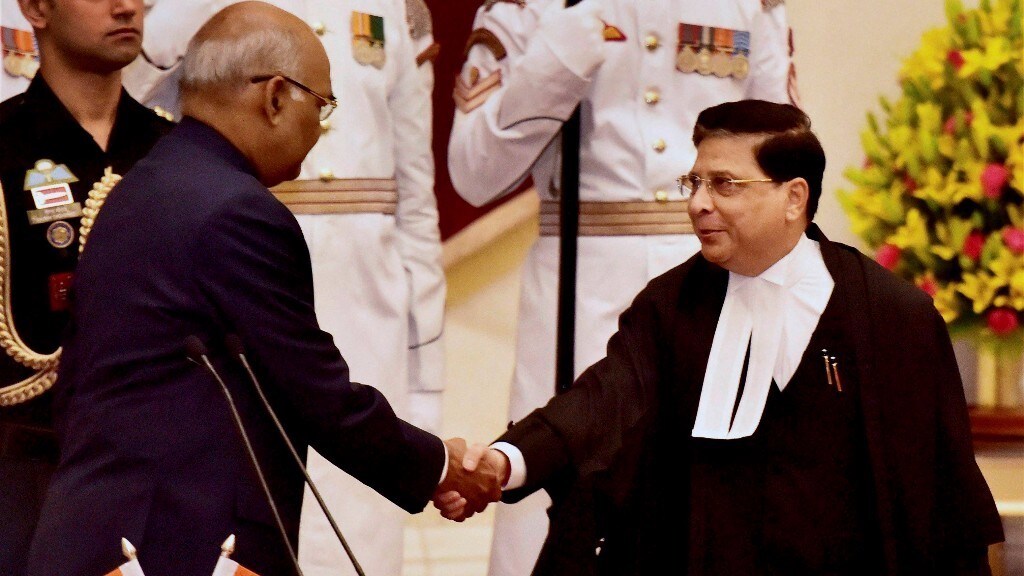
On Friday, 20 April, representatives of several Opposition parties submitted a motion to impeach Chief Justice of India Dipak Misra to Vice President M Venkaiah Naidu. The move to ask for removal of the CJI from his office as a judge of the Supreme Court comes a day after a bench headed by him refused to order a probe into the death of Judge Loya.
The motion is reportedly supported by 64 MPs of the Rajya Sabha, including those from the Congress, SP, BSP, RJD, CPI(M) and NCP. Leaders of these parties have signed the impeachment notice, and presented it to the Vice President in his capacity as Chairperson of the Upper House of Parliament.
Several Opposition parties had considered filing an impeachment motion against the CJI towards the end of March 2018 on the basis of his failure to address concerns raised by four senior judges of the apex court in January. The TMC and DMK, which had been part of those discussions, did not supported the new motion then.
But what happens now? What exactly is the process to be followed to remove the CJI from his post as a judge of the Supreme Court?
Process of Impeachment
The process of impeachment is described in Article 124(4) of the Constitution and the Judges (Inquiry) Act 1968. This process is the same for all judges of the Supreme Court and high courts of the country, including the Chief Justice of India.
A judge can be removed on the grounds of “proved misbehaviour or incapacity”. Neither misbehaviour nor incapacity are defined, but would include any criminal activity or other judicial impropriety.
The steps are as follows:
- An impeachment motion against the judge needs to be raised in either of the Houses of Parliament. The motion can only be admitted by the Speaker in the Lok Sabha or Chairperson (by default, the Vice-President) in the Rajya Sabha if it has the required levels of support – 100 MPs in Lok Sabha or 50 MPs in Rajya Sabha. Sixty-four Opposition MPs in the Rajya Sabha have already reportedly signed the motion to impeach CJI Misra.
- If the motion is admitted, a three-member committee is set up to investigate the allegations. The committee is to be made up of a Supreme Court judge, the Chief Justice of any high court, and a ‘distinguished jurist' (read: judge/lawyer/scholar) nominated by the Speaker/Vice-President.
- Once the committee prepares its report, this has to be submitted to the Speaker/Vice-President, who then also shares it with the other House.
- Both Houses of Parliament then need to pass an ‘address to the President', asking for the judge to be removed. To succeed, this needs to be passed by a 2/3rds majority of the MPs present in each House during the vote, and must also exceed the 50 percent mark in each House.
- If both addresses succeed, then the President can remove the judge from his position by Presidential Order.
What Would Happen if the Impeachment Process is Started?
The only time the process has got as far as the final step was in the case of Justice V Ramaswami of the Supreme Court. In 1993, the final vote failed to get a 2/3rds majority in the Lok Sabha.
It is unclear if the impeachment proceedings would succeed against Justice Misra – the investigation itself is unlikely to be completed by the time he is supposed to retire in October 2018. In previous cases, including Justice Ramaswami's as well as those of Justices Soumitra Sen (Calcutta High Court) and SK Gangele (MP High Court), the investigation by the three-member committee has taken two years to be completed.
However, if the process is initiated this time, it could affect CJI Misra's actions during the remainder of his tenure – there is considerable debate over whether or not he would need to recuse himself, or at least take no decisions relating to the significant issues before the court such as the Babri Masjid case, the Aadhaar matter, or the review of the Supreme Court's decision on Section 377 of the IPC.
There is no clear convention over what happens when impeachment is moved against a judge. Propriety would suggest that they no longer take up any matters till the process is completed. For instance, under the In-House Procedure formulated by the Supreme Court in 1999, if a judge is found by the CJI's inquiry committee to be guilty of any impropriety, the standard practice is to not assign any judicial work to them – note that this is to happen even if impeachment proceedings are not initiated against the judge.
However, there is no hard and fast rule which would be binding on CJI Misra to follow, and existing procedures don't even envisage complaints against the CJI.

-
Navigating Energy Crossroads: S Jaishankar's Call For Diversified Supply Chains At G20 Ministerial Meeting

As geopolitical fault lines continue to test maritime trade routes and commodity flows, Jaishankar's message remains pertinent: true economic resilience requires open markets, protected transit lines, and a genuine commitment to multilateral cooperation rather than coercion.
-
Indians Are Travelling, But Not Every Journey Is A Holiday | The Week In Whys
Pilgrims, patients and working women are the real travellers, and the system hasn't quite caught up with them.
-
Getting To Work Costs Women More | The Reason Why
It is not just about women paying more than men. It is about women paying much more in cities than in villages.
-
AI Bias In Investing Cannot Be Eliminated, But It Can Be Governed
Framing is a particularly important example as identical financial information presented in terms of gains rather than losses can lead an LLM to reach a different assessment.
-
Joining The Dots | Dark Skies, Steady Diya: Why Hope Holds This Diwali
With war, a weak rupee and foreign outflows weighing on sentiment, policymakers at the NDTV World Summit and market veterans at NDTV Profit Ignite: Diwali Edition offered the same advice: stay invested and filter out the noise.
-
The Curious Case of Equitas Small Finance Bank And A CEO Who Quit For Stock
PN Vasudevan believes persistent investor concerns over a perceived conflict of interest had become a governance overhang on Equitas Small Finance Bank's stock, even as the lender improved profitability and asset quality.
-
Talking Points This Week: AI Cash Burn, A Tiger Comeback And An India That Still Finds Its Own Path
India is not immune to higher oil or tighter global liquidity, yet its earnings base is broader, its domestic policy levers are still available.
-
Foreign Investors Own Half Of HDFC Bank and ICICI Bank. An LTCG Cut Could Matter Most Here
Foreign portfolio investors have US$115 billion parked in HDFC Bank, ICICI Bank. If the government cuts long-term capital gains tax, Jefferies says returning foreign money could land here first.
-
'Never Seen This Level Of Negativity': Sandeep Tandon Says The Next Rally May Be Closer Than You Think
Veteran investor Sandeep Tandon says foreign selling is easing, large-caps are due a comeback and mid-caps are crowded, while he turns positive on gold, power and pharma this Diwali.










