Brazil Race Tightens In New Poll, If Abstention Considered
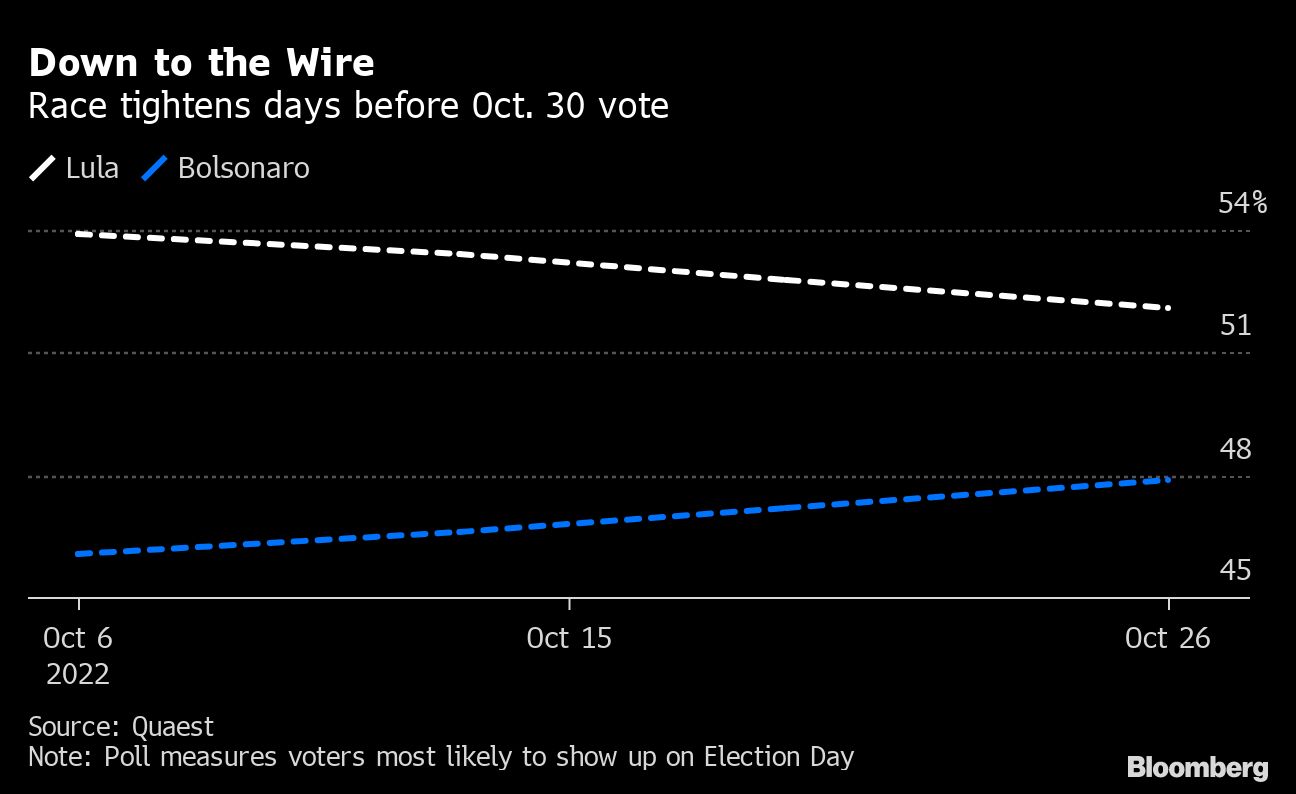
(Bloomberg) -- Brazil's presidential race is still tightening according to a new opinion poll that takes into account voters more likely to show up on election day.
While the Quaest poll published Wednesday confirmed the trend seen in other surveys that showed President Jair Bolsonaro stalling in the race, it also gauged the possible impact of abstention rates on Sunday's runoff vote.
Quaest's so-called “likely voter” scenario has leftist former President Luiz Inacio Lula da Silva getting 52.1% of valid votes, which excludes null and blank ballots, down from 52.8% last week. Bolsonaro would get 47.9%, up from 47.2%. The changes fell within the survey's margin of error.

Large abstention rates hurt Lula the most as they tend to be higher among the poor, who make up a large part of the former president's base of support.
Latin America's biggest election this year is coming down to the wire as both candidates try to chip away at each other's support in the final stretch. This month, Bolsonaro, 67, launched a slew of last-minute measures such as extending welfare handouts for half a million families and boosting assistance for taxi drivers in a bid to improve voters' feelings about the economy.
That may be paying off, according to Thomas Traumann, a Rio de Janeiro-based political consultant and columnist.
“Pork-barrel politics is highly efficient in Brazilian elections and normally gives the incumbent extra points when vote comes,” Traumann said.
For his part, Lula, 76, has tried to capitalize on blunders made by the president and his allies over the past few days. He said Bolsonaro's pro-gun stance and bellicose rhetoric contributed to a violent standoff this weekend between federal police and Roberto Jefferson, a onetime lawmaker and staunch supporter of the president.
Adjusting Methodology
After underestimating Bolsonaro's support in the first-round vote, some pollsters have tweaked their methodology and adjusted their representative samples in a bid to improve accuracy for the runoff.
The nation is bracing for the final televised presidential debate on Friday, though most voters have already made up their minds. According to Quaest, just 7% of respondents said they'd be willing to switch their vote.
Quaest interviewed 2,000 people between Oct. 23 and 25, and the poll has a margin of error of plus or minus 2 percentage points.
(Recasts story to explain impact of abstention rates in Quaest's numbers.)
More stories like this are available on bloomberg.com
©2022 Bloomberg L.P.

-
Blue Wave Will Derail the AI Trade but Won't Dismantle the AI Era | Unhedged Position

The Democrats' sweep of the US Congress will see politics collide with economic forces both over the long and short term.
-
It's Time To Take The GST Council's Bet On Trust Global
Payment records can prove India's services exports, and clear, proportionate rules can bring foreign digital sellers into the tax net.
-
Opinion | India at 38: From Innovation Overperformer to Innovation Powerhouse
India now has 453 VC-backed deep science startups, 18 of them late-stage, after 117 percent growth since 2020. Laurus Labs, at USD 9.3 billion, is the most valuable deep science company in any middle-income economy outside China.
-
Navigating Energy Crossroads: S Jaishankar's Call For Diversified Supply Chains At G20 Ministerial Meeting
As geopolitical fault lines continue to test maritime trade routes and commodity flows, Jaishankar's message remains pertinent: true economic resilience requires open markets, protected transit lines, and a genuine commitment to multilateral cooperation rather than coercion.
-
Indians Are Travelling, But Not Every Journey Is A Holiday | The Week In Whys
Pilgrims, patients and working women are the real travellers, and the system hasn't quite caught up with them.
-
Getting To Work Costs Women More | The Reason Why
It is not just about women paying more than men. It is about women paying much more in cities than in villages.
-
AI Bias In Investing Cannot Be Eliminated, But It Can Be Governed
Framing is a particularly important example as identical financial information presented in terms of gains rather than losses can lead an LLM to reach a different assessment.
-
Joining The Dots | Dark Skies, Steady Diya: Why Hope Holds This Diwali
With war, a weak rupee and foreign outflows weighing on sentiment, policymakers at the NDTV World Summit and market veterans at NDTV Profit Ignite: Diwali Edition offered the same advice: stay invested and filter out the noise.
-
The Curious Case of Equitas Small Finance Bank And A CEO Who Quit For Stock
PN Vasudevan believes persistent investor concerns over a perceived conflict of interest had become a governance overhang on Equitas Small Finance Bank's stock, even as the lender improved profitability and asset quality.









