BJP’s Twin Assembly Wins Won’t Give It More Clout In Rajya Sabha
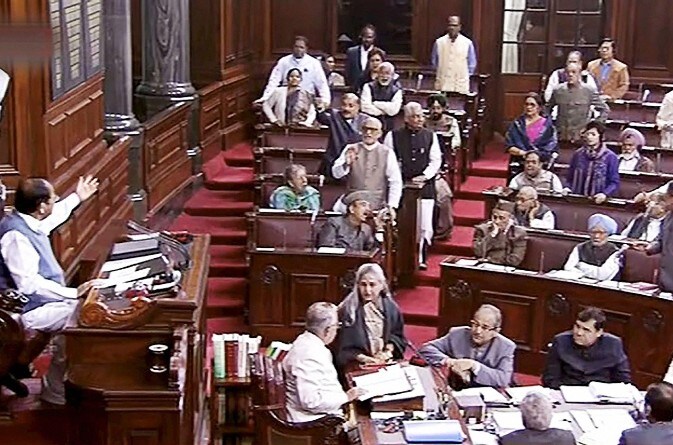
The recent assembly election wins in Gujarat and Himachal Pradesh will not give the ruling Bharatiya Janata Party the legislative muscle to push critical bills through Rajya Sabha, the upper house of the parliament, according to analysis.
The BJP now covers 19 out of 29 Indian states and 67 percent of the country's population. In Lok Sabha, the lower house of parliament, it already runs a majority government with 280 members.
However, a recent analysis by Delhi think tank, PRS Legislative Research, on the impact of BJP's victories in Gujarat and Himachal Pradesh showed the following: Four members of parliament from Gujarat will be retiring from the Rajya Sabha in 2018. Of them, both BJP and Congress will gain two seats each.
Himachal Pradesh has only one seat in the Rajya Sabha and BJP's victory there will have no significant impact on its position in the upper house.
The BJP now has 57 members in a 239-member Rajya Sabha as of Dec. 20, 2017, according to government data. This will increase to 70 with the addition of nine members from Uttar Pradesh, two from Gujarat, one each from Manipur and Goa in 2018, according to the PRS analysis.
But the BJP will need greater representation than what its recent electoral victories have brought because important national laws cannot be passed without being cleared by both houses of the parliament, as IndiaSpend reported in November 2015.
Also Read: Key Takeaways From The Fiercest Gujarat Election In Two Decades
Crucial Bills Coming Up This Session
The ongoing winter session, from Dec. 15, 2017, to Jan. 5, 2018, will have 14 sittings spread over 21 days. It will see a total of 39 bills, of which 25 will be considered for passing, 14 for introduction, consideration and passing and one for withdrawal, according to a Press Information Bureau release.
The Uniform Civil Code Bill, which needs a constitutional amendment, will require 167 votes to be passed in the Rajya Sabha and 271 in the Lok Sabha.
The other important business pending this season includes the Financial Resolution and Deposit Insurance Bill which will reduce the government's share in the bail-out of distressed banks and the bill to impose a ban on surrogacy.
Also Read: Why The BJP Continues To Win
BJP Dominates In Two Of Five States That Have 100 Seats In Rajya Sabha
Rajya Sabha members get elected from the states and the representation of a party in a state assembly affects its strength in the upper house.
The ruling National Democratic Alliance has 78 seats, including six seats from its ally, the Telugu Desam Party. The opposition United Progressive Alliance has 74 seats.
The membership of the Rajya Sabha is determined by the population of the state. The top five states based on population. Uttar Pradesh, Maharashtra, Tamil Nadu, Bihar and West Bengal have 100 seats in the Rajya Sabha. The BJP is currently in power in two states among the top five – Maharashtra and Uttar Pradesh and is an alliance partner in Bihar.
Of the 19 seats in Maharashtra, BJP has five and its ally Shiv Sena has three. The Congress has four seats in the state.
In Uttar Pradesh, the BJP has two seats and the Congress, three. However the BJP's landslide win in the state – 312 of 503 seats will work to its benefit.
Rajya Sabha members retire after six years. In 2018, 65 members will be retiring and of them, nine will be from Uttar Pradesh. This will bring the total number of BJP MPs from Uttar Pradesh in Rajya Sabha to 11 of 31 seats. In 2020, the BJP will have 21 of 31 seats from Uttar Pradesh alone.
Also Read: Did PM Modi Gain 2 Or Lose 11 Percentage Points?
Prachi Salve is an analyst with IndiaSpend.

-
High US Salaries, No Green Card Certainty: The Financial Calculation Facing Indian H-1B Families

The suspension of PERM processing at eight technology employers does not cancel existing H-1B visas. What it does is force a question many Indian families have been avoiding: is the US salary worth tying your career and family plans to one employer?
-
Unhedged Position: Can India See An Indonesia-Style Time Correction?
The Nifty is trading below levels it first clocked in 2024. Is there, then, as I have suggested in the headline, potential that the current time correction drags on painfully for the next three-five, even ten years?
-
Navigating Friction And Energy Realities: An Analysis Of Marco Rubio's October Visit To India
Occurring at a critical juncture marked by stalled trade negotiations and escalating geopolitical pressures over global energy supplies, the visit offers a profound window into modern US-India relations.
-
India Exports Capital. Why Not Export Trusteeship?
The big question, then, is whether India can build an institution that global borrowers, investors, banks, and lawyers can trust, even without an Indian connection.
-
France's Economy & Politics Are In Crisis | The Reason Why
Let's look at how the French economy and politics evolved under Nicolas Sarkozy, Franois Hollande and Emmanuel Macron.
-
You May Inherit The Business. You Must Earn Its Credibility.
Succession tests the founder's ability to share authority as much as it tests the next generation's readiness to assume it.
-
Signing Deals Is One Thing; Making Them Work Is Another | The Week In Whys
Sometimes, things don't turn out as planned. Indian companies have lost some bids to rivals, some projects won't produce until 2030.
-
FOMC Wall, PERM Suspension, Hospital Stocks | Talking Points This Week
A PERM suspension would directly affect green-card sponsorship rather than H-1B visas, so the near-term earnings impact could remain relatively limited. The key question is whether this marks a new phase in US scrutiny of Indian IT.
-
Everything, Everywhere, All At Once: Dalal Street's Week To Forget | Joining The Dots
Visa curbs, a Starlink spat and cancer drug caps: what connects this week's shocks for Indian markets
-
India Is Going Abroad For Critical Minerals. But It May Take Years To Pay Off | The Reason Why
Although India's steps are in the right direction, they remain modest compared with India's growing dependence.









