Be More Active: SEBI To Passive Funds
Eleven years ago, almost to the date, SEBI ushered in a new era of stewardship by institutional investors when it mandated mutual funds to disclose how they voted on resolutions of investee companies. Funds were directed to disclose their overall voting policies and the actual exercise of their votes on matters of corporate governance, capital structure, managerial compensation, the appointment of directors etc...
A few years later, SEBI asked funds to also disclose voting rationale—why they voted the way they did. Then came a stewardship code that underscored the responsibility of institutional investors.
And now voting has been made compulsory. By all funds. On all resolutions.
- Not just for active funds/schemes but also passive funds/schemes, such as index funds or ETFs too.
- Voting on important corporate actions is mandatory April 1 onwards. Voting on all resolutions mandatory April 1, 2022, onwards.
- Also, while the vote is cast at the fund level, differences between fund managers on a vote must be recorded, said a circular issued on March 5.
- There's more—fund managers or those deciding on the votes have to submit quarterly declarations of integrity.
“That the votes cast by them have not been influenced by any factor other than the best interest of the unitholders.”
'Apply And Explain'
To some, the latest directive is a logical progression of a policy evolving over a decade. “This circular should be seen as one more step towards strengthening investor stewardship and a shift to an ‘apply and explain' regime from a ‘comply or explain' one,” says Amit Tandon, founder and managing director of proxy advisory firm IiAS.
To others, it smells of overreach.
It's almost unconstitutional, said one former regulatory official. Voting is optional even in Lok Sabha and assembly elections, he said, and there's also the choice of a NOTA vote. None of the above. He described himself as “flabbergasted” at this sudden change in policy sans any stakeholder consultation.
So far, the Securities and Exchange Board of India was using the soft touch of disclosures to achieve two things:
1. More active and responsible institutional investors and hence better protection of mutual fund unitholders.
2. Improved corporate governance at listed companies and hence better protection for all shareholders.
Now it's wielding a hammer. Chances are that could injure the very cause it has set out to promote.
Why Do Funds Abstain?
Data collated by IiAS, from fiscal year 2014-15 to December 2020, shows India's top five fund houses—SBI Mutual Fund, HDFC Mutual Fund, ICICI Prudential AMC, Aditya Birla Sun Life AMC and Kotak Mutual Fund—abstained one in four times (24.5%).
Or they voted yes (74%).
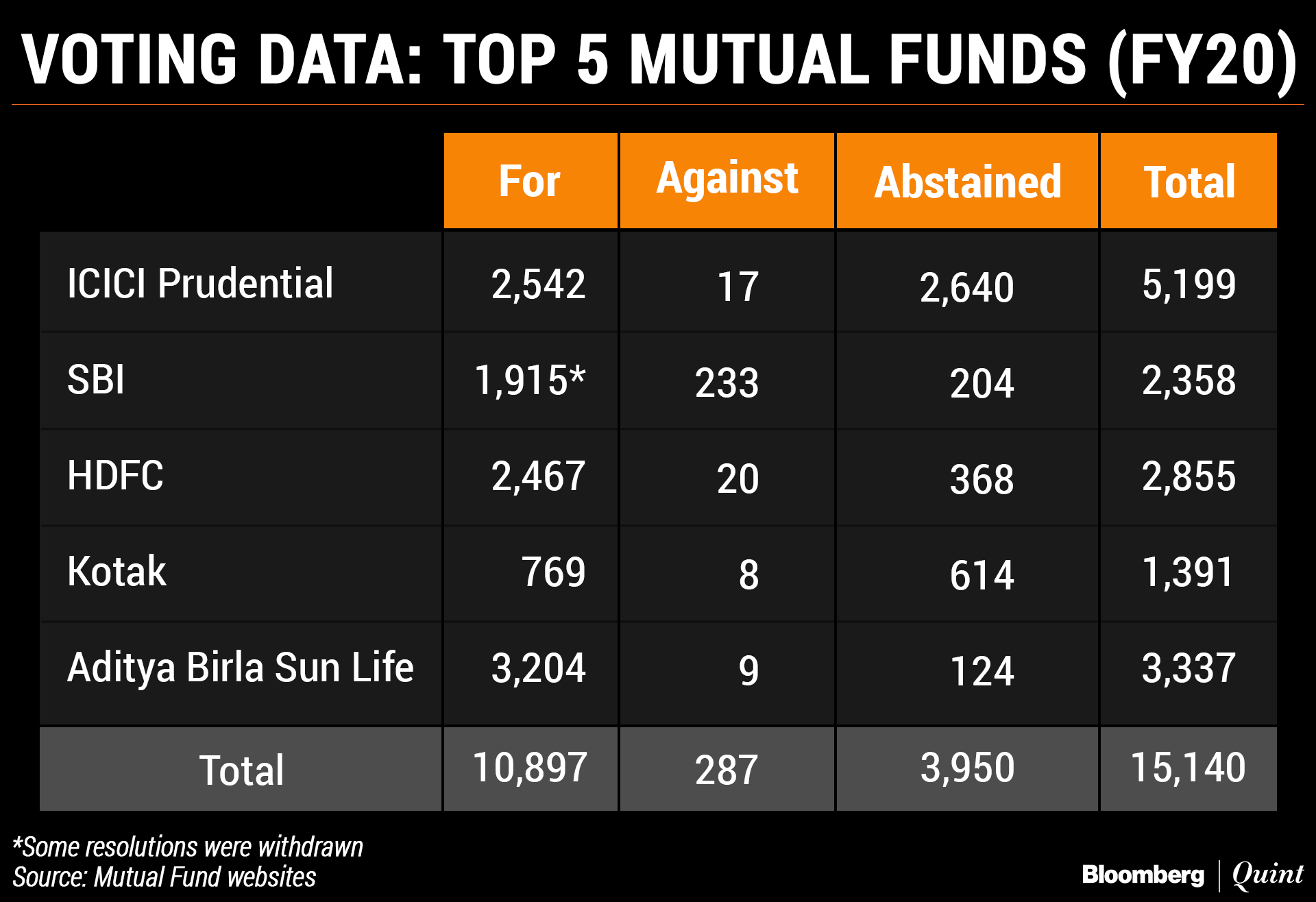
The HDFC Mutual Fund voting policy speaks to the approach of most funds houses when it says the decision to invest is an endorsement of sound management practices and, hence, on routine matters it will vote with the company management.
Yet, funds often abstain from voting for reasons ranging from costs to insufficient information.
- For instance, SBI Mutual Fund's voting policy says it may abstain on routine matters that do not materially impact the interest of the unitholders.
- ICICI Prudential Mutual Fund may abstain from voting if the proposal is not detrimental to the interests of unitholders or the cost involved in voting outweighs the benefits.
- Kotak Mutual Fund may not vote if its investment in the company is below 2% of the scheme's assets.
- At HDFC Mutual Fund, the investment manager may abstain from voting when it has insufficient information or does not have a clear stance on the proposal.
Aditya Birla Sun Life AMC's voting policy has no specific abstinence clauses but provides that a vote against an investee company resolution requires the fund management team to see approval in writing from the Investment Committee.
Unintended Outcomes
Should passive schemes/funds vote on shareholder resolutions? More, importantly, should they be mandated to vote?
Yes, says Tandon. “An active investor has the option to exit a stock if they are unhappy with its strategy or governance or if they are troubled by the CEO's salary. The passive investors do not have this option. So it is imperative for them to engage and vote. Only then will they be able to nudge companies to better balance stakeholders interest.”
He points to the U.S., where assets under management of passive funds exceeded those at active funds in 2019, and where leading fund managers have made the case for more active engagement on corporate governance issues.
In 2018, Larry Fink, chairman and chief executive of BlackRock, with a large passive portfolio, said his firm would redouble efforts towards global investment stewardship because “index investors are the ultimate long-term investors” and “the time has come for a new model of shareholder engagement”.
This responsibility goes beyond casting proxy votes at annual meetings—it means investing the time and resources necessary to foster long-term value.Larry Fink's annual letter to CEOs - 2018
Fink's approach is the best any market could hope for. An investor voluntarily devoting money and manpower to engage more actively with investee companies. With $8.7 trillion in assets under management and $5 billion in net income, Blackrock can put money where its mouth is.
Can the same outcome be achieved if forced via regulation? In India or elsewhere.
A 2017 paper published by the University of Chicago Law School made some useful arguments against voting by passive shareholders.
- As they don't actively pick their investments, passive funds lack company-specific information and would have to expend additional resources to arrive at voting decisions.
- Investment in improving the performance of a company will benefit all funds that track the index equally, while only the activist fund incurs the costs.
The absence of any financial incentive will force these low profit-margin funds to choose “a low-cost, one-size-fits-all approach to governance that is unlikely to be in the company's best interest", according to the author.
In India, passive funds, with an estimated less than 10% share of assets, may rely on outsourced voting advise, said the regulatory official cited above as he warned of ‘robo-voting'.
Besides, when for active funds the predilection is to vote in favour, passive funds, if forced to vote, may just do more of that.
At best the additional voting could be meaningless. At worst it could dilute any meaningful opposition to the resolution by informed investors.
Slim profit margins, capped expenses and rising stewardship costs—ignoring commercial realities can reduce the best intentions to tick box outcomes, argue a few mutual fund officials who prefer not to be named.
SEBI's intent is good, but the unintended outcomes may not be. Why use a hammer, when nudges work? Especially, when in the ESG era even retail investors want their money to have a conscience. That's a nudge and a push.

-
A New Samvat Wishlist: Inclusive Prosperity And Human Development

India has strengthened its economic foundations through infrastructure, digital access and enterprise. Its next growth chapter must deepen productivity, create better livelihoods and widen participation in prosperity.
-
Ten Things I Learnt This Samvat
Patience can be a trap. Cheap stocks can stay cheap. Leverage can wipe you out. What did Samvat 2082 teach us? Niraj Shah writes on 10 lessons from the year gone by.
-
Talking Points This Week: Tech Nerves, FII Buying, And A Faraway Banking Shock
The global markets are not shining this Diwali. The exception in the large markets is, India.
-
Midterm Rally Lasted A Day. The Hard Reality Of A Divided US May Last Two Years | Opinion
Between a contested AI boom, a debt ceiling that arrives in 2027 and a president with every incentive to act alone, the next two years may prove more volatile than the first day's rally suggests.
-
Blue Wave Will Derail the AI Trade but Won't Dismantle the AI Era | Unhedged Position
The Democrats' sweep of the US Congress will see politics collide with economic forces both over the long and short term.
-
It's Time To Take The GST Council's Bet On Trust Global
Payment records can prove India's services exports, and clear, proportionate rules can bring foreign digital sellers into the tax net.
-
Opinion | India at 38: From Innovation Overperformer to Innovation Powerhouse
India now has 453 VC-backed deep science startups, 18 of them late-stage, after 117 percent growth since 2020. Laurus Labs, at USD 9.3 billion, is the most valuable deep science company in any middle-income economy outside China.
-
Navigating Energy Crossroads: S Jaishankar's Call For Diversified Supply Chains At G20 Ministerial Meeting
As geopolitical fault lines continue to test maritime trade routes and commodity flows, Jaishankar's message remains pertinent: true economic resilience requires open markets, protected transit lines, and a genuine commitment to multilateral cooperation rather than coercion.
-
Indians Are Travelling, But Not Every Journey Is A Holiday | The Week In Whys
Pilgrims, patients and working women are the real travellers, and the system hasn't quite caught up with them.









