Ahmedabad Plane Crash: Air India May Face These Court Cases Going Ahead
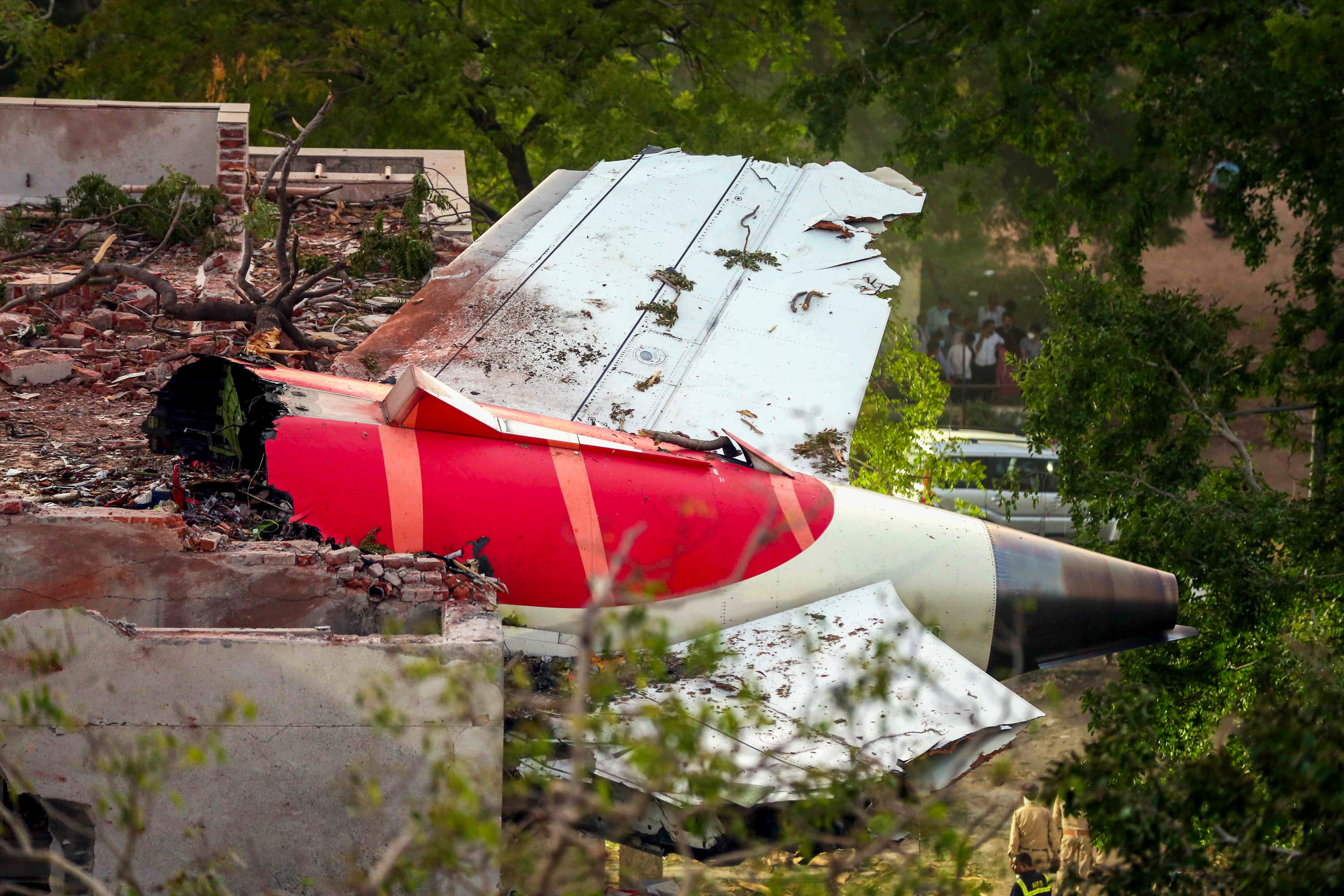
The crash of Air India flight AI 171 on Thursday raises a conflicting questions ahead for the families of victims—what kind of legal remedies can they avail now?
The Air India flight, headed to Gatwick, London from Ahmedabad, crashed shortly after takeoff on Thursday afternoon. There were 242 people onboard the Boeing 787 Dreamliner. Only one person survived the crash. The plane tore into the residential quarters of the BJ Medical College, in the Meghani area of the city.
While there are several legal remedies available, the route that can be opted for depends heavily on the investigation, as per Shiv Sapra, partner, Kochhar & Co.
Families may approach the courts for breach of contract, negligence or even a class action suit.
Notably, Tata Group has already announced voluntary compensation for those affected. "Tata Group will provide Rs 1 crore to the families of each person who lost their life in this tragedy. We will also cover the medical expenses of those injured and ensure that they receive all necessary care and support," Tata Sons Chairman, N Chandrasekharan, said in a statement.
This may help the airline's position, according to Sapra.
Since there was a service availed by the passengers in this case and other elements of a contract are also present, an action for not being able to deliver the service can lead to a claim for a breach of contract before the court, he said.
Meanwhile, class action suits in India are legal proceedings where a group of people with the same or similar grievance come together to file a single lawsuit, rather than each individual filing separately. This is particularly useful when many people are affected by the same wrongdoing.
This could become a lawsuit not just for the families of the victims but others who may have taken flights from the same airline previously, considering that Air India had received Directorate General of Civil Aviation warning in the past as well, Sapra said.
However, he mentioned that the courts might have to sift out nuisance litigations from genuine claims.
Since the Tata Group's takeover of Air India in 2022, the airline has faced a series of regulatory actions from the DGCA for various safety and passenger service lapses.
The earliest of these came in June 2022, when Air India was fined Rs 10 lakh for denying boarding to valid ticket holders without compensating them, highlighting issues in customer service, immediately after the ownership transition.
In January 2023, the airline drew heavy criticism and a Rs 30-lakh fine for its delayed handling of an onboard incident, where a passenger urinated on another. A month later, in February 2023, cockpit protocol violations surfaced when a Delhi-Dubai flight captain allowed a woman into the cockpit, leading to his suspension and a warning for the co-pilot.
Another cockpit breach occurred in June 2023, with two pilots being suspended for letting an unauthorised person into the cockpit on a Chandigarh-Leh flight.
Operational and safety violations marked the early part of 2024 as well. In January, the DGCA imposed a Rs 30 lakh penalty on Air India for not rostering enough CAT-III-trained pilots during fog, causing delays and cancellations.
In February 2024, the airline was fined another Rs 30 lakh following the death of an elderly passenger, reportedly due to inadequate in-flight assistance. In March 2024, Air India faced its most severe penalty—Rs 80 lakh—for violating flight-duty time limitations, raising concerns over pilot fatigue and flight safety.
By May 2024, the regulator had issued a show-cause notice after passengers on two long-haul flights complained of poorly cooled cabins, reinforcing concerns about recurring lapses in passenger care.
Most recently, in January 2025, Air India was fined another Rs 30 lakh for letting a pilot operate a flight without meeting recency requirements, despite multiple alerts—pointing to persistent compliance issues within the airline's operations.

-
High US Salaries, No Green Card Certainty: The Financial Calculation Facing Indian H-1B Families

The suspension of PERM processing at eight technology employers does not cancel existing H-1B visas. What it does is force a question many Indian families have been avoiding: is the US salary worth tying your career and family plans to one employer?
-
Swiggy vs Eternal: Food Delivery's Two Rivals Are No Longer In The Same Race
Eternal is building a private AI assistant, dark.ai. Swiggy is still working out how to make Instamart pay, with an operating loss of Rs 895 crore in the July-September quarter while Blinkit stayed profitable.
-
Where You Live Shapes How You Get To Work | The Reason Why
Two-wheelers are the most popular way to get to work in India, accounting for nearly 43% of workplace commutes.
-
Unhedged Position: Can India See An Indonesia-Style Time Correction?
The Nifty is trading below levels it first clocked in 2024. Is there, then, as I have suggested in the headline, potential that the current time correction drags on painfully for the next three-five, even ten years?
-
Navigating Friction And Energy Realities: An Analysis Of Marco Rubio's October Visit To India
Occurring at a critical juncture marked by stalled trade negotiations and escalating geopolitical pressures over global energy supplies, the visit offers a profound window into modern US-India relations.
-
India Exports Capital. Why Not Export Trusteeship?
The big question, then, is whether India can build an institution that global borrowers, investors, banks, and lawyers can trust, even without an Indian connection.
-
France's Economy & Politics Are In Crisis | The Reason Why
Let's look at how the French economy and politics evolved under Nicolas Sarkozy, Franois Hollande and Emmanuel Macron.
-
You May Inherit The Business. You Must Earn Its Credibility.
Succession tests the founder's ability to share authority as much as it tests the next generation's readiness to assume it.
-
Signing Deals Is One Thing; Making Them Work Is Another | The Week In Whys
Sometimes, things don't turn out as planned. Indian companies have lost some bids to rivals, some projects won't produce until 2030.
-
FOMC Wall, PERM Suspension, Hospital Stocks | Talking Points This Week
A PERM suspension would directly affect green-card sponsorship rather than H-1B visas, so the near-term earnings impact could remain relatively limited. The key question is whether this marks a new phase in US scrutiny of Indian IT.









