Abhay Aima: Markets, Music And Mysticism
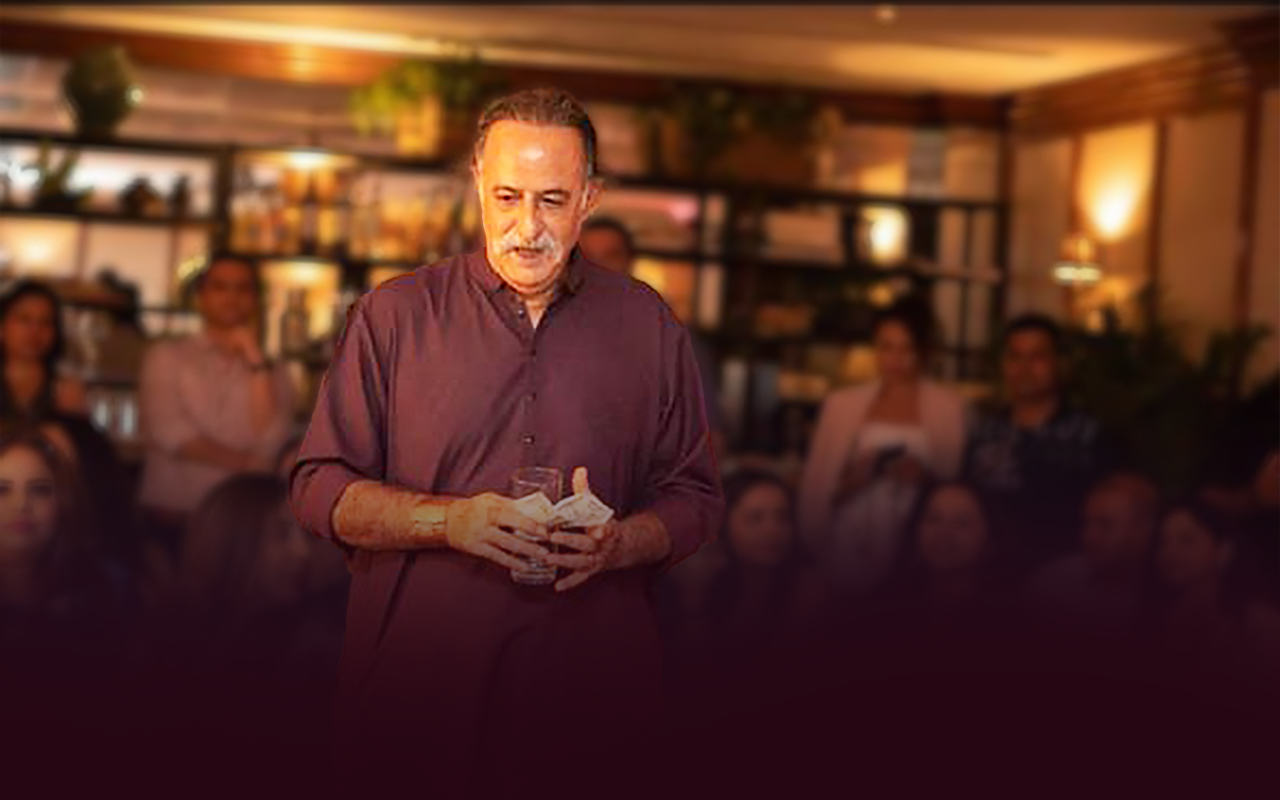
Our salutations to each other, in person with a bear hug and on the phone with a guffaw, are unprintable. For decades, we exchanged the same obscenities with equal emotion, intent, and intensity. We would caricature the way Kashmiris speak Urdu and English. Perhaps it was our way of reminding ourselves of our roots and reassuring us that nothing much had changed. Or, even if it had, it somehow bypassed us. In a sense, we had cocooned ourselves to neither face nor accept the many changes in and around our lives. It provided me—perhaps him too—with a space where we refused to grow up. The small joys of life, the carefreeness of school, the recklessness of teenagers, and the irreverence of youth were what our interaction was all about. We would make light of issues that divided communities and questioned people's right to represent us. It helped us overcome personal tragedies and professional setbacks.
We fancied ourselves as “Ghareeb Kashmiris” in the big, bad financial world of Mumbai. I was running a financial daily and he was not far from my office, running a financial business. Many years later, when I was heading the J&K Bank and he was running the wealth management business of HDFC Bank, his boss for over 25 years, Aditya Puri, would call us the Kashmiri Mafia. Our banter had served its purpose: to retain and assert our identity as Kashmiris. That was the glue until the last date.
Despite having lived almost all his life outside Kashmir, he retained three non-negotiables for qualifying as a Kashmiri: first, the language. Abhay spoke the language fluently and flawlessly, with cuss words to boot. Second, there is the love for the land. He would come every year and spend a month at the Nehru's Hotel on Boulevard, and later at Yasin Tomar's newly built houseboat at Nigeen. He was rich enough to afford the fanciest, but he chose to stay there because he was a friend. Third, the ethnicity ended up being Kashmiri. There were no sub-categories whatsoever.
This is exactly why he was indulgent with even those with a separatist ideology; for him, they were all Kashmiris. I remember telling him about some people he was associating with who were Ikhwanis. But he resolutely avoided looking at any binary beyond Kashmiri. To be so in a ruptured civil society of the valley required not just conviction but also faith that transcends religious boundaries. It is here that the man, who was a respected market player with unique insights, sought refuge in music. Over the last 10 years or so, he has gotten heavily into Sufi music. He would host young artists and promote them in small mehfils at his home in Bandra or in Goa, where he used to spend quite a lot of time, of late.
Some of his love for music was in his genes, as his uncle Mohan Lal Aima was a fabled musician of Kashmir, popularly known as “Mohane Chakker”, a leading exponent and propagator of the musical form of Chakkre that he was. Abhay once gave me a handwritten article by his uncle on Kashmir's language and music. He thought I would use it better.
Aima's early years were spent in Mumbai and Srinagar. His father, Omkar Nath Aima, was a Bollywood actor and good-looking man who resembled Balraj Sahni, who starred in the first and only Kashmiri feature film, Maenz Raat (Mehndi Raat). His mother was a schoolteacher. They lived in Batmaloo, an area closer to downtown in sensibility but geographically closer to the upmarket residential areas. Batmaloo defined his outlook and approach to life as intertwined community life, extremely social, and practical instinct to survive. At school, his best friend was Jahangir Shafi, a neighbour. We were schoolmates at Burn Hall during the late sixties and early seventies. He then left to join the National Defence Academy, a rather unlikely choice given his nickname in school, “Gaeb” (ewe lamb), given to him by a school bully, Talib.
Abhay lived in many realms. As a market guy who rubbed shoulders with the high and mighty. Be it an Amitabh Jhunjhunwala or a Madhu Kela or a Hemanta Kothari. He was respected and regarded. He knew and operated in the bowels of the stock markets. I would often ask him for stock-tips, but he would never give any! The only time he told me to invest after he had himself invested, turned out to be a dud. And I never let him forget that. I was awed by his knowledge of the stock markets, and he took my take on the macro-economy seriously. I got him to write a weekly column for Business Standard when I was the Resident Editor but it didn't last long. I think he wrote about five odd columns. He was not in the habit of intellectualising issues. He was far too practical for that. Where Abhay showed intellectual maturity was how he let different facets of his coexist which with lesser mortals have become contradictions.
Abhay evolved over the years to have more followers than friends. Every day a brood of young professionals, men and women, he had an eye for the latter, would troop into his apartment at Bandra and generally imbibe his way of life. The interiors of his apartment had a distinct Kashmiri sensibility; a Kashmiri style “chuik” was the only piece of furniture even as there were artefacts from all over the world; and a small functional bar. He was a single malt person and would enjoy his Glenmorangie. The Batmaloo kid never left him as he always took great pride and joy in his aquarium. He has one in his Shivaji Park apartment where he originally lived with his wife Radha, and Zoon.
He was a canine parent much before I became one. He had the loveliest Labrador, Zoon, which was his DP for the longest time before he changed it one with Sadguru. How I wish I had made him meet Rista, my English bulldog. He loved the name but couldn't meet him as he was spending more time in Goa.
I would rib him endlessly on his recent close association with Sadguru. To be fair, he was not a Sadguru “bakht”, but respected his wisdom; he found Sadguru was a wise man who would lead him into mysticism. Increasingly I saw him getting absorbed with the mystical roots of Kashmiri songs, and he would often make me provide the context for the songs.
Aima's favourite Kashmiris phrase for any and every eventuality was, “Kya Karav, Naras Dimva Nare” (what can we do, can put out the fire with our arms?); the helplessness in the face of inevitability. That is exactly how one feels today.
It has suddenly dawned on me that one doesn't age because of years; one ages because the world around you shrinks. Today my world has shrunk more than a little with the loss of a friend. And it is scary that it will shrink increasingly from here on. For the mast malang from the markets, the space can only grow. Rest in Peace my friend. I will miss you.
Haseeb A Drabu is an economist and former finance minister of Jammu & Kashmir (2015–2018)
The views expressed here are those of the author and do not necessarily represent the views of NDTV Profit or its editorial team.
This article first appeared in www.greaterkashmir.com

-
Talking Points This Week: Tech Nerves, FII Buying, And A Faraway Banking Shock

The global markets are not shining this Diwali. The exception in the large markets is, India.
-
Midterm Rally Lasted A Day. The Hard Reality Of A Divided US May Last Two Years | Opinion
Between a contested AI boom, a debt ceiling that arrives in 2027 and a president with every incentive to act alone, the next two years may prove more volatile than the first day's rally suggests.
-
Blue Wave Will Derail the AI Trade but Won't Dismantle the AI Era | Unhedged Position
The Democrats' sweep of the US Congress will see politics collide with economic forces both over the long and short term.
-
It's Time To Take The GST Council's Bet On Trust Global
Payment records can prove India's services exports, and clear, proportionate rules can bring foreign digital sellers into the tax net.
-
Opinion | India at 38: From Innovation Overperformer to Innovation Powerhouse
India now has 453 VC-backed deep science startups, 18 of them late-stage, after 117 percent growth since 2020. Laurus Labs, at USD 9.3 billion, is the most valuable deep science company in any middle-income economy outside China.
-
Navigating Energy Crossroads: S Jaishankar's Call For Diversified Supply Chains At G20 Ministerial Meeting
As geopolitical fault lines continue to test maritime trade routes and commodity flows, Jaishankar's message remains pertinent: true economic resilience requires open markets, protected transit lines, and a genuine commitment to multilateral cooperation rather than coercion.
-
Indians Are Travelling, But Not Every Journey Is A Holiday | The Week In Whys
Pilgrims, patients and working women are the real travellers, and the system hasn't quite caught up with them.
-
Getting To Work Costs Women More | The Reason Why
It is not just about women paying more than men. It is about women paying much more in cities than in villages.
-
AI Bias In Investing Cannot Be Eliminated, But It Can Be Governed
Framing is a particularly important example as identical financial information presented in terms of gains rather than losses can lead an LLM to reach a different assessment.









