A Look At The 5 Newly Appointed Supreme Court Judges
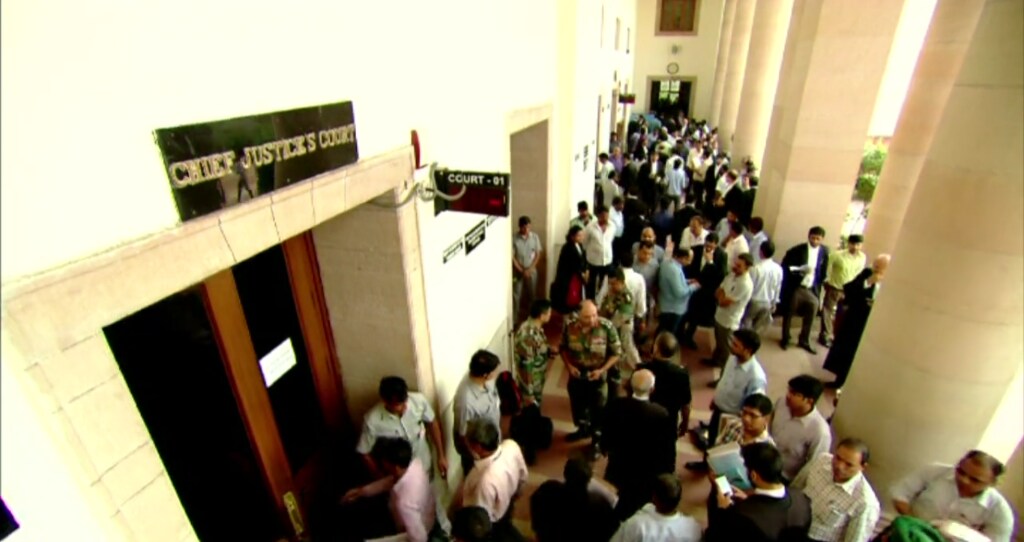
The five new judges appointed to the Supreme Court were sworn in on Friday by Chief Justice of India Justice JS Khehar. With these new appointments, the total strength of Supreme Court judges has risen to 28, still three short of the total sanctioned strength of 31.
Four of the new appointees were High Court Chief Justices while one was a justice in the Karnataka High Court.
Here's a look at their profiles in detail:

Justice Sanjay Kishan Kaul
After completing his LLB from Campus Law Centre, Delhi University, Justice Kaul started practice at the Delhi High Court and the Supreme Court. Before being elevated as a permanent High Court judge in 2003, Justice Kaul served as an advocate on record of the Supreme Court from 1987 to 1999 and was designated as senior advocate in 1999. Justice Kaul has also served as the Chief Justice of the Punjab and Haryana High Court, and was serving as the Chief Justice of the Madras High Court before being elevated to the apex court.
Justice Kaul has penned some liberal judgements upholding the freedom of speech and expression. In 2008, it was Justice Kaul who quashed the case of obscenity against painter MF Hussain and then later in 2016 against acclaimed writer Perumal Murugan.
In the Perumal Murugan judgement, this is what the bench headed by Justice Kaul had said, ”It is a matter of concern that as an evolving society, our tolerance level seems to be on the decline. Any contra view or social thinking is met at times with threats or violent behaviour. Our greatest problem today is fundamentalism which is the triumph of the letter over the spirit.‘'
Justice Naveen Sinha
Grandson of the first Advocate General of Bihar, Babu Baldev Sahay, Justice Naveen Sinha began practicing in the Patna High Court after completing his LLB from Campus Law Centre, Delhi University. Appointed as a judge of the Patna high court on February 11, 2004, Justice Sinha was transferred to the Chhattisgarh High Court in July 2014. He became the acting Chief Justice of Chhattisgarh High Court in October 2014 and was confirmed as its Chief Justice in April 2015. He took over as the Chief Justice of the Rajasthan High Court in May, 2016.
Justice Sinha is credited with championing computerisation of the Patna, Chhattisgarh and Rajasthan High Courts. It was under him that the Chhattisgarh High Court introduced electronic payment facility, becoming the second court in the country to do so.
Justice Mohan M Shantangoudar
After enrolling as an advocate in 1980, Justice Shantanagoudar started his independent practice in 1984 practicing in civil, criminal and constitutional matters. Justice Shatanangoudar also served as the State Public Prosecutor of Karnataka from 1999 to 2002 and was then appointed as Permanent Judge of the Karnataka High Court. He was serving as the Chief Justice of the Kerala High Court before his elevation to the Supreme Court.
Justice Deepak Gupta
Born in a family of lawyers, Justice Deepak Gupta started his practice in 1978 after completing his LLB from Campus Law Centre, University of Delhi. He was elevated as the Judge of the Himachal Pradesh High Court and also headed the green bench in the Himachal Pradesh High Court. Later, he was transferred as Chief Justice of the Tripura High Court in 2013 and he was serving as the Chief Justice of the Chattisgarh High Court before being elevated to the Supreme Court.
Justice S Abdul Nazeer
Justice Nazeer's appointment is a rarity as he is elevated to the Supreme Court with out first serving as Chief Justice of any High Court. Justice Nazeer enrolled as an advocate in 1983 and practised in the Karnataka High Court. He was appointed as the permanent judge of the Karnataka High Court in 2004 and was serving in the same position before being elevated to the Supreme Court.

-
Where You Live Shapes How You Get To Work | The Reason Why

Two-wheelers are the most popular way to get to work in India, accounting for nearly 43% of workplace commutes.
-
High US Salaries, No Green Card Certainty: The Financial Calculation Facing Indian H-1B Families
The suspension of PERM processing at eight technology employers does not cancel existing H-1B visas. What it does is force a question many Indian families have been avoiding: is the US salary worth tying your career and family plans to one employer?
-
Unhedged Position: Can India See An Indonesia-Style Time Correction?
The Nifty is trading below levels it first clocked in 2024. Is there, then, as I have suggested in the headline, potential that the current time correction drags on painfully for the next three-five, even ten years?
-
Navigating Friction And Energy Realities: An Analysis Of Marco Rubio's October Visit To India
Occurring at a critical juncture marked by stalled trade negotiations and escalating geopolitical pressures over global energy supplies, the visit offers a profound window into modern US-India relations.
-
India Exports Capital. Why Not Export Trusteeship?
The big question, then, is whether India can build an institution that global borrowers, investors, banks, and lawyers can trust, even without an Indian connection.
-
France's Economy & Politics Are In Crisis | The Reason Why
Let's look at how the French economy and politics evolved under Nicolas Sarkozy, Franois Hollande and Emmanuel Macron.
-
You May Inherit The Business. You Must Earn Its Credibility.
Succession tests the founder's ability to share authority as much as it tests the next generation's readiness to assume it.
-
Signing Deals Is One Thing; Making Them Work Is Another | The Week In Whys
Sometimes, things don't turn out as planned. Indian companies have lost some bids to rivals, some projects won't produce until 2030.
-
FOMC Wall, PERM Suspension, Hospital Stocks | Talking Points This Week
A PERM suspension would directly affect green-card sponsorship rather than H-1B visas, so the near-term earnings impact could remain relatively limited. The key question is whether this marks a new phase in US scrutiny of Indian IT.
-
Everything, Everywhere, All At Once: Dalal Street's Week To Forget | Joining The Dots
Visa curbs, a Starlink spat and cancer drug caps: what connects this week's shocks for Indian markets









