US Retail Sales Jump By Most In Two Years On Car-Buying Rush
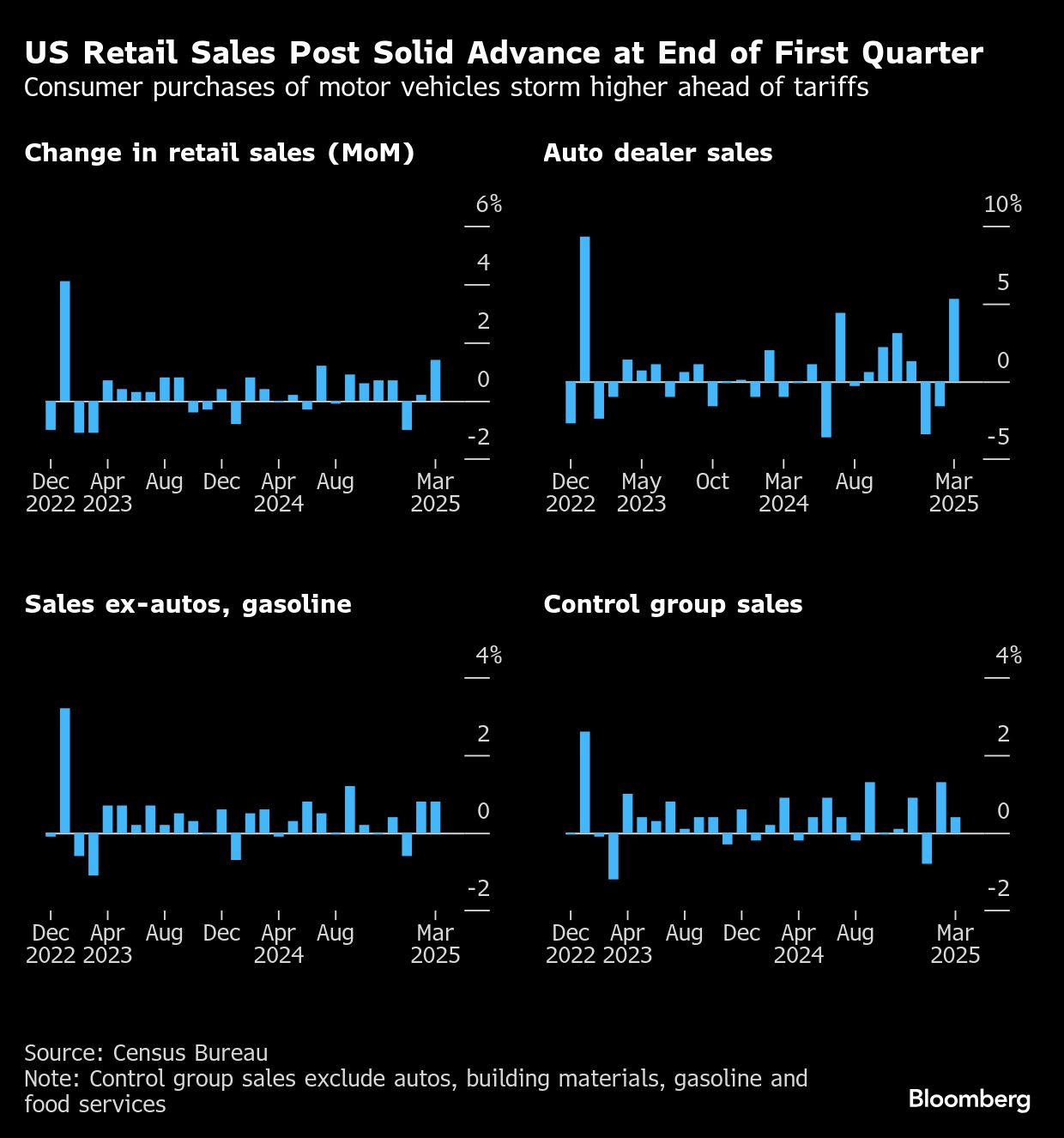
US retail sales rose substantially in March on a jump in car purchases and other goods such as electronics, suggesting consumers were scrambling to get ahead of tariffs.
The value of retail purchases, not adjusted for inflation, increased 1.4%, the most in over two years, Commerce Department data showed Wednesday. Excluding autos, sales climbed 0.5%.
The advance suggests consumers were rushing to buy cars before President Donald Trump's 25% tariffs on finished vehicles, with duties on parts set to take effect no later than May 3. That's expected to drive up prices by thousands of dollars, though Trump is exploring possible temporary exemptions.
While autos saw the biggest advance in two years, the overall gain was broad, with 11 of the report's 13 categories posting increases. Sales of building materials, sporting goods and electronics climbed as well, which could also indicate consumers were trying to beat tariffs on such goods. Many of those products are made in China and are now facing 145% levies.
Several surveys of consumer attitudes have plunged as Trump presses forward with tariffs, which are also causing some measures of inflation expectations to soar and tanking Americans' perception of their financial situations. With low-income consumers already facing hardships and wealthier ones being hit by a recent stock-market selloff, that's clouding the outlook for spending and adding to recessions fears.
The data showed so-called control-group sales — which feed into the government's calculation of goods spending for gross domestic product — climbed 0.4% in March, suggesting momentum at the end of the first quarter. The measure excludes food services, auto dealers, building materials stores and gasoline stations.
While importers are the ones who pay for tariffs, they ultimately pass at least some of those costs on to consumers — even if the pass-through can take a few months. Since retail sales figures aren't adjusted for inflation, tariffs may distort the numbers going forward, as an advance could merely reflect higher prices rather than greater sales activity.
Companies like Ford Motor Co. and Walmart Inc. are trying to help consumers by attempting to offset some of the additional costs, which will eat into margins. Still, executives from luxury group LVMH to brewer Constellation Brands Inc. have generally been downbeat on the outlook and are wary as to how consumers will respond.
Federal Reserve officials are now in wait-and-see mode until they get further clarity on how tariffs impact prices — and the economy as a whole. Some policymakers have argued that the levies would result in a one-time price shock, while others warn the impact could be broader.
Spending at restaurants and bars, the only service-sector category in the report, increased 1.8%, also the most since January 2023.

-
Midterm Rally Lasted A Day. The Hard Reality Of A Divided US May Last Two Years | Opinion

Between a contested AI boom, a debt ceiling that arrives in 2027 and a president with every incentive to act alone, the next two years may prove more volatile than the first day's rally suggests.
-
Blue Wave Will Derail the AI Trade but Won't Dismantle the AI Era | Unhedged Position
The Democrats' sweep of the US Congress will see politics collide with economic forces both over the long and short term.
-
It's Time To Take The GST Council's Bet On Trust Global
Payment records can prove India's services exports, and clear, proportionate rules can bring foreign digital sellers into the tax net.
-
Opinion | India at 38: From Innovation Overperformer to Innovation Powerhouse
India now has 453 VC-backed deep science startups, 18 of them late-stage, after 117 percent growth since 2020. Laurus Labs, at USD 9.3 billion, is the most valuable deep science company in any middle-income economy outside China.
-
Navigating Energy Crossroads: S Jaishankar's Call For Diversified Supply Chains At G20 Ministerial Meeting
As geopolitical fault lines continue to test maritime trade routes and commodity flows, Jaishankar's message remains pertinent: true economic resilience requires open markets, protected transit lines, and a genuine commitment to multilateral cooperation rather than coercion.
-
Indians Are Travelling, But Not Every Journey Is A Holiday | The Week In Whys
Pilgrims, patients and working women are the real travellers, and the system hasn't quite caught up with them.
-
Getting To Work Costs Women More | The Reason Why
It is not just about women paying more than men. It is about women paying much more in cities than in villages.
-
AI Bias In Investing Cannot Be Eliminated, But It Can Be Governed
Framing is a particularly important example as identical financial information presented in terms of gains rather than losses can lead an LLM to reach a different assessment.
-
Joining The Dots | Dark Skies, Steady Diya: Why Hope Holds This Diwali
With war, a weak rupee and foreign outflows weighing on sentiment, policymakers at the NDTV World Summit and market veterans at NDTV Profit Ignite: Diwali Edition offered the same advice: stay invested and filter out the noise.









