Trump's Trade War Shaking Pillars Of Global Financial System, IMF Warns
President Donald Trump's trade war is threatening the global financial stability that's kept banks and insurers safe since the 2008 crisis, the International Monetary Fund warned, as it urged policymakers to bolster their industries' defenses.
The world has seen a sharp repricing of some assets and heightened volatility across stock, currency and bond markets in response to the latest tariff announcements, the Washington-based lender wrote in a report published Tuesday. More adjustments might be in the pipeline if the economic outlook were to deteriorate.
“Global financial stability risks have increased significantly,” the IMF said, warning that some financial institutions — especially highly leveraged ones — could come under strain. “One main trigger of further selloffs could be geopolitical risk.”
There's no shortage of that. The implications of Trump's tit-for-tat trade war with China extend far beyond those two economies, also affecting countries suffering from uncertainty about their own trade relations with the US.
The Bank of England warned earlier this month that the trade conflict “could harm financial stability by depressing growth.”
At the same time, the Russian invasion of Ukraine continues with a peace accord still elusive, and fighting continues in Gaza as well.
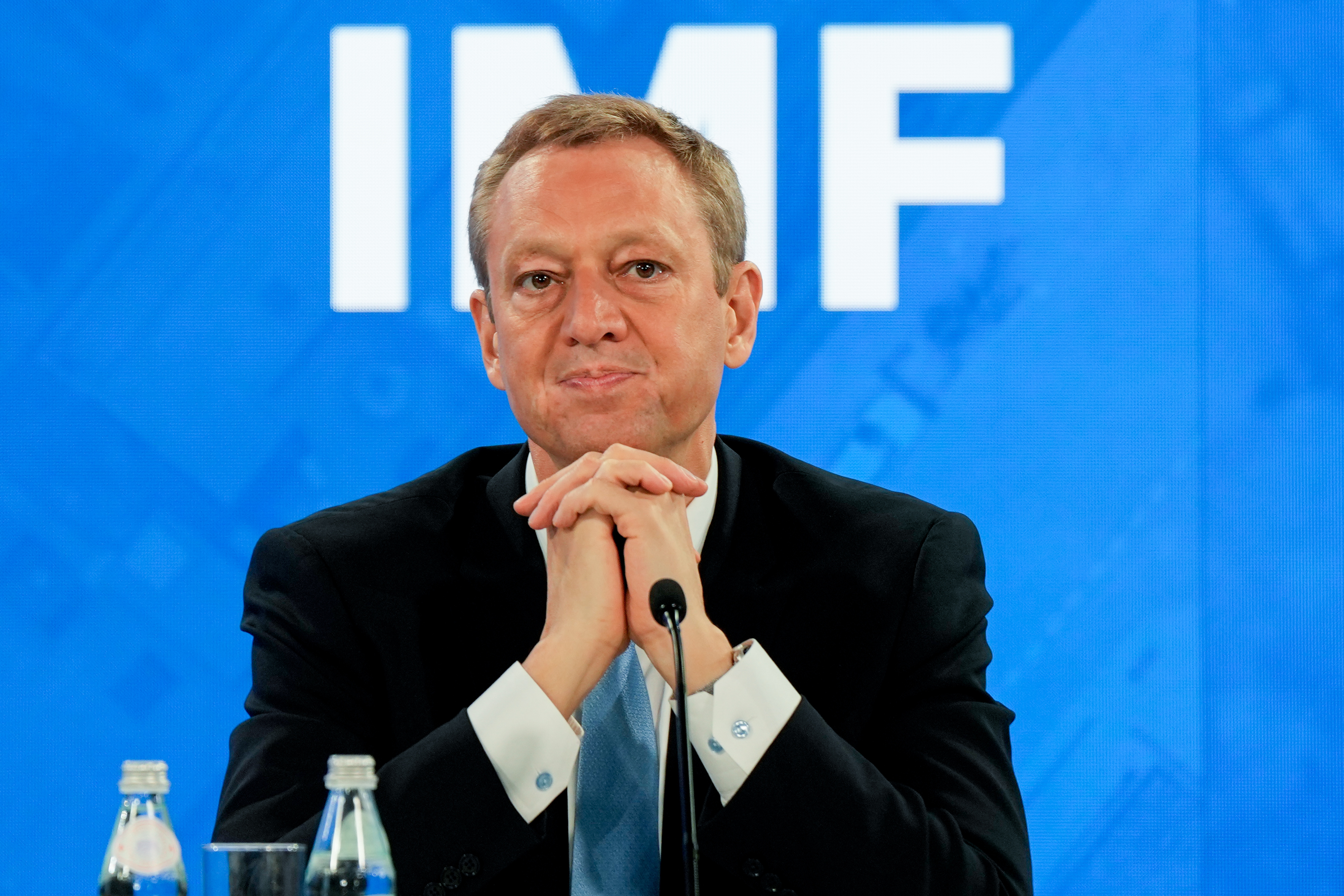
Despite the IMF's stark warnings, there's no reason for alarm, according to Tobias Adrian, who heads the lender's monetary and capital-markets department.
It's true that the magnitude and speed of the market adjustment following the April 2 tariff announcements was “fairly abrupt,” he said in an interview in Washington, “but it wasn't disorderly.”

‘Stretched Valuations'
There haven't been any institutional failures, the global economy isn't headed for a recession and one thing to remember is that “we really have come from a place of pretty stretched valuations,” he said. “So in some sense, it's more of a normalization.”
Adrian said that the IMF was examining whether the market turmoil had triggered a “forced unwinding or disorderly unwinding” on a popular highly-leveraged bet known as the “basis trade” which is designed to exploit small mispricings in US government bonds.
“We haven't seen that, there's probably some degree of unwinding, but it's pretty contained,” he added of the recent performance of a strategy that has long spooked watchdogs for its potential to exacerbate market stresses.
“If things go very badly” on the tariff-negotiation front, “we may end up in a concerning place from a financial stability point of view,” he said. “But there's also a possibility that there's some resolution of those tensions.”
The IMF, which is holding its spring meetings in Washington this week along with the World Bank, is urging vigilance nonetheless.
“Authorities should prepare to deal with financial instability by ensuring that financial institutions are ready to access central bank liquidity facilities and by being prepared to intervene to address severe liquidity or market function stress,” the report's authors wrote.
They added that sufficient levels of capital and liquidity in the banking sector continue to be an anchor of global financial stability, particularly considering high levels of leverage and growing interconnectedness between banks and nonbanks, a broad swathe of financial institutions spanning everything from insurers to hedge funds and private credit
They also called for the full and timely implementation of the final suite of post crisis reforms, known as Basel III, agreed upon in 2017 to safeguard the banking system from future calamity.

-
Talking Points This Week: Tech Nerves, FII Buying, And A Faraway Banking Shock

The global markets are not shining this Diwali. The exception in the large markets is, India.
-
Midterm Rally Lasted A Day. The Hard Reality Of A Divided US May Last Two Years | Opinion
Between a contested AI boom, a debt ceiling that arrives in 2027 and a president with every incentive to act alone, the next two years may prove more volatile than the first day's rally suggests.
-
Blue Wave Will Derail the AI Trade but Won't Dismantle the AI Era | Unhedged Position
The Democrats' sweep of the US Congress will see politics collide with economic forces both over the long and short term.
-
It's Time To Take The GST Council's Bet On Trust Global
Payment records can prove India's services exports, and clear, proportionate rules can bring foreign digital sellers into the tax net.
-
Opinion | India at 38: From Innovation Overperformer to Innovation Powerhouse
India now has 453 VC-backed deep science startups, 18 of them late-stage, after 117 percent growth since 2020. Laurus Labs, at USD 9.3 billion, is the most valuable deep science company in any middle-income economy outside China.
-
Navigating Energy Crossroads: S Jaishankar's Call For Diversified Supply Chains At G20 Ministerial Meeting
As geopolitical fault lines continue to test maritime trade routes and commodity flows, Jaishankar's message remains pertinent: true economic resilience requires open markets, protected transit lines, and a genuine commitment to multilateral cooperation rather than coercion.
-
Indians Are Travelling, But Not Every Journey Is A Holiday | The Week In Whys
Pilgrims, patients and working women are the real travellers, and the system hasn't quite caught up with them.
-
Getting To Work Costs Women More | The Reason Why
It is not just about women paying more than men. It is about women paying much more in cities than in villages.
-
AI Bias In Investing Cannot Be Eliminated, But It Can Be Governed
Framing is a particularly important example as identical financial information presented in terms of gains rather than losses can lead an LLM to reach a different assessment.









