Trump Threatens 10% Tariff On China, Cites Trade Deficit With EU
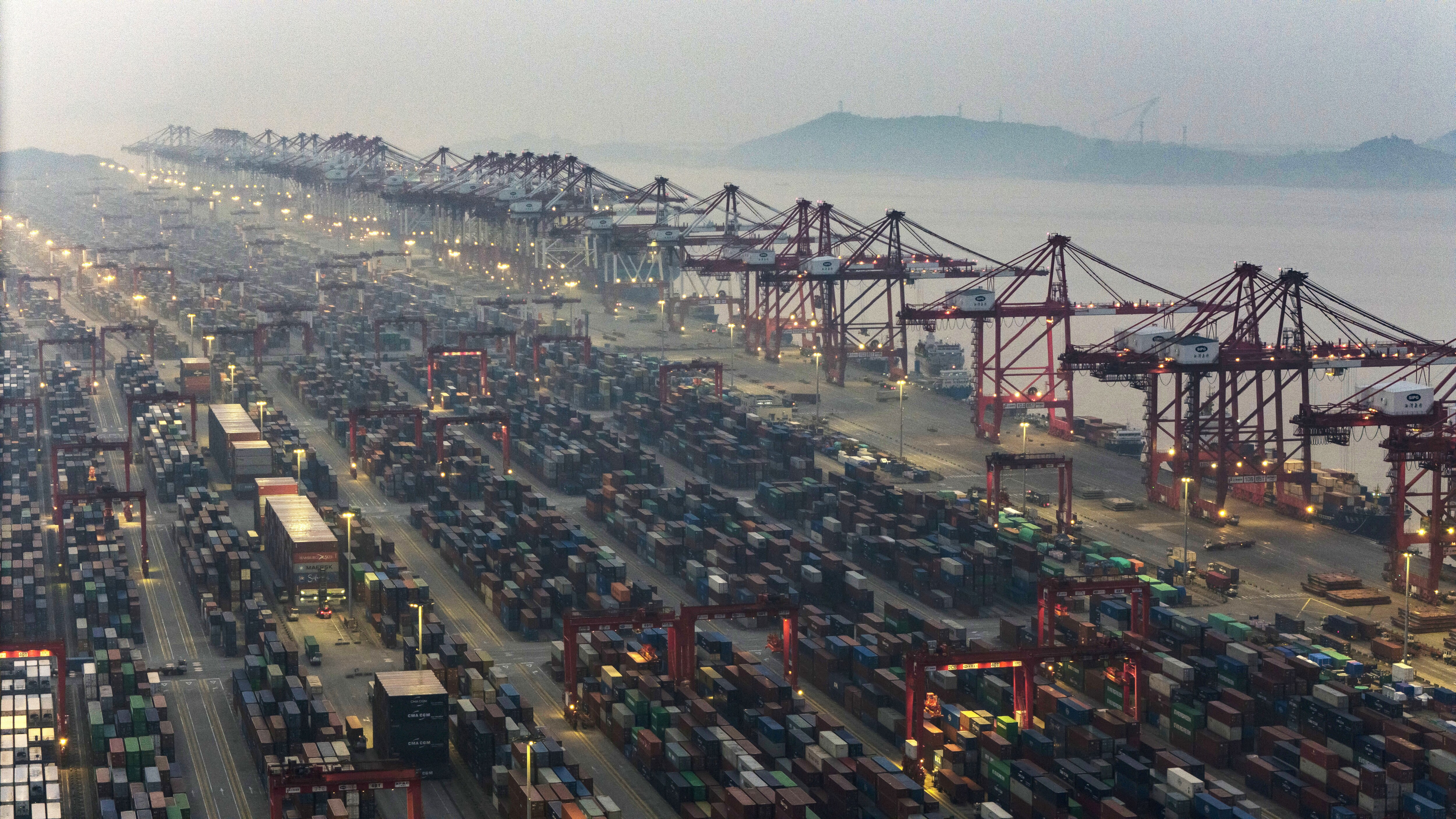
President Donald Trump widened his tariff threats to include China and the European Union on his second day back in office after day one saw Canada and Mexico in his sights.
“We're talking about a tariff of 10% on China, based on the fact that they're sending fentanyl to Mexico and Canada,” Trump said during an event at the White House on Tuesday, specifying Feb. 1 as a possible date.
“Other countries are big abusers also, you know it's not just China,” Trump said. “We have a $350 billion deficit with the European Union. They treat us very very badly, so they're going to be in for tariffs.”
The threats echo comments made throughout Trump's campaign for a return to the White House and since his sweeping Nov. 5 victory. But the only actual action taken so far is the call for a review of trade practices that's due by April 1, potentially giving China and others almost 10 weeks to avert new levies or address his demands.
China's government reiterated their opposition to tariffs, with Ministry of Foreign Affairs spokeswoman Mao Ning saying Wednesday that there are no winners in a trade war, adding that China would safeguard its national interest.
Earlier Tuesday, Chinese Vice Premier Ding Xuexiang said China would expand its imports, saying the country did not seek a “trade surplus.” Bloomberg News has reported that people familiar with Trump's discussions around China have said that he is interested in opening negotiations with China.
On Monday, the first day of his new term, Trump held off on ordering China-specific tariffs, even as he said that he intended to hit Canada and Mexico — both US neighbors and close allies — with the 25% levies by Feb. 1. That had fueled gains for Asian shares on Tuesday.
Market Volatility
Chinese stocks fell Wednesday after Trump's latest comments, with the onshore benchmark CSI 300 Index headed for its first decline in five days and the Hang Seng China Enterprises Index the worst performer in Asia.
While the 10% level is lower than the potential levies of 60% on Chinese products that Trump floated during his election campaign, investors are bracing for more volatility.
“It only gets tougher from here,” said Xin-Yao Ng, an investment director at abrdn Plc in Singapore. “It's a reminder that Trump will do something, because the first day might have given some the false impression that he might not. More gradual tariffs might also delay or reduce the force of stimulus that the market wants.”

US President Donald Trump in the Roosevelt Room of the White House in Washington, DC, US, on Tuesday, Jan. 21, 2025. Trump announced a joint venture to fund artificial intelligence infrastructure worth billions of dollars with the leaders of Softbank Group Corp., OpenAI LLC, and Oracle Corp., an effort aimed at speeding development of the emerging technology. (Photo Source: Aaron Schwartz/Sipa/Bloomberg)
Trump on Tuesday also reiterated his earlier threat to hit Canada and Mexico with tariffs, emphasizing that this wasn't an attempt to force renegotiations of the three nations' free-trade deal, but was because they had allowed illegal immigrants and drugs to cross into the US.
It is unclear under what legal authority Trump could order these tariffs imposed. In the executive action on Monday, he told officials to “assess the unlawful migration and fentanyl flows” from Canada, Mexico, and China and report back by April 1.
Before his inauguration there were reports he was considering declaring a national economic emergency to allow new tariffs, but such a move hasn't been announced.
“While the Trump administration's instant actions do not lead to new tariffs being imposed immediately, the memorandum demonstrates a clear and methodical effort to lay the foundations for future tariff actions and other measures,” according to a report on the executive order by law firm Baker McKenzie.
Trump aggressively targeted China during his first term over trade, starting a clash that reshaped supply chains and the global economy. Trump spoke to his Chinese counterpart Xi Jinping days before his second inauguration, in a call in which they discussed trade, fentanyl and ByteDance Ltd.'s social media app TikTok.
“We didn't talk too much about tariffs, other than he knows where I stand,” Trump said Tuesday, defending his approach to the issue.
“Look, I put large tariffs on China. I've taken in hundreds of billions of dollars. Until I was president, China never paid not 10 cents to the United States,” he said.

-
Talking Points This Week: Tech Nerves, FII Buying, And A Faraway Banking Shock

The global markets are not shining this Diwali. The exception in the large markets is, India.
-
Midterm Rally Lasted A Day. The Hard Reality Of A Divided US May Last Two Years | Opinion
Between a contested AI boom, a debt ceiling that arrives in 2027 and a president with every incentive to act alone, the next two years may prove more volatile than the first day's rally suggests.
-
Blue Wave Will Derail the AI Trade but Won't Dismantle the AI Era | Unhedged Position
The Democrats' sweep of the US Congress will see politics collide with economic forces both over the long and short term.
-
It's Time To Take The GST Council's Bet On Trust Global
Payment records can prove India's services exports, and clear, proportionate rules can bring foreign digital sellers into the tax net.
-
Opinion | India at 38: From Innovation Overperformer to Innovation Powerhouse
India now has 453 VC-backed deep science startups, 18 of them late-stage, after 117 percent growth since 2020. Laurus Labs, at USD 9.3 billion, is the most valuable deep science company in any middle-income economy outside China.
-
Navigating Energy Crossroads: S Jaishankar's Call For Diversified Supply Chains At G20 Ministerial Meeting
As geopolitical fault lines continue to test maritime trade routes and commodity flows, Jaishankar's message remains pertinent: true economic resilience requires open markets, protected transit lines, and a genuine commitment to multilateral cooperation rather than coercion.
-
Indians Are Travelling, But Not Every Journey Is A Holiday | The Week In Whys
Pilgrims, patients and working women are the real travellers, and the system hasn't quite caught up with them.
-
Getting To Work Costs Women More | The Reason Why
It is not just about women paying more than men. It is about women paying much more in cities than in villages.
-
AI Bias In Investing Cannot Be Eliminated, But It Can Be Governed
Framing is a particularly important example as identical financial information presented in terms of gains rather than losses can lead an LLM to reach a different assessment.









