OPEC+ Mulls Even Larger Oil-Output Hike As It Seeks Market Share
OPEC+ is considering accelerating its production increases by discussing a potential hike of more than 411,000 barrels a day for July as it seeks to recoup lost market share, according to people familiar with the matter.
Eight key members of the Organization of the Petroleum Exporting Countries and its partners, led by Saudi Arabia, are due to hold a video conference on Saturday to discuss output policy. Their last two calls resulted in super-sized production increases that drove down prices, and the cartel may go even further this time, the people said.
Some delegates among the eight nations said they were unaware of plans for an outsize boost and expected an increase closer to the 411,000-barrel-a-day hikes set for May and June. Yet the group's deliberations are increasingly confined to a smaller group of its most powerful members, who sometimes only share decisions with their counterparts at short notice.
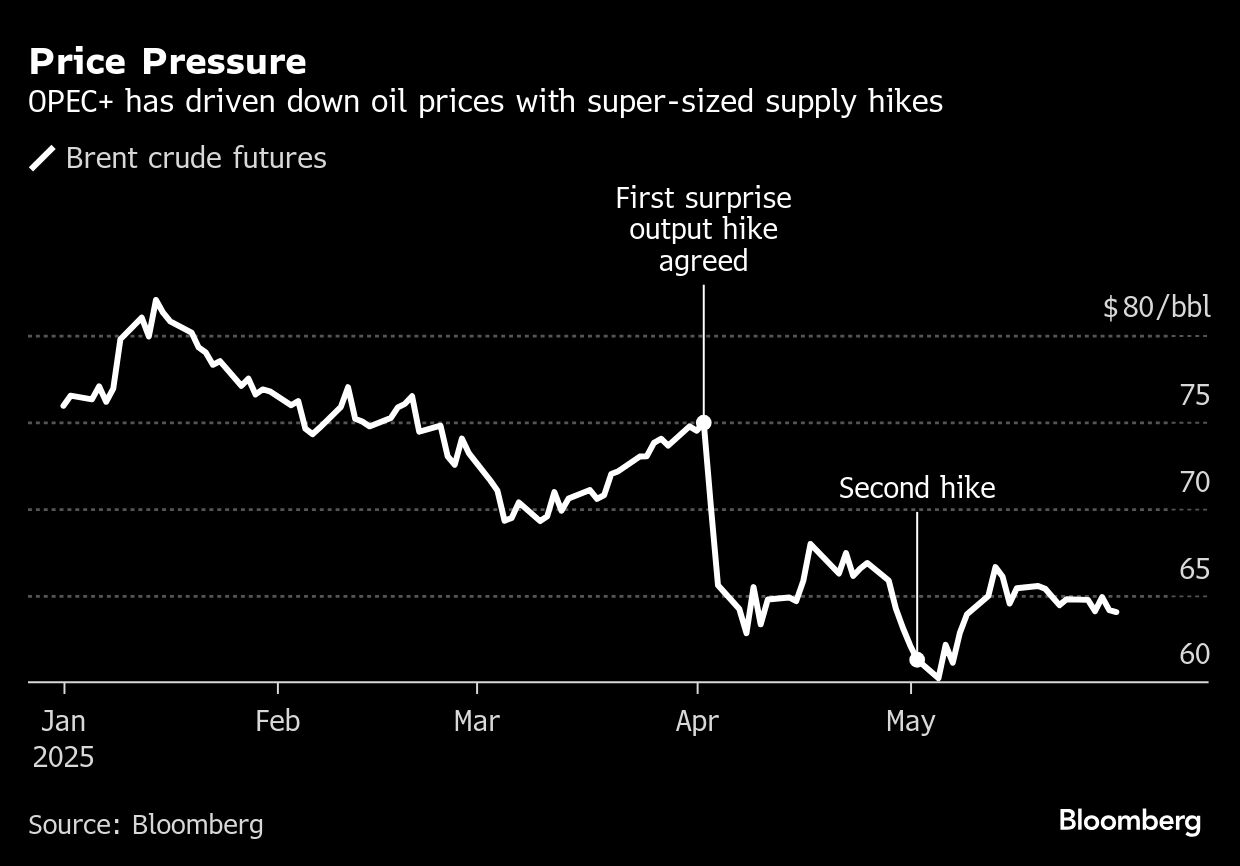
OPEC+ has made a radical policy shift from defending prices to actively seeking to drive them lower. It stunned traders in early April by announcing a supply increase that was three times the volume planned. The move came even as markets faltered amid slowing demand and President Donald Trump's trade war, briefly dragging crude to a four-year low below $60 a barrel, and was repeated the following month.
Brent futures slipped to trade below $64 a barrel in London on Friday.
Kazakhstan's Deputy Energy Minister Alibek Zhamauov had already alluded to the possibility of an bigger surge in comments to reporters on Thursday. “There will be a hike, but whether it will be 400, 500, 600, we don't know — that will be announced on Saturday,” he said in Astana, according to the news agency.
Delegates have offered a range of explanations for the pivot by Riyadh. Some assert that OPEC+ is simply satisfying robust demand, while others say Saudi Arabia seeks to punish members like Kazakhstan and Iraq for cheating on their output quotas. Officials have also suggested the kingdom is trying to appease Trump, or to reclaim the market share relinquished to US shale drillers and other rivals. The ultimate motive may combine several of these objectives.
If Riyadh's strategy was to discipline the cartel's quota cheats through a “controlled sweating,” it doesn't seem to be working.
Kazakhstan, the most blatant offender, continues to exceed its limits by several hundred thousand barrels a day and has publicly stated that it has no plans to atone. Energy Minister Yerlan Akkenzhenov told reporters on Thursday that the country can neither enforce cutbacks on international corporate partners, or dial back at state-run fields.
The strategy transition hasn't been without a cost. While crude's pullback offers relief for consumers and central banks grappling with stubborn inflation, it poses financial peril for oil producers in OPEC+ and around the world.
The International Monetary Fund estimates the Saudis need prices above $90 to cover the lavish spending plans of Crown Prince Mohammed bin Salman. The kingdom is contending with a soaring budget deficit, and has been forced to cut investment on flagship projects such as the futuristic city, Neom.

-
Talking Points This Week: Tech Nerves, FII Buying, And A Faraway Banking Shock

The global markets are not shining this Diwali. The exception in the large markets is, India.
-
Midterm Rally Lasted A Day. The Hard Reality Of A Divided US May Last Two Years | Opinion
Between a contested AI boom, a debt ceiling that arrives in 2027 and a president with every incentive to act alone, the next two years may prove more volatile than the first day's rally suggests.
-
Blue Wave Will Derail the AI Trade but Won't Dismantle the AI Era | Unhedged Position
The Democrats' sweep of the US Congress will see politics collide with economic forces both over the long and short term.
-
It's Time To Take The GST Council's Bet On Trust Global
Payment records can prove India's services exports, and clear, proportionate rules can bring foreign digital sellers into the tax net.
-
Opinion | India at 38: From Innovation Overperformer to Innovation Powerhouse
India now has 453 VC-backed deep science startups, 18 of them late-stage, after 117 percent growth since 2020. Laurus Labs, at USD 9.3 billion, is the most valuable deep science company in any middle-income economy outside China.
-
Navigating Energy Crossroads: S Jaishankar's Call For Diversified Supply Chains At G20 Ministerial Meeting
As geopolitical fault lines continue to test maritime trade routes and commodity flows, Jaishankar's message remains pertinent: true economic resilience requires open markets, protected transit lines, and a genuine commitment to multilateral cooperation rather than coercion.
-
Indians Are Travelling, But Not Every Journey Is A Holiday | The Week In Whys
Pilgrims, patients and working women are the real travellers, and the system hasn't quite caught up with them.
-
Getting To Work Costs Women More | The Reason Why
It is not just about women paying more than men. It is about women paying much more in cities than in villages.
-
AI Bias In Investing Cannot Be Eliminated, But It Can Be Governed
Framing is a particularly important example as identical financial information presented in terms of gains rather than losses can lead an LLM to reach a different assessment.









