Japan’s Labor Demand Holds Steady In Positive Sign For Wages
(Bloomberg) -- Japan's labor market remained relatively tight in November, keeping pressure on employers to boost pay in order to fill positions as companies prepare to engage in annual wage negotiations with unions.
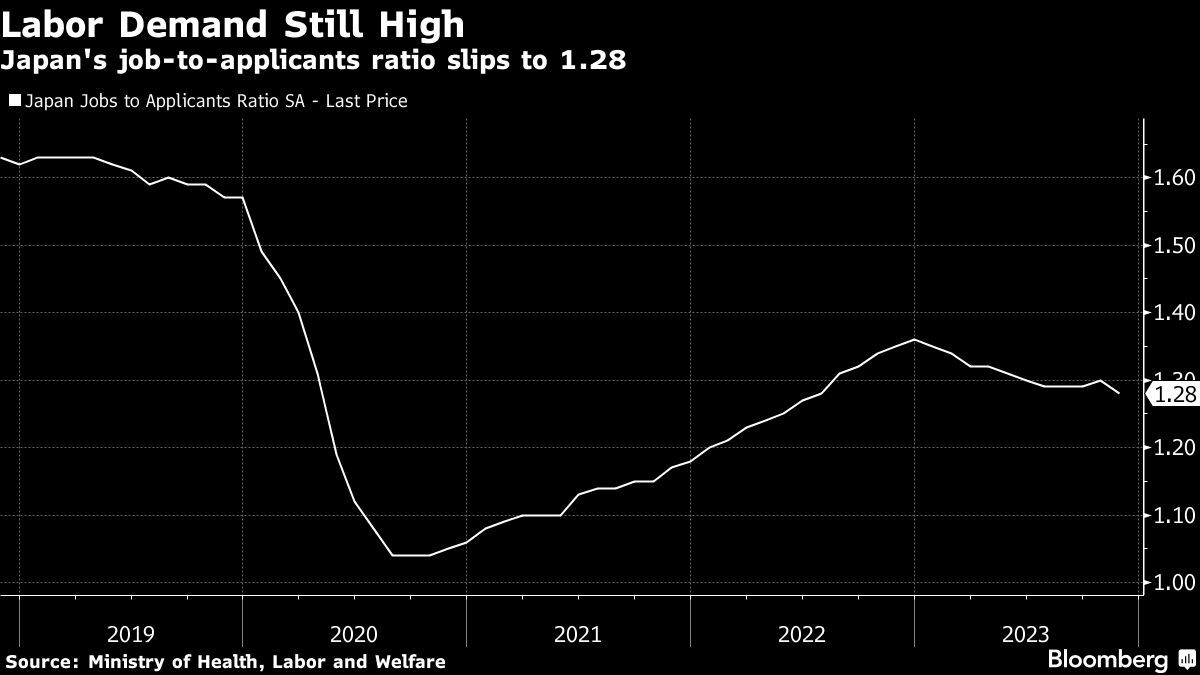
The job-to-applicants ratio eased a tad to 1.28, meaning there were 128 jobs offered for every 100 applicants, the labor ministry reported Tuesday. Economists had forecast the reading would be unchanged at 1.30.
A separate report from the ministry of internal affairs showed the unemployment rate held steady at 2.5% in November. The number of workers rose by 560,000 from the same month a year earlier, marking the 16th consecutive increase, while those without jobs rose by 40,000. The number of female workers rose by 420,000 from a year earlier. On a month-on-month basis, there were 260,000 more workers in November than October.
Bank of Japan Governor Kazuo Ueda noted in a speech on Monday that labor conditions have tightened relative to last year, helping to support wage growth and spur workplace efficiency. The BOJ will be monitoring the progress of annual spring wage negotiations for signs employers plan to build on this year's historic salary increases, boosting the prospects for achieving a virtuous wage-price cycle.
“We cannot say the results were strong enough to influence the outcome of the spring wage negotiations, but they at least indicate that the labor market remains tight,” said Masato Koike, economist at Sompo Institute Plus. “Ueda has said that he will scrutinize upcoming data, and today's results became one of those that give a positive impression.”
READ: Japan to Use More Tax Incentives to Encourage Wage Increases
While Japan's labor conditions have loosened somewhat since the peak of the pandemic, the country's jobless rate remains the lowest among nations in the Organization for Economic Cooperation and Development. As for labor demand, the job-offers-to-applicants ratio fell precipitously toward the end of the pandemic but has since edged higher. Economists say the trend indicates some workers are voluntarily quitting jobs in order to pursue better opportunities as more companies raise salaries.
Labor shortages are becoming increasingly severe across industries, particularly in the services sector. The BOJ's latest Tankan survey showed that non-manufacturers experienced the worst workforce tightness in more than three decades, as inbound tourism and domestic demand for travel and dining continue to surge after pandemic restrictions were eased.
The number of bankruptcies due to manpower constraints reached 206 this year as of October, the most since 2014 when survey began, according to a report by Teikoku Databank. The data firm also noted that the construction and logistics sectors are facing the most serious challenges, and the trend may persist.
Data Friday showed that service prices rose in November at the fastest pace since 1993 excluding the impact of sales tax hikes, indicating that high demand is creating upward pressure on wages for workers in related businesses.
Tightness in the labor market increases the likelihood that companies will once again boost wages aggressively as part of the wage negotiations that reach an outcome in March. It will also force companies to be more efficient, Ueda said in his speech.
“Changes have been seen recently as the labor market has tightened, such as an increasingly active labor market for regular employees looking for new jobs,” Ueda said. “These developments are also expected to benefit the economy as a whole, as they promote the appropriate allocation of human resources to areas where they are most needed.”
Still, the unexpected dip in the job offers-to-applicants ratio may give the BOJ pause if policymakers believe it heralds a slowdown in hiring.
What Bloomberg Economics Says...
“The job-to-applicant ratio dropped again — a disappointment after it rose in October for the first time in 10 months. Wobbly domestic demand and a gloomy outlook for global growth may have caused businesses to think twice before stepping up hiring.”
— Taro Kimura, economist
For the full report, click here.
(Adds economists' comments)
More stories like this are available on bloomberg.com
©2023 Bloomberg L.P.

-
Navigating Energy Crossroads: S Jaishankar's Call For Diversified Supply Chains At G20 Ministerial Meeting

As geopolitical fault lines continue to test maritime trade routes and commodity flows, Jaishankar's message remains pertinent: true economic resilience requires open markets, protected transit lines, and a genuine commitment to multilateral cooperation rather than coercion.
-
Indians Are Travelling, But Not Every Journey Is A Holiday | The Week In Whys
Pilgrims, patients and working women are the real travellers, and the system hasn't quite caught up with them.
-
Getting To Work Costs Women More | The Reason Why
It is not just about women paying more than men. It is about women paying much more in cities than in villages.
-
AI Bias In Investing Cannot Be Eliminated, But It Can Be Governed
Framing is a particularly important example as identical financial information presented in terms of gains rather than losses can lead an LLM to reach a different assessment.
-
Joining The Dots | Dark Skies, Steady Diya: Why Hope Holds This Diwali
With war, a weak rupee and foreign outflows weighing on sentiment, policymakers at the NDTV World Summit and market veterans at NDTV Profit Ignite: Diwali Edition offered the same advice: stay invested and filter out the noise.
-
The Curious Case of Equitas Small Finance Bank And A CEO Who Quit For Stock
PN Vasudevan believes persistent investor concerns over a perceived conflict of interest had become a governance overhang on Equitas Small Finance Bank's stock, even as the lender improved profitability and asset quality.
-
Talking Points This Week: AI Cash Burn, A Tiger Comeback And An India That Still Finds Its Own Path
India is not immune to higher oil or tighter global liquidity, yet its earnings base is broader, its domestic policy levers are still available.
-
Foreign Investors Own Half Of HDFC Bank and ICICI Bank. An LTCG Cut Could Matter Most Here
Foreign portfolio investors have US$115 billion parked in HDFC Bank, ICICI Bank. If the government cuts long-term capital gains tax, Jefferies says returning foreign money could land here first.
-
'Never Seen This Level Of Negativity': Sandeep Tandon Says The Next Rally May Be Closer Than You Think
Veteran investor Sandeep Tandon says foreign selling is easing, large-caps are due a comeback and mid-caps are crowded, while he turns positive on gold, power and pharma this Diwali.
-
Indians Stay With Family, Not In Hotels | The Reason Why
India still lacks enough clean, reliable and affordable hotels for budget-conscious travellers.










