Goldman Sachs Sees Central Banks Buying More Yuan, Singapore Dollars
South Korea, Singapore and China's currencies are likely to be the biggest Asian beneficiaries as central banks look to diversify their reserves away from the dollar, according to Goldman Sachs Group Inc.
While the greenback and euro remain pre-eminent reserve assets, there's scope for central banks to boost their allocations to “non-traditional” peers as the dollar's dominance continues to ebb, strategists including Danny Suwanapruti and Rina Jio wrote in a note.
The won, Singapore dollar and yuan are the top candidates for the flows in Asia, according to Goldman. Demand for the won may rise with South Korea on track to join the FTSE World Government Bond Index next year. Singapore, which is rated AAA, is likely already attracting central bank investments. China's trade linkages with the world make the yuan a “natural candidate” for potential reserve re-allocations.
“We believe the diversification away from dollar should persist, as this trend has been well entrenched for the past decade,” they wrote.
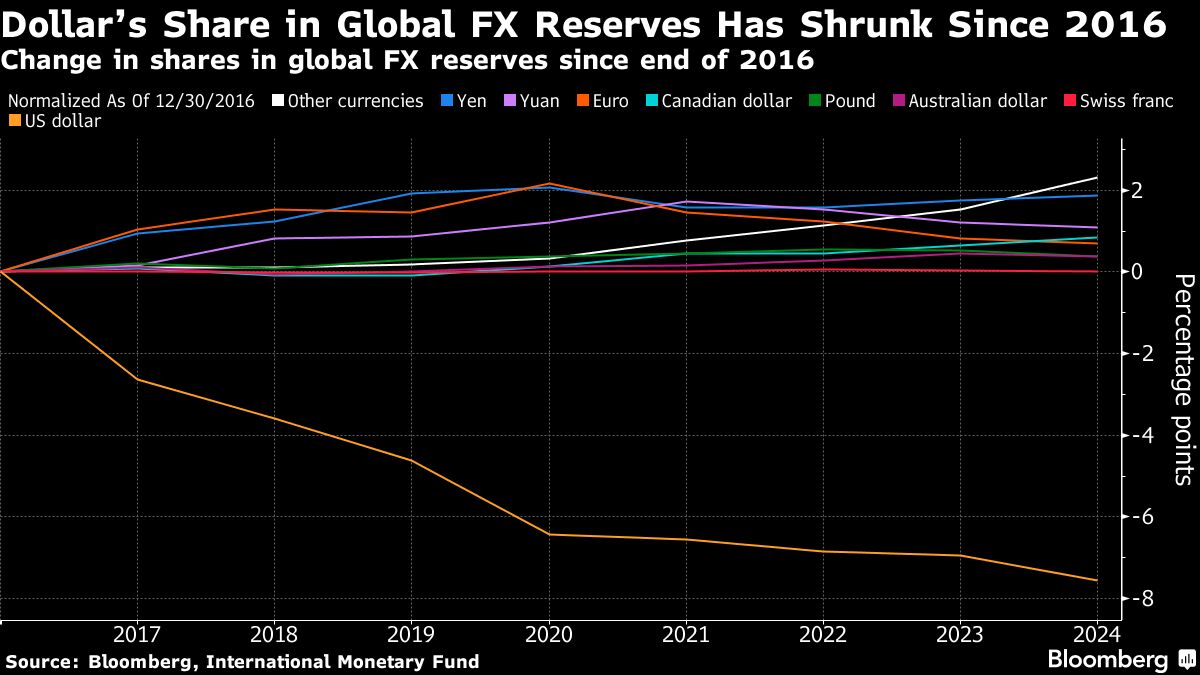
Central banks are accelerating searches for alternatives to the greenback, jolted in part by sanctions on Russia in 2022 that saw Washington seize dollar reserves from Moscow and cut the nation off from the international financial system. Jitters around the greenback are amplified even more now as President Donald Trump's policies threaten to upend global trade and the world's economy. They've been adding to gold reserves as well, underpinning demand for the metal.
Of course, the dollar remains the world's key currency, used for the majority of central bank reserves and for the purchase of commodities like oil, in large part because no significant alternative has emerged. Its central role won't easily be displaced in part because the size of the Treasury market makes it the most liquid in the world, allowing investors to trade large blocks of securities without affecting the price.
However, recent trading across the $7.5 trillion-a-day foreign exchange market underscores cooling demand for the dollar: Bloomberg's greenback gauge has dropped more than 7% since a February peak as US exceptionalism wanes.
The dollar remains around 17% overvalued based on Goldman's metrics, the strategists wrote. That's adding to investor worries as US economic policy uncertainty spikes to levels not seen since the start of the pandemic in 2020.
“We anticipate a rotation to other global assets, of which Asian assets could be a subset,” the strategists wrote.

-
Midterm Rally Lasted A Day. The Hard Reality Of A Divided US May Last Two Years | Opinion

Between a contested AI boom, a debt ceiling that arrives in 2027 and a president with every incentive to act alone, the next two years may prove more volatile than the first day's rally suggests.
-
Blue Wave Will Derail the AI Trade but Won't Dismantle the AI Era | Unhedged Position
The Democrats' sweep of the US Congress will see politics collide with economic forces both over the long and short term.
-
It's Time To Take The GST Council's Bet On Trust Global
Payment records can prove India's services exports, and clear, proportionate rules can bring foreign digital sellers into the tax net.
-
Opinion | India at 38: From Innovation Overperformer to Innovation Powerhouse
India now has 453 VC-backed deep science startups, 18 of them late-stage, after 117 percent growth since 2020. Laurus Labs, at USD 9.3 billion, is the most valuable deep science company in any middle-income economy outside China.
-
Navigating Energy Crossroads: S Jaishankar's Call For Diversified Supply Chains At G20 Ministerial Meeting
As geopolitical fault lines continue to test maritime trade routes and commodity flows, Jaishankar's message remains pertinent: true economic resilience requires open markets, protected transit lines, and a genuine commitment to multilateral cooperation rather than coercion.
-
Indians Are Travelling, But Not Every Journey Is A Holiday | The Week In Whys
Pilgrims, patients and working women are the real travellers, and the system hasn't quite caught up with them.
-
Getting To Work Costs Women More | The Reason Why
It is not just about women paying more than men. It is about women paying much more in cities than in villages.
-
AI Bias In Investing Cannot Be Eliminated, But It Can Be Governed
Framing is a particularly important example as identical financial information presented in terms of gains rather than losses can lead an LLM to reach a different assessment.
-
Joining The Dots | Dark Skies, Steady Diya: Why Hope Holds This Diwali
With war, a weak rupee and foreign outflows weighing on sentiment, policymakers at the NDTV World Summit and market veterans at NDTV Profit Ignite: Diwali Edition offered the same advice: stay invested and filter out the noise.









