Fed’s Deepest Tariff Fear Is A Price Shock That Won’t Fade Away

If President Donald Trump's tariffs jack up US consumer prices — as pretty much everyone thinks they will, at least for a while — then that's already bad news for inflation-fighters at the Federal Reserve. It could also open the door to something even worse.
What businesses and workers anticipate will happen to prices, economists say, can play a key role in determining what actually does happen. That's why Fed officials always keep a close eye on estimates of future inflation — and the latest ones show cause for concern. The benchmark long-run expectations gauge, which had already climbed to a 30-year high since Trump's election, soared higher still on Friday after his sweeping global tariffs.
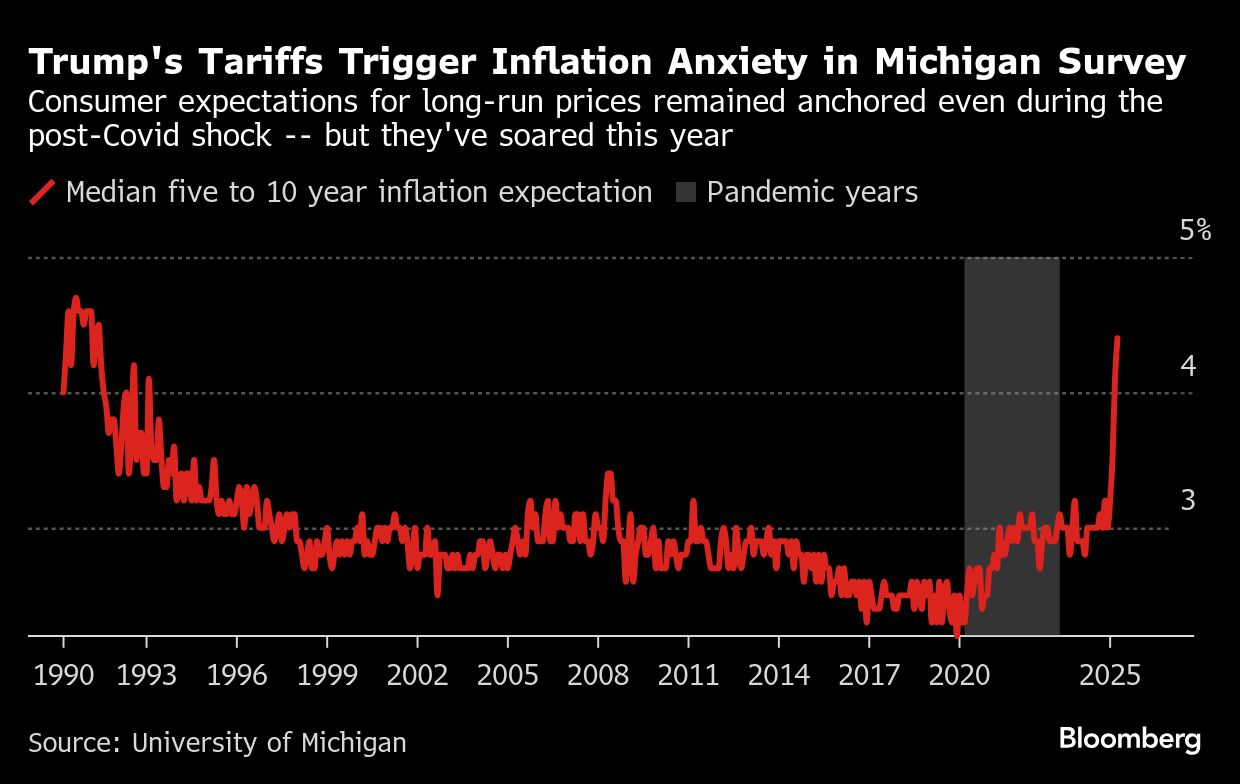
That kind of mindset could help turn a one-time price hit from Trump's trade war into a more persistent inflationary impulse. The risk is all the greater because it's surfacing at a time when American households are still shaken by the post-pandemic price spike – and may not trust the Fed to head off another one.
Consumer and business estimates of future inflation open a window into the public's faith in central banks and their ability to tame prices. When that's eroded, especially over the longer run, monetary theory suggests that policy becomes less efficient. In concrete terms, interest rates have to go higher than they'd otherwise need to, until trust is regained.
‘We Have a Problem'
A sharp rise in long-term expectations would signal a loss of faith in the Fed's ability to bring inflation back to 2%. “That would worry me,” says Jeffrey Fuhrer, a former director of research at the Boston Fed who's now with the Brookings Institution.
To be sure, that's not what most surveys are pointing to. But even without an erosion of trust on that scale, a trade war could make the Fed's job harder, Fuhrer says. If consumers face tariff-led price hikes well above 3% over the next year, they may decide that's the new normal, and build it into their everyday calculations. Workers would demand higher wages while firms adapt their pricing plans. “Then we have a problem,” he says. “And we don't need that problem right now.”
The key measures of US inflation as of March stood around 2.5%, far below their 2022 peaks but still stubbornly above-target. Most economists expect a pickup in the coming months, as tariffs make imported goods more expensive.
Consumers in the latest University of Michigan survey are expressing the same concern. They see prices rising 6.7% in the coming year, and at an annual rate of 4.4% over a 5 to 10-year horizon — multi-decade highs in both cases. While some economists question Michigan's methodology, the Conference Board's year-ahead gauge also surged since December.
Other data sets, though, paint a less alarming picture. Market measures such as five- and ten-year breakevens based on Treasury bonds are hovering around the Fed's 2% goal. The latest New York Fed Survey of Consumer Expectations, for February, showed three- and five-year inflation estimates unaffected by trade-war fallout at around 3%. The March survey is due out on Monday.
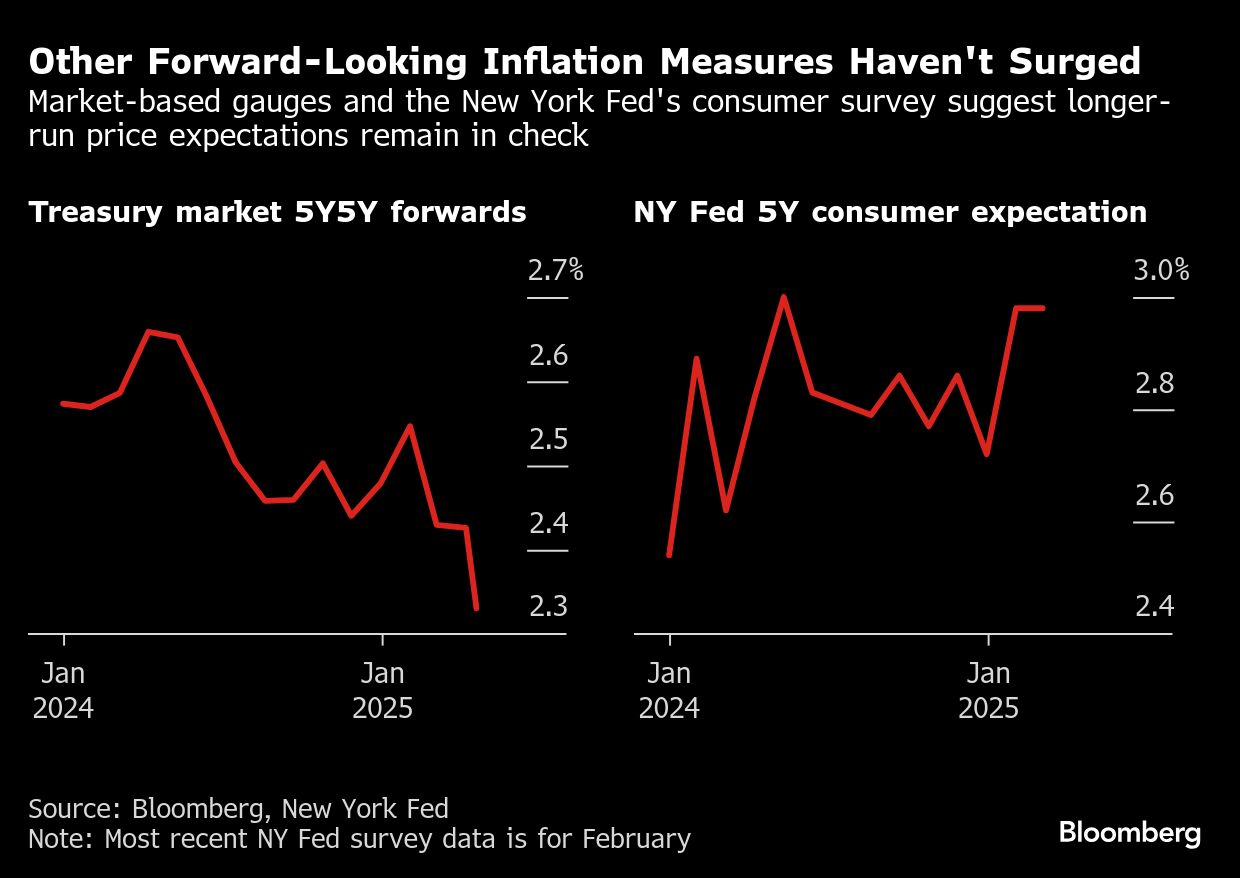
That's prompted Fed Chair Jerome Powell to say the Michigan results are an “outlier.” Still, Powell and his colleagues are watching inflation expectations closely, as they try to map a path through the trade war.
“One of the very important assets that the Federal Reserve has is its credibility, and that is manifested in anchored longer-term inflation expectations,” Boston Fed President Susan Collins told Yahoo Finance on Friday. She also said the tariff impact will likely be “more broad-based than many people realize.”
Fed officials had already revised growth estimates down, and inflation up, before Trump's tariff announcements this month. Since then a number of them have warned that consumer prices could rise around 4% this year. It's given policymakers reasons to refrain from rate cuts — even as fears of a slowdown mount — and instead hold borrowing costs steady.
‘Deeply Wounded'
Until the last few years, US inflation had been stable enough for long enough — essentially since the early 1990s — to keep future expectations in check. The price shock that followed the pandemic and the war in Ukraine has changed the picture. It's turned inflation into front-page news, and that's feeding through into the forward-looking gauges.
American consumers “have yet to really recover,” says Joseph Brusuelas, chief economist at RSM US LLP. They're responding to inflation surveys “in such a way that speaks to their current mindset — which is, they remain deeply wounded.”
Of course, there's no automatic link from expected to actual price rises. That's especially true in the US, where built-in inflation indexing for labor contracts or rents is less common than in many other countries. Some economists have questioned whether price expectations really contain much useful information.
Still, the consensus is that they do – and that's based on research that stretches across history and around the world.
Michael Weber, a professor at the University of Chicago, has studied the fallout from Germany's hyperinflation after World War I. Even though a century has passed, he found that people in towns with higher inflation back then are still prone to have higher expectations for prices today — and their local politicians are more likely to talk about it.
For central bankers, too, past experience with inflation can shape their approach. Lately, some of the Fed officials who've more publicly voiced concern over the expectation surveys are those with an international background, or links to high-inflation countries in Latin America. “Even if you are a central banker, the weight you put on inflation depends on your upbringing, where you're from,” Weber says.
All the accumulated experience from countries that are more accustomed to inflation shocks holds some valuable lessons for Powell and peers, according to Ricardo Reis of the London School of Economics. Among them: Look at a wide range of measures, grasp that above-target expectations can result in lasting shocks, and take swift action when needed.
Reis says the pandemic price spike has been a useful reminder to developed-world central banks of the importance of inflation expectations as a mirror of their own credibility.
“Ignoring them, talking about transitory things, pretending the problem is not there, is not what you should do,” he says.

-
Midterm Rally Lasted A Day. The Hard Reality Of A Divided US May Last Two Years | Opinion

Between a contested AI boom, a debt ceiling that arrives in 2027 and a president with every incentive to act alone, the next two years may prove more volatile than the first day's rally suggests.
-
Blue Wave Will Derail the AI Trade but Won't Dismantle the AI Era | Unhedged Position
The Democrats' sweep of the US Congress will see politics collide with economic forces both over the long and short term.
-
It's Time To Take The GST Council's Bet On Trust Global
Payment records can prove India's services exports, and clear, proportionate rules can bring foreign digital sellers into the tax net.
-
Opinion | India at 38: From Innovation Overperformer to Innovation Powerhouse
India now has 453 VC-backed deep science startups, 18 of them late-stage, after 117 percent growth since 2020. Laurus Labs, at USD 9.3 billion, is the most valuable deep science company in any middle-income economy outside China.
-
Navigating Energy Crossroads: S Jaishankar's Call For Diversified Supply Chains At G20 Ministerial Meeting
As geopolitical fault lines continue to test maritime trade routes and commodity flows, Jaishankar's message remains pertinent: true economic resilience requires open markets, protected transit lines, and a genuine commitment to multilateral cooperation rather than coercion.
-
Indians Are Travelling, But Not Every Journey Is A Holiday | The Week In Whys
Pilgrims, patients and working women are the real travellers, and the system hasn't quite caught up with them.
-
Getting To Work Costs Women More | The Reason Why
It is not just about women paying more than men. It is about women paying much more in cities than in villages.
-
AI Bias In Investing Cannot Be Eliminated, But It Can Be Governed
Framing is a particularly important example as identical financial information presented in terms of gains rather than losses can lead an LLM to reach a different assessment.
-
Joining The Dots | Dark Skies, Steady Diya: Why Hope Holds This Diwali
With war, a weak rupee and foreign outflows weighing on sentiment, policymakers at the NDTV World Summit and market veterans at NDTV Profit Ignite: Diwali Edition offered the same advice: stay invested and filter out the noise.









