Diverging US Economic Data Begs The Question: Is A Slowdown Coming?

US economic data are diverging wildly, fueling a debate over whether rising anxiety from President Donald Trump's trade policies will push a moderating economy into a serious downturn.
Surveys of sentiment among households and businesses, known as “soft data,” are warning of a marked slowdown ahead as Trump pushes forward with tariffs and steep cuts to federal spending. But “hard data” from government statistics, like employment and manufacturing, suggest those fears — potentially including stagflation or even recession — are overblown.
The mixed signals are causing jitters across Washington and Wall Street on what lies ahead for the world's largest economy — which, in a matter of weeks, has shifted from global outperformer to the top source of uncertainty. Federal Reserve officials lowered their forecast for annual growth this week by the most since 2022, while the OECD says US trade policy will slow economic activity around the world.
Much of the anxiety can be traced to surveys of consumer attitudes from the University of Michigan and The Conference Board, which have both cited concerns that tariffs will lead to higher prices. Executives from Nike Inc. to Delta Air Lines Inc. have noted the trend, contributing to a multi-trillion dollar wipeout in stocks in the past month.
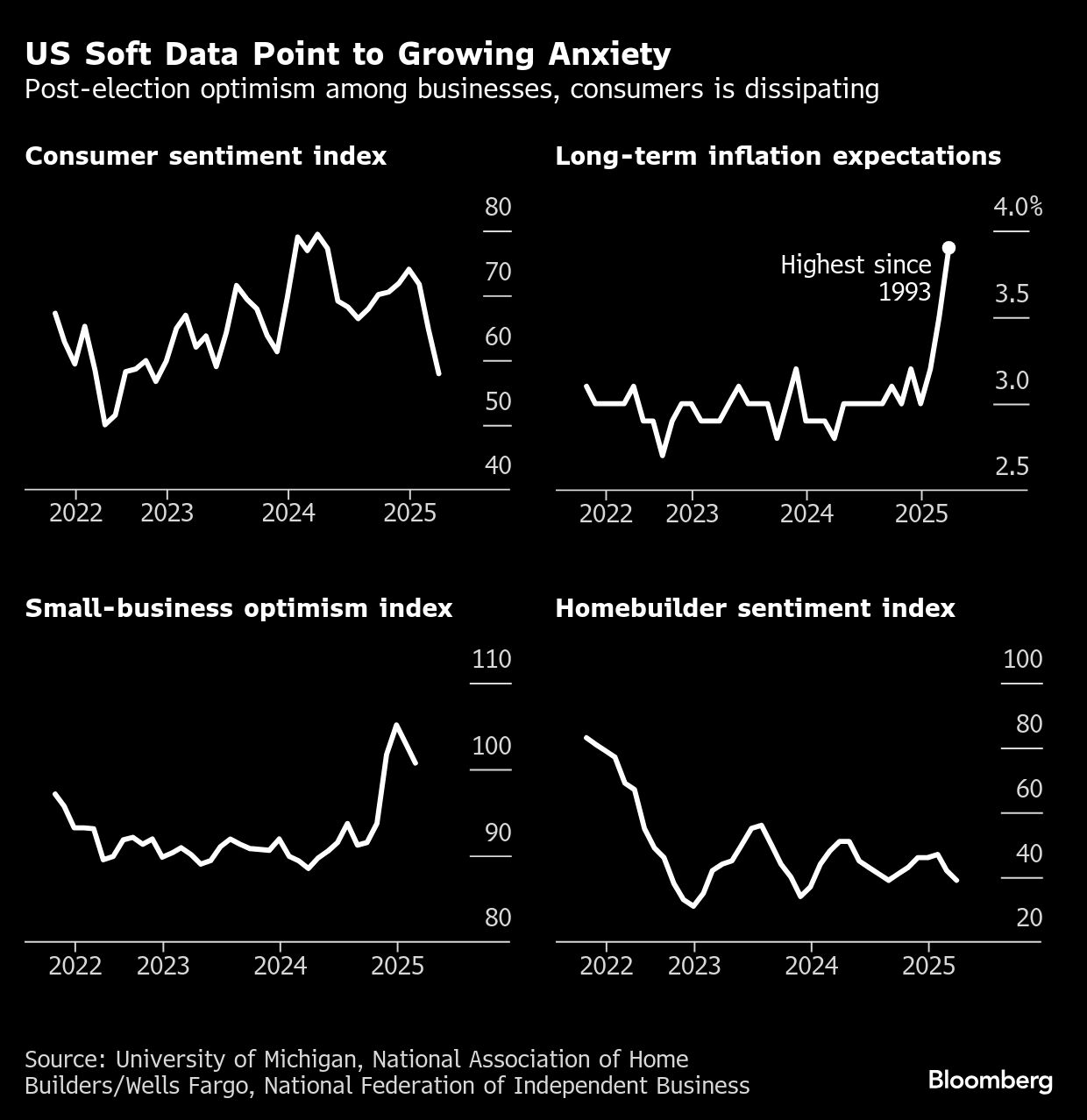
“You don't want to take it as the end-all, be-all of what's going on in the economy,” said Andrew Hollenhorst, chief US economist at Citigroup Inc. “On the other hand, you need to look at these surveys because if you just look at the hard data, you're looking at what happened a month ago, sometimes even two months. Surveys are telling you what people are thinking about the future.”
Consumers' expectations of their finances dropped to a record low in the Michigan survey in early March, and respondents saw prices rising in the next five to 10 years at the fastest pace in three decades.
Fed Chair Jerome Powell on Wednesday sought to tamp down worries over those inflation expectations, repeatedly referring to the figure as an outlier. He also said the relationship between soft and hard data “hasn't been very tight,” and it makes sense for policymakers to hold interest rates steady until they have a better sense of Trump's policies.
There was an initial surge of optimism in surveys of consumers, as well as small businesses and homebuilders, following Trump's election win on expectations he'd prioritize initiatives like tax cuts and deregulation. But the focus on tariffs, as well as a surge in prices of basic staples like eggs and the stock-market rout, is taking a toll on sentiment and inciting growth concerns.
The Trump administration so far has done little to ease those fears, as the president and his advisers now say it could take months or longer for a promised “golden age” to arrive. And with more tariffs to come on April 2, economists are bracing for another hit to sentiment.
“What we and the market got wrong this year was the sequencing and pain threshold for Trump,” said Stephanie Roth, chief economist at Wolfe Research. Business-friendly policies “were expected to boost growth before tariff policy took hold. Tariffs are also much bigger than we thought.”
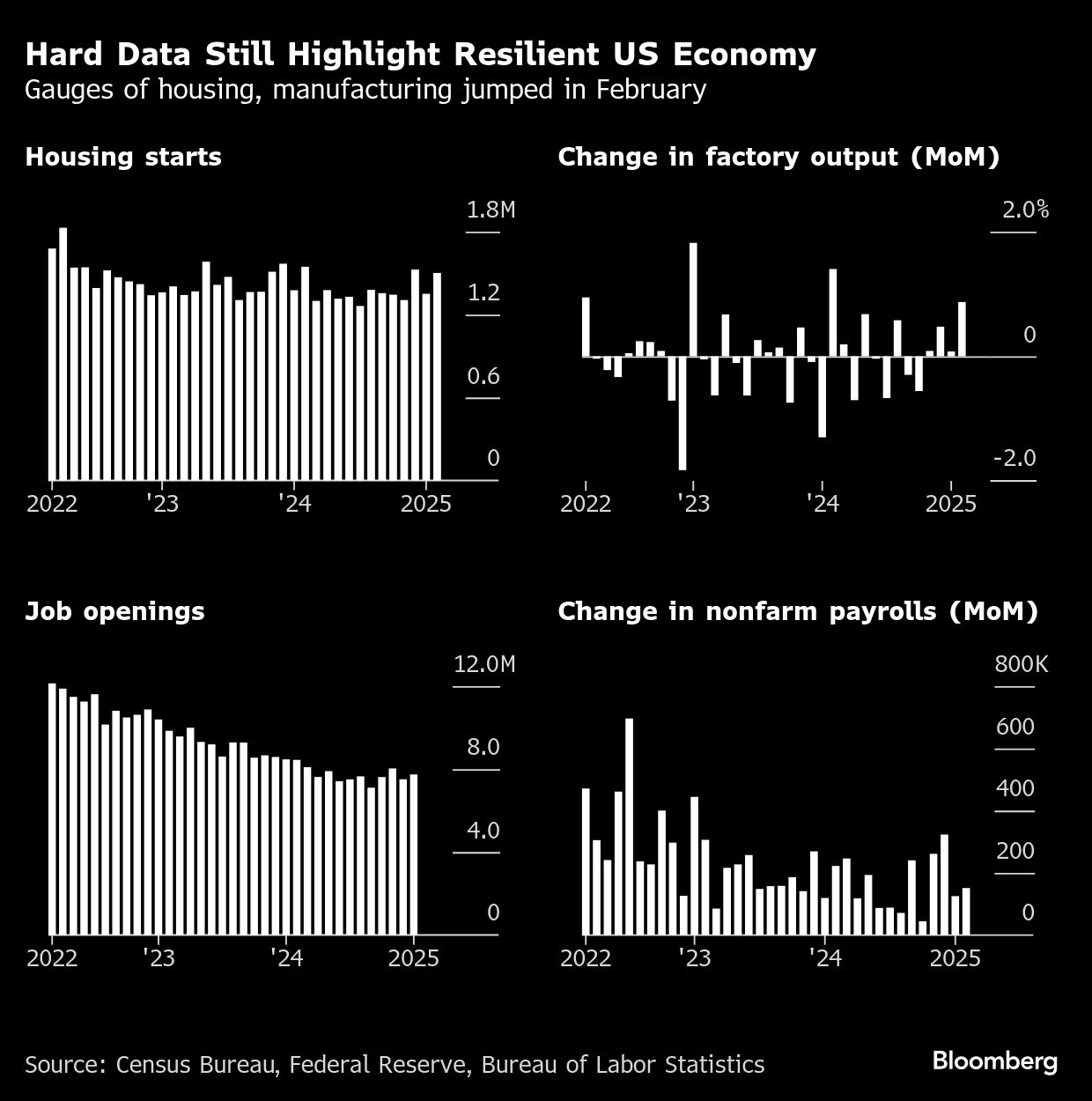
Then there's the hard data, which indicates the economy is cooling off but hardly dropping off. Job gains moderated in February and unemployment ticked up, but both still point to a solid labor market. Inflation eased in February, notching the slowest pace of price growth in four months.
Other data have also been positive, but not without caveats. US factory output came in higher than expected in February, which economists largely said was indicative of manufacturers ramping up production to get ahead of tariffs. And while new home construction picked up last month, it was seen as a rebound from January's bad weather.
The trend in consumer spending has been the most discouraging, judging by retail sales data and inflation-adjusted figures from the Commerce Department. But taken together, Powell still says the economy is solid.
“It is the soft data, the surveys, that are showing significant concerns,” Powell said Wednesday after the central bank's policy meeting. “If that's going to affect the hard data, we should know it very quickly. And of course we will understand that. But you don't see that yet.”
The uncertainty is gripping Wall Street and Main Street alike. Alicia Barker, whose Arizona-based company designs and manufactures components used to build custom closets and garage cabinet organizers, is hamstrung by rapidly changing trade policy.
“Our industry is already experiencing rising material costs, and these tariffs will only compound the challenge,” said Barker, president of Organizers Direct Industries. “The lack of clarity makes it challenging to determine the right strategic path forward.”

-
Unhedged Position: Can India See An Indonesia-Style Time Correction?

The Nifty is trading below levels it first clocked in 2024. Is there, then, as I have suggested in the headline, potential that the current time correction drags on painfully for the next three-five, even ten years?
-
Navigating Friction And Energy Realities: An Analysis Of Marco Rubio's October Visit To India
Occurring at a critical juncture marked by stalled trade negotiations and escalating geopolitical pressures over global energy supplies, the visit offers a profound window into modern US-India relations.
-
India Exports Capital. Why Not Export Trusteeship?
The big question, then, is whether India can build an institution that global borrowers, investors, banks, and lawyers can trust, even without an Indian connection.
-
France's Economy & Politics Are In Crisis | The Reason Why
Let's look at how the French economy and politics evolved under Nicolas Sarkozy, Franois Hollande and Emmanuel Macron.
-
You May Inherit The Business. You Must Earn Its Credibility.
Succession tests the founder's ability to share authority as much as it tests the next generation's readiness to assume it.
-
Signing Deals Is One Thing; Making Them Work Is Another | The Week In Whys
Sometimes, things don't turn out as planned. Indian companies have lost some bids to rivals, some projects won't produce until 2030.
-
FOMC Wall, PERM Suspension, Hospital Stocks | Talking Points This Week
A PERM suspension would directly affect green-card sponsorship rather than H-1B visas, so the near-term earnings impact could remain relatively limited. The key question is whether this marks a new phase in US scrutiny of Indian IT.
-
Everything, Everywhere, All At Once: Dalal Street's Week To Forget | Joining The Dots
Visa curbs, a Starlink spat and cancer drug caps: what connects this week's shocks for Indian markets
-
India Is Going Abroad For Critical Minerals. But It May Take Years To Pay Off | The Reason Why
Although India's steps are in the right direction, they remain modest compared with India's growing dependence.
-
When Everyone Has AI, What Gives You An Edge?
India's young workforce is entering an uncertain world of work where powerful AI tools are becoming widely accessible. The advantage will belong to those who combine deep expertise with digital fluency, and the distinctly human capabilities that technology cannot manufacture.