Cost-of-Living Crisis Is Top Immediate Risk For Davos Elite
(Bloomberg) -- The threat of recession, the cost-of-living crisis and mounting debt distress will dominate the global economy in the next two years as it struggles to move on from the pandemic and war in Ukraine, according to a survey by the World Economic Forum.
Its Global Risks Report, an annual poll of 1,200 government, business and civil society professionals compiled by the Geneva-based foundation, suggests there will be little respite as countries grapple with “energy, inflation, food and security crises.”
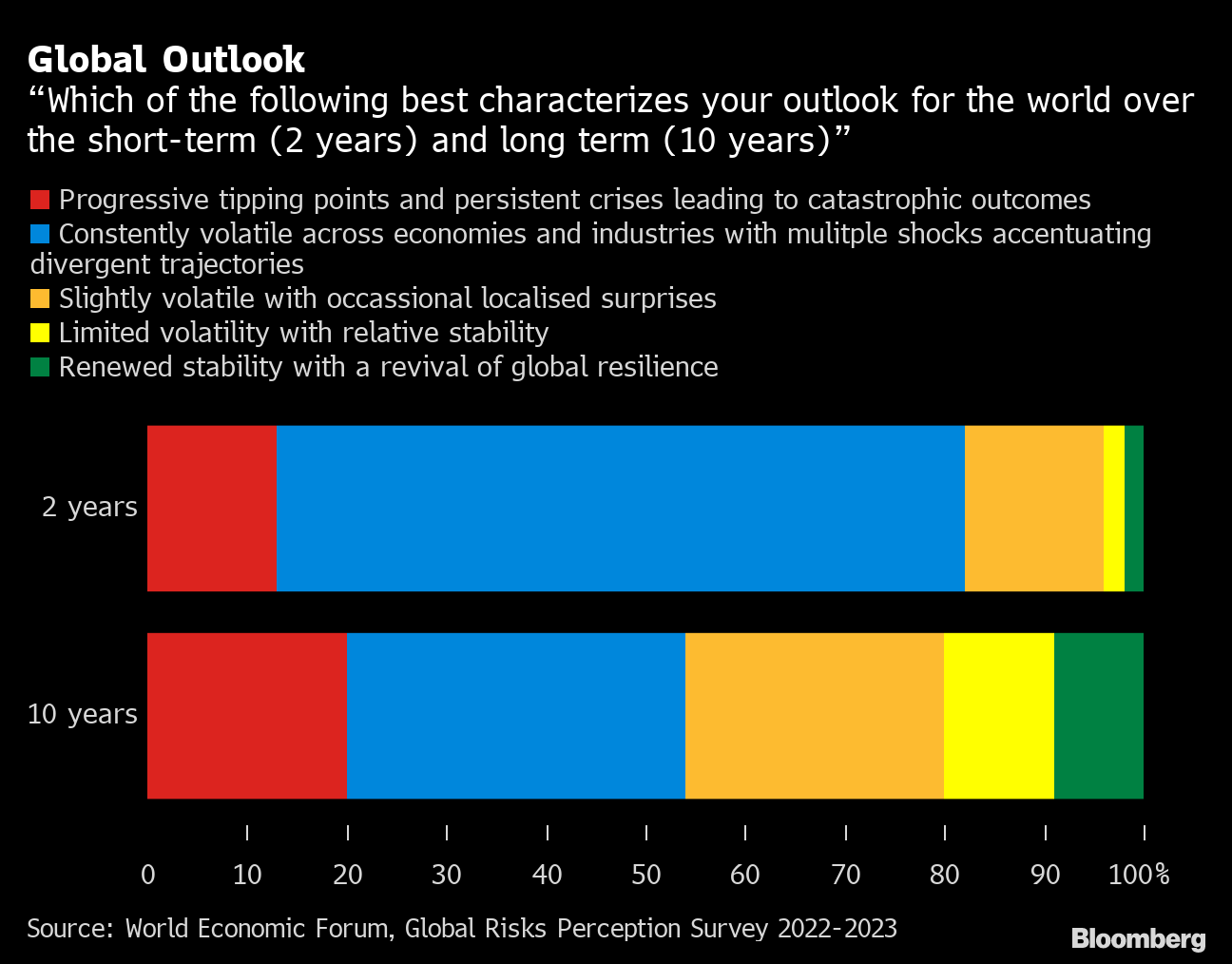
Almost seven in 10 respondents reckon the near term will be characterized by volatile economies and multiple shocks, while a fifth of them fear “catastrophic outcomes” within a decade.
The most immediate risk is the cost-of-living crisis, while the biggest long-term threats remain climate-related, the survey found. Saadia Zahidi, WEF managing director, is concerned that the world might be entering a “vicious cycle.”
“Very few leaders in today's generation have been through these kind of traditional risks around food and energy, while at the same time battling what's coming up in terms of debt, what's coming up in terms of climate,” she told Francine Lacqua on Bloomberg Television. “We're going to need a sort of new type of leadership that is much more agile.”
Next week, the WEF holds its annual meetings in Davos, Switzerland, where the business, political and academic elite will share insights and start framing plans for the year ahead.
The gathering begins at a time when inflation is at a four-decade-high across many advanced economies, with interest rates far more elevated than anyone was predicting 12 months ago.
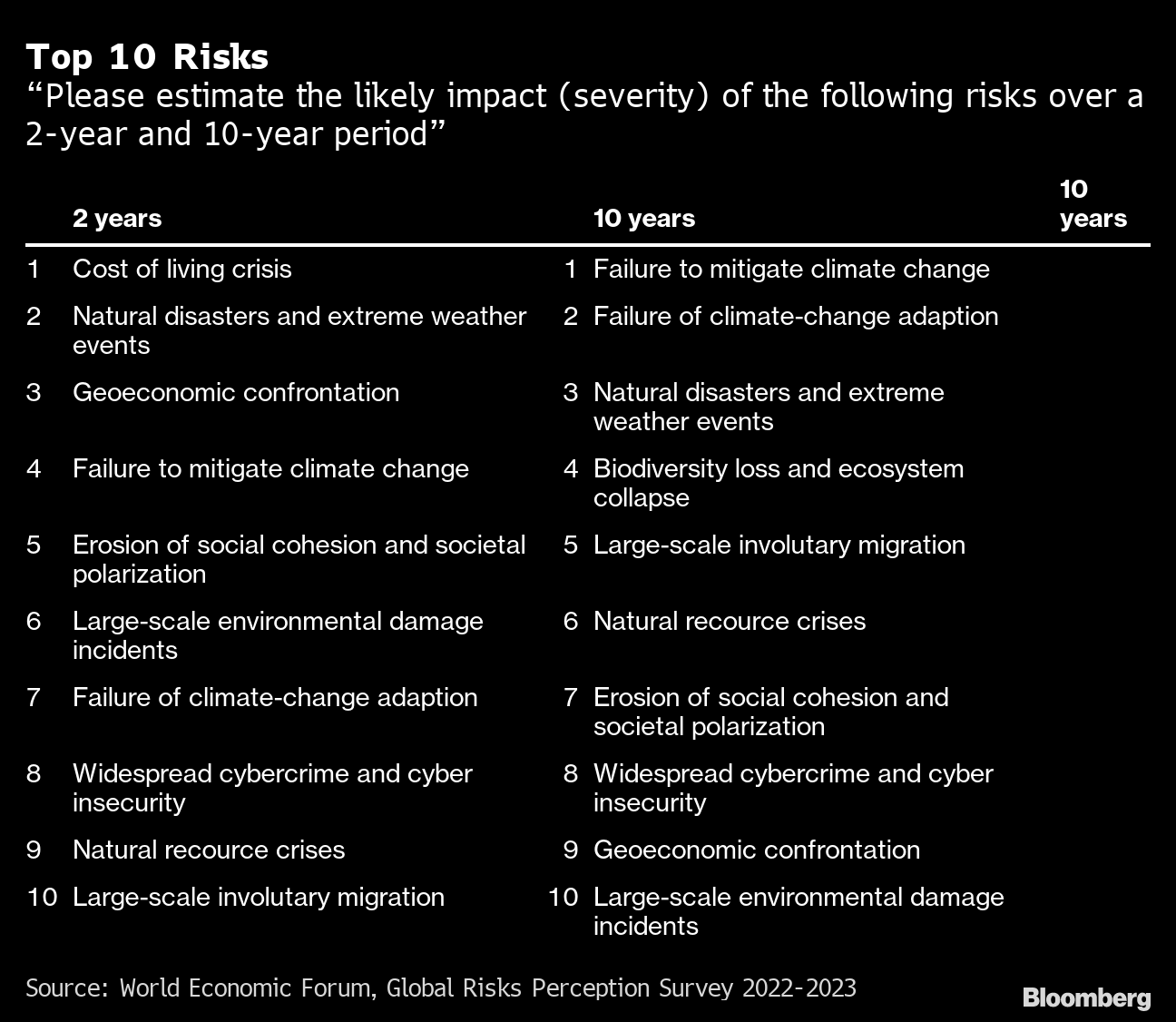
The report calls for global cooperation, and warns that if governments mishandle the current crisis they “risk creating societal distress at an unprecedented level, as investments in health, education and economic development disappear, further eroding social cohesion.”
Increases in military expenditure could reduce support for vulnerable households, leaving some countries in a “perpetual state of crisis” and set back the urgent need to tackle climate change and biodiversity loss.
In the worst case, “geoeconomic warfare” could turn into remilitarization. Geopolitical rivalries are likely to heighten economic constraints and exacerbate both short-and long-term risks, the report found. Countries must work together, it said.
“In this already toxic mix of known and rising global risks, a new shock event, from a new military conflict to a new virus, could become unmanageable,” said Zahidi. “Climate and human development therefore must be at the core of concerns of global leaders to boost resilience against future shocks.”
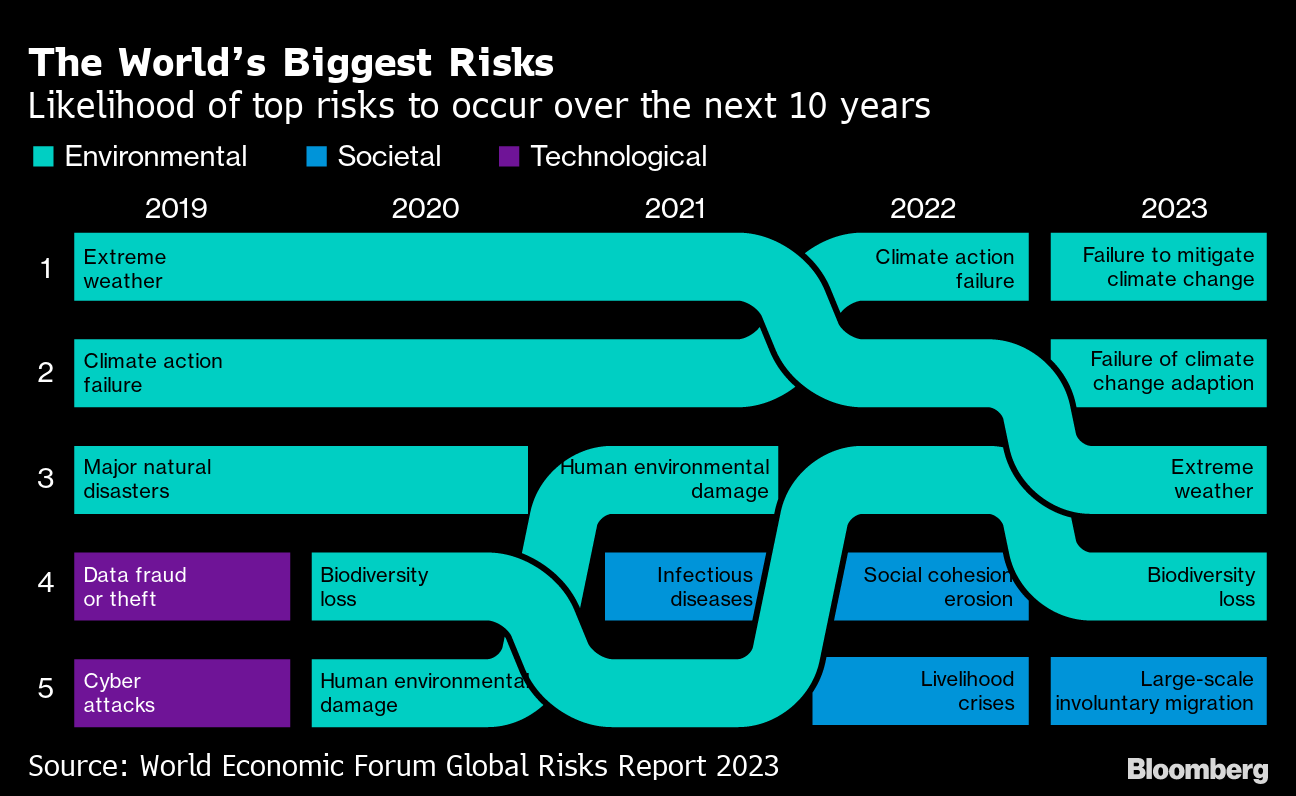
Environmental issues have dominated the longer-term risks over the past years, taking the top three spots in every report over the last half decade.
The report also warned that the world could face a period of “polycrisis,” where the interaction of a cluster of risks causes compounding future problems. One such threat might stem from “resource rivalry” as countries compete for natural resources including food, water and energy.
--With assistance from .
(Updated with longer-term risks in 12th paragraph)
More stories like this are available on bloomberg.com
©2023 Bloomberg L.P.

-
Blue Wave Will Derail the AI Trade but Won't Dismantle the AI Era | Unhedged Position

The Democrats' sweep of the US Congress will see politics collide with economic forces both over the long and short term.
-
It's Time To Take The GST Council's Bet On Trust Global
Payment records can prove India's services exports, and clear, proportionate rules can bring foreign digital sellers into the tax net.
-
Opinion | India at 38: From Innovation Overperformer to Innovation Powerhouse
India now has 453 VC-backed deep science startups, 18 of them late-stage, after 117 percent growth since 2020. Laurus Labs, at USD 9.3 billion, is the most valuable deep science company in any middle-income economy outside China.
-
Navigating Energy Crossroads: S Jaishankar's Call For Diversified Supply Chains At G20 Ministerial Meeting
As geopolitical fault lines continue to test maritime trade routes and commodity flows, Jaishankar's message remains pertinent: true economic resilience requires open markets, protected transit lines, and a genuine commitment to multilateral cooperation rather than coercion.
-
Indians Are Travelling, But Not Every Journey Is A Holiday | The Week In Whys
Pilgrims, patients and working women are the real travellers, and the system hasn't quite caught up with them.
-
Getting To Work Costs Women More | The Reason Why
It is not just about women paying more than men. It is about women paying much more in cities than in villages.
-
AI Bias In Investing Cannot Be Eliminated, But It Can Be Governed
Framing is a particularly important example as identical financial information presented in terms of gains rather than losses can lead an LLM to reach a different assessment.
-
Joining The Dots | Dark Skies, Steady Diya: Why Hope Holds This Diwali
With war, a weak rupee and foreign outflows weighing on sentiment, policymakers at the NDTV World Summit and market veterans at NDTV Profit Ignite: Diwali Edition offered the same advice: stay invested and filter out the noise.
-
The Curious Case of Equitas Small Finance Bank And A CEO Who Quit For Stock
PN Vasudevan believes persistent investor concerns over a perceived conflict of interest had become a governance overhang on Equitas Small Finance Bank's stock, even as the lender improved profitability and asset quality.










