Asia Bears Brunt Of Trump Tariffs, Needs To Ease, Economists Say

Asia is bearing the brunt of new US tariffs which will drag on regional growth through weaker business investment and sentiment, requiring central banks to step in with more interest-rate cuts, economists reckon.
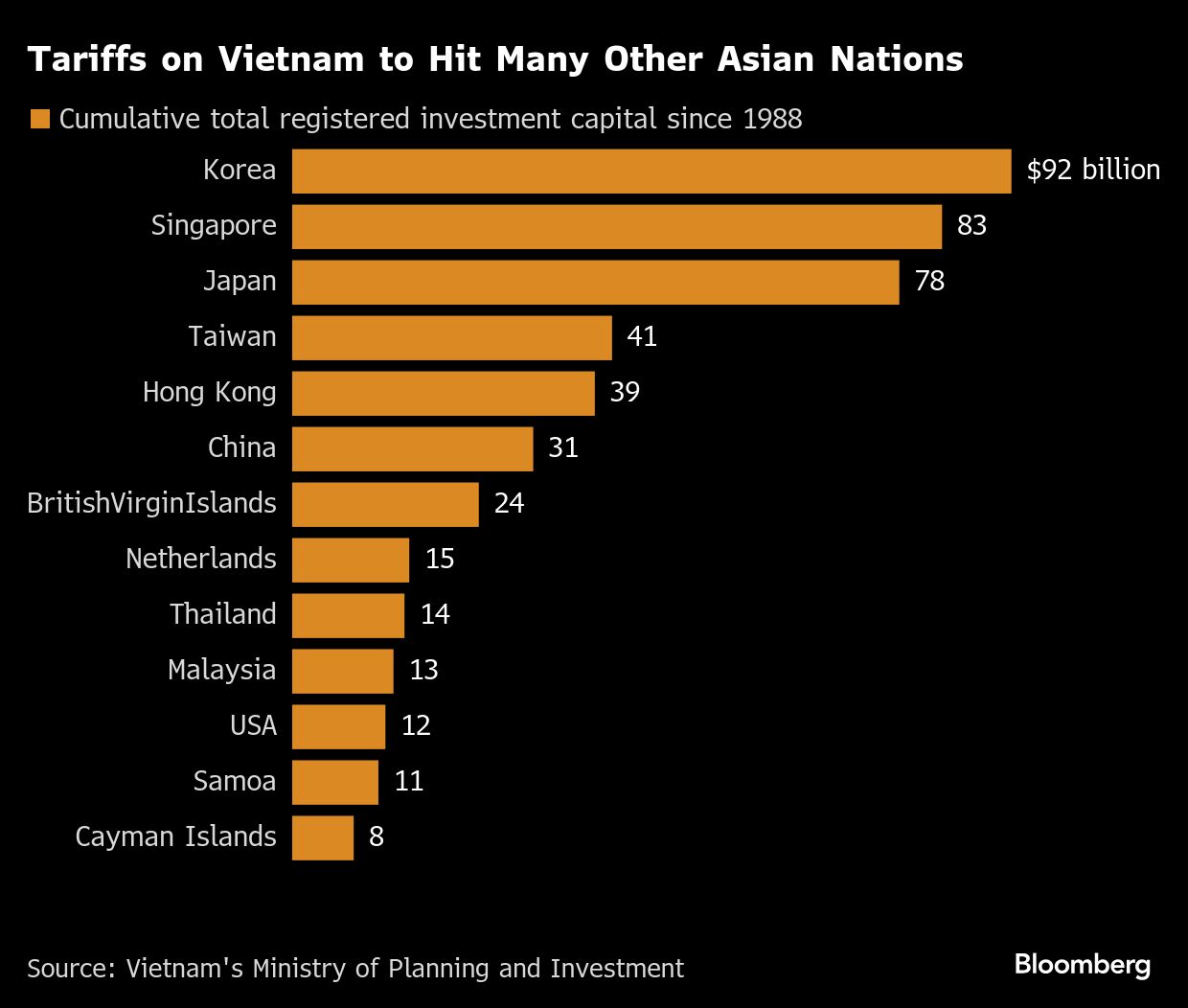
“The impact on ASEAN is more pronounced this time,” said Selena Ling, head of research at Oversea-Chinese Banking Corp. “Given a narrower tariff gap between China and previous popular destinations such as Vietnam and Thailand, China's prior strategy of routing exports through ASEAN may now be less effective. As a result, the trade dynamic may shift again.”
The Trump administration's tariffs come at a time when Asian economies are already grappling with tepid growth, with sticky inflation keeping some central banks on high alert. While Australia and New Zealand are among countries that got off relatively lightly with a 10% levy, as small, open economies they are particularly reliant on global trade to underpin prosperity.
Money markets are now pricing four more rate cuts this year by Australia's central bank, up from three previously, which would take its cash rate to 3.1%.
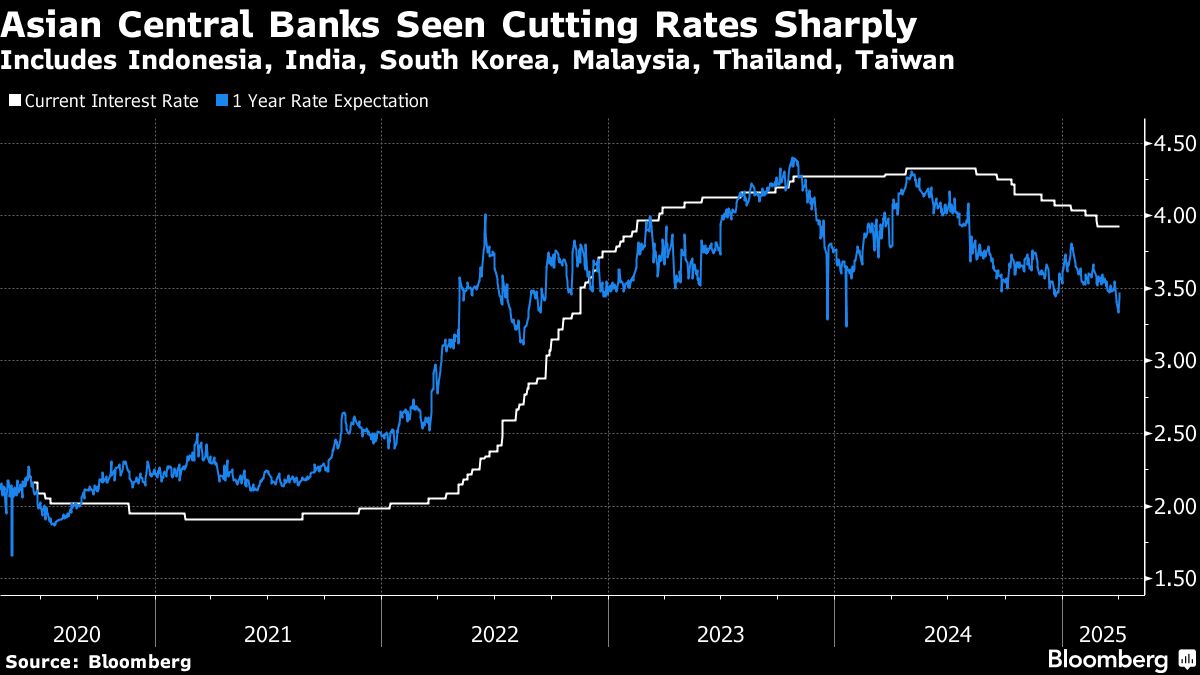
Economists at Goldman Sachs Group Inc. have cut growth forecasts for Asia and predict an easier monetary policy stance in India, South Korea and several Southeast Asian economies including Indonesia and Malaysia.
There will be a “hard-hitting impact” on economic growth for the region, OCBC's Ling said, singling out Vietnam as the country set to see the biggest impact, followed by Thailand. She anticipates Indonesia and India will be “more insulated” and the Philippines the least impacted. Ling also revised her central bank forecasts, adding 50-basis points of cuts each for the five countries.
New Zealand's central bank is expected to deliver a quarter-point cut on Wednesday, taking its official cash rate to 3.5%. Economists at Westpac Banking Corp. say the US tariffs are a reason for policymakers in Wellington to retain an easing bias.
“We don't think this means they will step up to a 50 basis-point cut — the 25 basis point cut will likely remain the preferred option,” Westpac said. “Global developments will continue to be a key risk factor, and uncertainty, that will drive their actions over the balance of the year.”
On the same day as New Zealand's policy decision, India's central bank is also predicted to cut its repurchase rate. On Thursday, Philippine monetary authorities will likely seize on February's softer inflation reading to resume their easing cycle.
One country where the scope for rate cuts could increase is Thailand, given headline CPI is forecast to slip into negative territory in the second quarter, according to ING Groep NV.
Morgan Stanley's Chief Asia Economist Chetan Ahya sees the potential for 50-100 basis points of additional rate cuts in Asia relative to his current base case, though he worries about the capacity for fiscal policy to buttress monetary easing.
“The magnitude of easing in Asia may be more moderate in this cycle given more limited fiscal space this time around on account of higher public debt to GDP ratios,” Ahya said. “We therefore expect more monetary easing than fiscal easing to come.”

-
Talking Points This Week: Tech Nerves, FII Buying, And A Faraway Banking Shock

The global markets are not shining this Diwali. The exception in the large markets is, India.
-
Midterm Rally Lasted A Day. The Hard Reality Of A Divided US May Last Two Years | Opinion
Between a contested AI boom, a debt ceiling that arrives in 2027 and a president with every incentive to act alone, the next two years may prove more volatile than the first day's rally suggests.
-
Blue Wave Will Derail the AI Trade but Won't Dismantle the AI Era | Unhedged Position
The Democrats' sweep of the US Congress will see politics collide with economic forces both over the long and short term.
-
It's Time To Take The GST Council's Bet On Trust Global
Payment records can prove India's services exports, and clear, proportionate rules can bring foreign digital sellers into the tax net.
-
Opinion | India at 38: From Innovation Overperformer to Innovation Powerhouse
India now has 453 VC-backed deep science startups, 18 of them late-stage, after 117 percent growth since 2020. Laurus Labs, at USD 9.3 billion, is the most valuable deep science company in any middle-income economy outside China.
-
Navigating Energy Crossroads: S Jaishankar's Call For Diversified Supply Chains At G20 Ministerial Meeting
As geopolitical fault lines continue to test maritime trade routes and commodity flows, Jaishankar's message remains pertinent: true economic resilience requires open markets, protected transit lines, and a genuine commitment to multilateral cooperation rather than coercion.
-
Indians Are Travelling, But Not Every Journey Is A Holiday | The Week In Whys
Pilgrims, patients and working women are the real travellers, and the system hasn't quite caught up with them.
-
Getting To Work Costs Women More | The Reason Why
It is not just about women paying more than men. It is about women paying much more in cities than in villages.
-
AI Bias In Investing Cannot Be Eliminated, But It Can Be Governed
Framing is a particularly important example as identical financial information presented in terms of gains rather than losses can lead an LLM to reach a different assessment.









