Nirmala Sitharaman Says WTO Could Be More 'Progressive'

Finance Minister Nirmala Sitharaman has said that the World Trade Organisation could be more "progressive" and fair to all members and should "not just hear but heed" to the voices of countries that have something different to say.
The moratorium on electronic transmissions has continued since 1998 despite the evolution into the digital age, Sitharaman said in Washington ahead of the IMF-World Bank annual spring meet. "Shouldn't there be a change in WTO policy in terms of a moratorium? ... We don't have to reverse the benefits of globalisation but make it more transparent."
The WTO members have agreed not to impose customs duties on electronic transmissions, according to the 1998 moratorium. However, Sitharaman said this has a different impact on different countries and that there is a need to review it.
The finance minister was talking to American economist Adam Posen at the Peterson Institute for International Economics ahead of the annual IMF-World Bank meetings. The Minister will also be attending the second G20 finance ministers and central bankers meetings.
Sitharaman referred to U.S. Commerce Secretary Katherine Tai's remarks on the extent of liberalisation and tariff reduction and the impact they have on a country's own market.
In India, she said, "We have already extended to all the least developed countries a quota-free, tariff-free trading policy. Countries in Africa, the Pacific Islands, and aspirational low-income countries can export to India without restrictions."
More Substantive Discussion On IPEF
Sitharaman also expressed that there needs to be more substantive discussion on all three pillars of the Indo-Pacific Economic Forum, championed by the current United States administration.
"There has to be greater involvement of all those who have subscribed to it to sit and talk about it. The sooner we see tangible results, the greater the benefit for all of us, especially when the global churn is happening on trade," the minister said.
India is part of three of the four pillars of the IPEF pertaining to supply chains, a clean economy, and a fair economy. India opted out of the fourth pillar on trade.
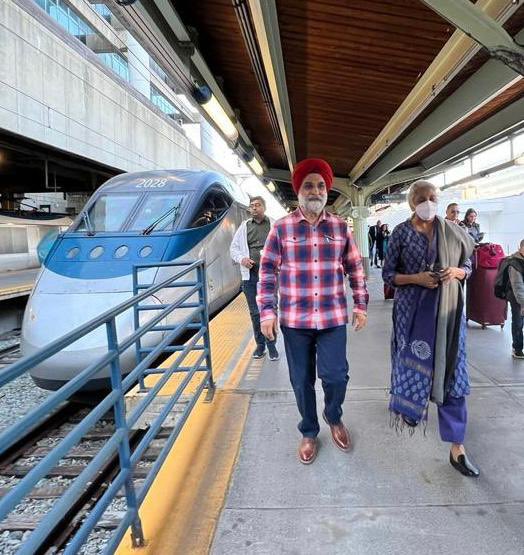
Sitharaman arrived in Washington DC's Union Station on April 10th, 2023 ahead of bilateral meetings and discussions before the IMF-World Bank and G20 meeting scheduled for April 12-13th. She was received by Taranjit Singh Sandhu, India's Ambassador to US.
India's Stance On China+1 Strategy
Moving out of China may not be realistically possible, the Indian finance minister said in response to a question on whether reducing reliance on China would be enough to sustain the shift in global value chains and the IPEF agenda.
"However much we would think that supply chains will have to be moved out of China, it may not be the case. China and others could be the possible, realistic solution. So even as China is opening up again, I would still think that there would be a lot of investment and manufacturing interest going back to China or restoring themselves in China," she said.
(It is) unrealistic to think everything is going to get out of China. But yet, the shock that had happened in terms of disruptions in the supply chain, justifies more than one location. And countries like India would be the best in terms of skillsets, particularly because of the youth we have. 15-29 years of age constitute 27% of our population...Nirmala Sitharaman, India's Finance and Corporate Affairs Minister
While India is among other countries like Vietnam and Indonesia that are also pitching themselves as an alternate supply market, called the 'China+1' strategy by economists, India's young, skilled population offers a reason to invest in India and make use of the captive market in the country, Sitharaman said.
"It sends a strong message that the world didn't notice earlier or didn't want to choose earlier … spreading your resource basket or supply chain is a far more prudent way of continuing in business, however much the cost complications make it difficult in other places, and the cost-benefit makes it possible to concentrate in one jurisdiction," she said.
The impact of this growing concern on globalisation and the extent of it can also be seen in India's finalised free trade agreements. India recently signed FTAs with Australia, the UAE, and Mauritius.
"We shall proceed along that route (FTA) also with the United Kingdom, the European Union, and Canada," Sitharaman said. "All three are happening as we speak; the negotiations are going on."
Carbon Border Adjustments
India's finance minister also spoke on the emerging carbon border adjustment mechanism by the U.S. and Europe. She anticipates that any non-green steel export from India will be burdened with higher taxes in some countries, but money won't flow into India to make the steel greener.
"There are worries about how green issues will be spoken about," she said.

-
Opinion | India at 38: From Innovation Overperformer to Innovation Powerhouse

India now has 453 VC-backed deep science startups, 18 of them late-stage, after 117 percent growth since 2020. Laurus Labs, at USD 9.3 billion, is the most valuable deep science company in any middle-income economy outside China.
-
Navigating Energy Crossroads: S Jaishankar's Call For Diversified Supply Chains At G20 Ministerial Meeting
As geopolitical fault lines continue to test maritime trade routes and commodity flows, Jaishankar's message remains pertinent: true economic resilience requires open markets, protected transit lines, and a genuine commitment to multilateral cooperation rather than coercion.
-
Indians Are Travelling, But Not Every Journey Is A Holiday | The Week In Whys
Pilgrims, patients and working women are the real travellers, and the system hasn't quite caught up with them.
-
Getting To Work Costs Women More | The Reason Why
It is not just about women paying more than men. It is about women paying much more in cities than in villages.
-
AI Bias In Investing Cannot Be Eliminated, But It Can Be Governed
Framing is a particularly important example as identical financial information presented in terms of gains rather than losses can lead an LLM to reach a different assessment.
-
Joining The Dots | Dark Skies, Steady Diya: Why Hope Holds This Diwali
With war, a weak rupee and foreign outflows weighing on sentiment, policymakers at the NDTV World Summit and market veterans at NDTV Profit Ignite: Diwali Edition offered the same advice: stay invested and filter out the noise.
-
The Curious Case of Equitas Small Finance Bank And A CEO Who Quit For Stock
PN Vasudevan believes persistent investor concerns over a perceived conflict of interest had become a governance overhang on Equitas Small Finance Bank's stock, even as the lender improved profitability and asset quality.
-
Talking Points This Week: AI Cash Burn, A Tiger Comeback And An India That Still Finds Its Own Path
India is not immune to higher oil or tighter global liquidity, yet its earnings base is broader, its domestic policy levers are still available.
-
Foreign Investors Own Half Of HDFC Bank and ICICI Bank. An LTCG Cut Could Matter Most Here
Foreign portfolio investors have US$115 billion parked in HDFC Bank, ICICI Bank. If the government cuts long-term capital gains tax, Jefferies says returning foreign money could land here first.










