Poorest Monsoon In Five Years Clouds India Sugar Export Prospect
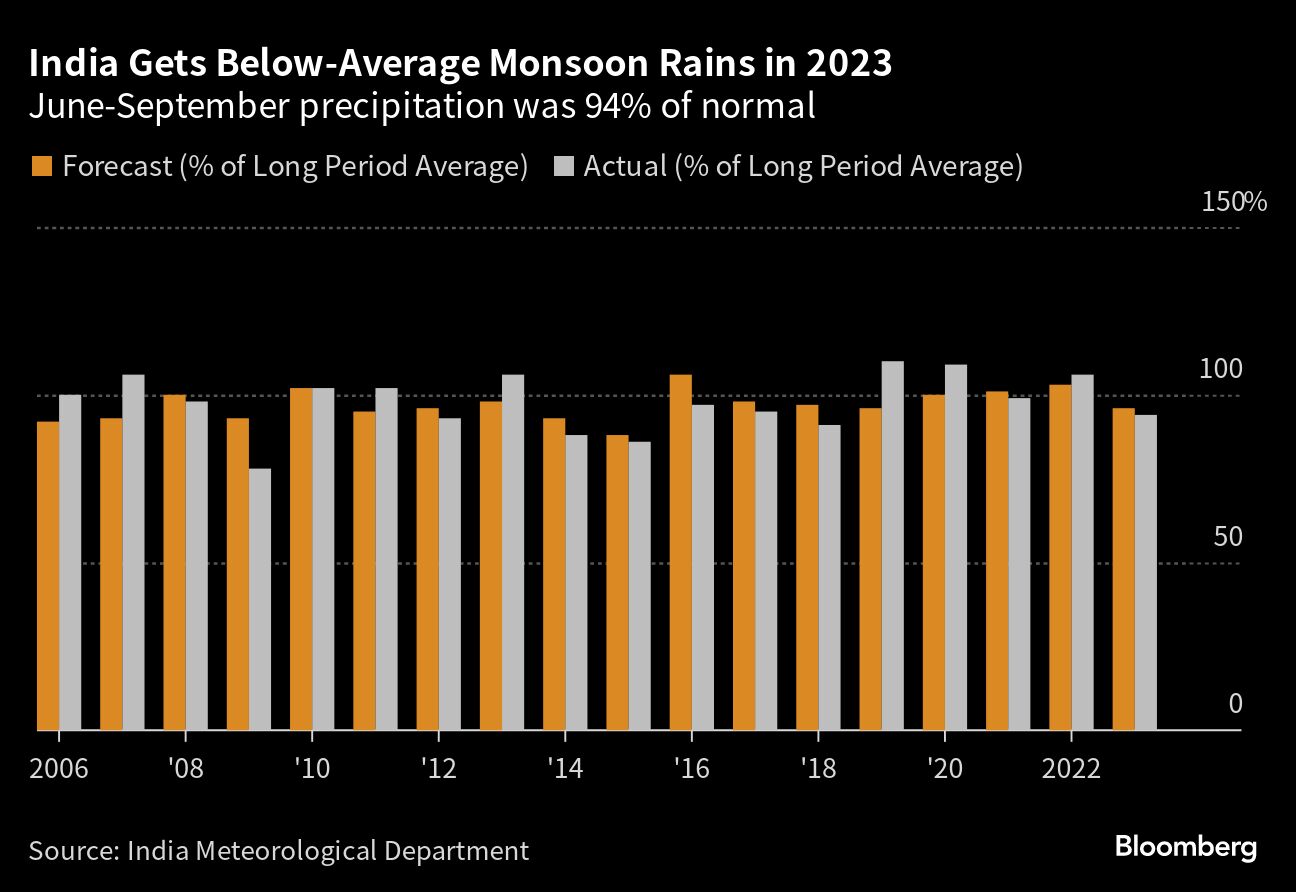
(Bloomberg) -- India recorded the weakest monsoon rains in five years, increasing the risk to crops in the fields and raising the probability of longer curbs on exports of farm commodities such as sugar, rice and wheat.
The Asian nation, which relies on rains to irrigate about half of its farmland, received 820 millimeters (32.3 inches) of rainfall during the June-September monsoon season, 6% less than the long-term average, according to the India Meteorological Department.
Poor rains have increased worries that India, the second-biggest producer of wheat, rice and sugar, will continue to curb exports of key commodities to manage food inflation before the national election in 2024. Such a move would support global prices. Rice in Asia is near a 15-year high, while sugar in New York has jumped more than 30% this year to trade just below a 12-year peak.

Precipitation in the east and northeast, major rice-growing regions, was 18% below normal during the monsoon, the weather office said. Some parts of Karnataka and Maharashtra states, key sugar producers, were among the driest areas this year, it said.
Even as Food Secretary Sanjeev Chopra is positive on prospects for the sugar cane crop, 12 respondents in a Bloomberg survey of 14 analysts, traders and millers, said that India may not export any sugar in the new season starting on Oct. 1 because of lower production.
Sucden's General Director Jeremy Austin said last week that the nation is expected to produce 28.6 million tons of sugar in 2023-24, much less than the Indian Sugar Mills Association's prediction of 31.68 million tons. The country's estimated production in 2022-23 was 32.8 million tons, according to ISMA.
Although monsoon activity was below-normal this year, rainfall was not impacted much by the El Niño, according to Mrutyunjay Mohapatra, director general of India's weather bureau. A positive Indian Ocean Dipole — a weather phenomenon that generally brings normal to above-normal rains in the country — compensated the negative impact of El Niño conditions, he said at an online press conference.
A weak El Niño developed in July, but became moderate later, Mohapatra said. The first half of the monsoon season received 10% more precipitation than normal, but rain levels were 17% below average during the August-September period, he said. The El Niño event, which creates an abnormal warming of the Pacific Ocean, tends to lower rainfall during India's monsoons.
Deficient monsoon rains have also raised concerns about winter crops such as wheat and oilseeds, which generally rely on stored water because of the lack of precipitation during the season from November to March. India's 150 reservoirs held about 130 billion cubic meters of water as of Friday, 18% less than a year earlier, according to the Central Water Commission.
The risk of lower farm production this year could prompt the government to keep taking aggressive measures to control food inflation, which surged to almost 10% in August from a year earlier. Besides curbing exports of sugar and some grains, the authorities are cracking down on hoarding and selling farm goods from central reserves to cool prices.
--With assistance from Andrew Davis.
(Updates to add comments from IMD head in seventh paragraph)
More stories like this are available on bloomberg.com
©2023 Bloomberg L.P.

-
Ten Things I Learnt This Samvat

Patience can be a trap. Cheap stocks can stay cheap. Leverage can wipe you out. What did Samvat 2082 teach us? Niraj Shah writes on 10 lessons from the year gone by.
-
Talking Points This Week: Tech Nerves, FII Buying, And A Faraway Banking Shock
The global markets are not shining this Diwali. The exception in the large markets is, India.
-
Midterm Rally Lasted A Day. The Hard Reality Of A Divided US May Last Two Years | Opinion
Between a contested AI boom, a debt ceiling that arrives in 2027 and a president with every incentive to act alone, the next two years may prove more volatile than the first day's rally suggests.
-
Blue Wave Will Derail the AI Trade but Won't Dismantle the AI Era | Unhedged Position
The Democrats' sweep of the US Congress will see politics collide with economic forces both over the long and short term.
-
It's Time To Take The GST Council's Bet On Trust Global
Payment records can prove India's services exports, and clear, proportionate rules can bring foreign digital sellers into the tax net.
-
Opinion | India at 38: From Innovation Overperformer to Innovation Powerhouse
India now has 453 VC-backed deep science startups, 18 of them late-stage, after 117 percent growth since 2020. Laurus Labs, at USD 9.3 billion, is the most valuable deep science company in any middle-income economy outside China.
-
Navigating Energy Crossroads: S Jaishankar's Call For Diversified Supply Chains At G20 Ministerial Meeting
As geopolitical fault lines continue to test maritime trade routes and commodity flows, Jaishankar's message remains pertinent: true economic resilience requires open markets, protected transit lines, and a genuine commitment to multilateral cooperation rather than coercion.
-
Indians Are Travelling, But Not Every Journey Is A Holiday | The Week In Whys
Pilgrims, patients and working women are the real travellers, and the system hasn't quite caught up with them.
-
Getting To Work Costs Women More | The Reason Why
It is not just about women paying more than men. It is about women paying much more in cities than in villages.









