Only Credible Plaint Will Trigger GST Anti-Profiteering Clause
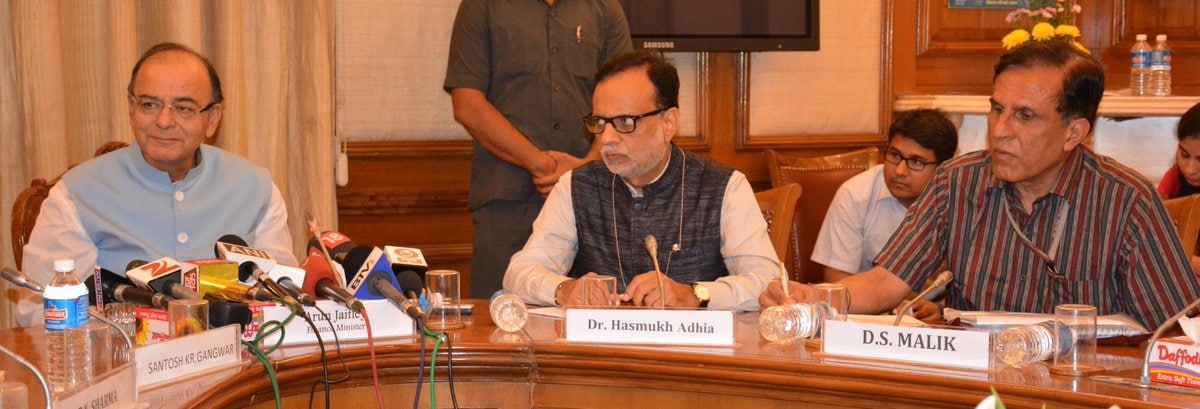
The contentious anti-profiteering measure in the Goods and Services Tax (GST) Law will be triggered only if there is a credible complaint, Revenue Secretary Hasmukh Adhia said.
He said the anti-profiteering clause in the law is meant to be a deterrent and is an enabling clause so that reduction in tax incidence due to the GST is passed on to consumers.
Adhia told PTI that the Centre and states will in due course prescribe the procedure for filing a complaint where the complainant feels that the benefit of tax cut has not been passed on to him as well as the quantum of penalty to be imposed.
Asked who will decide if the benefits have been passed on or not, he said, "It would be based on complaints...Anti-profiteering provision may not be required in majority of items because wherever there is perfect competition, there is nothing to worry. Competition will take care." Adhia, however, said it was not yet decided which agency will look into the anti-profiteering complaints. The government may decide on an agency if there is a plethora of complaints.
The agencies at the government's disposal include the Competition Commission of India (CCI).
Also Read: No GST Shock This Year: Healthcare And Education To Be Exempt
Adhia also said that although the anti-profiteering clause could be a transitory provision, it can be retained as the provisions can come into play in future when the tax rates are changed.
Asked if the anti-profiteering clause could cease to exist after some time, Adhia said: "It may. But somebody may also argue that there may be future changes in the tax rate also and at that time, this (anti-profiteering) provision may have to be applied."
The GST Council has decided on a four-tier rate structure of 5, 12, 18 and 28 percent. It has, however, pegged the peak rate at 40 percent in the law to obviate the need to approach Parliament in future for any change in rate.
On top of the 28 percent rate slab, there is a provision for imposition of cess on demerit and luxury goods.
Adhia said that if tax revenues go up in future because of widening of tax net, GST rates can be reduced.
The purpose is over a period the high taxation rate should come down... The moment we are able to widen the tax net and bring parallel economy into mainstream, then the tax net will go up and if more people start paying taxes, we will be able to reduce the tax rate.Hasmukh Adhia, Revenue Secretary
The Central GST (CGST) Law, as approved by the Lok Sabha last week, provides an 'anti-profiteering' clause to ensure business passes on the benefit of reduced tax incidence on goods or services or both to consumers.
It also provided for establishment of an authority for ensuring the benefits are passed on to consumers.
Touted as the biggest taxation reform since Independence, GST will subsume central excise, service tax, VAT and other local levies and make India one market for seamless flow of goods and services.
Also Read: Central GST Bill: The ‘Reverse' Charge And 3 Other Key Changes

-
Unhedged Position: Can India See An Indonesia-Style Time Correction?

The Nifty is trading below levels it first clocked in 2024. Is there, then, as I have suggested in the headline, potential that the current time correction drags on painfully for the next three-five, even ten years?
-
Navigating Friction And Energy Realities: An Analysis Of Marco Rubio's October Visit To India
Occurring at a critical juncture marked by stalled trade negotiations and escalating geopolitical pressures over global energy supplies, the visit offers a profound window into modern US-India relations.
-
India Exports Capital. Why Not Export Trusteeship?
The big question, then, is whether India can build an institution that global borrowers, investors, banks, and lawyers can trust, even without an Indian connection.
-
France's Economy & Politics Are In Crisis | The Reason Why
Let's look at how the French economy and politics evolved under Nicolas Sarkozy, Franois Hollande and Emmanuel Macron.
-
You May Inherit The Business. You Must Earn Its Credibility.
Succession tests the founder's ability to share authority as much as it tests the next generation's readiness to assume it.
-
Signing Deals Is One Thing; Making Them Work Is Another | The Week In Whys
Sometimes, things don't turn out as planned. Indian companies have lost some bids to rivals, some projects won't produce until 2030.
-
FOMC Wall, PERM Suspension, Hospital Stocks | Talking Points This Week
A PERM suspension would directly affect green-card sponsorship rather than H-1B visas, so the near-term earnings impact could remain relatively limited. The key question is whether this marks a new phase in US scrutiny of Indian IT.
-
Everything, Everywhere, All At Once: Dalal Street's Week To Forget | Joining The Dots
Visa curbs, a Starlink spat and cancer drug caps: what connects this week's shocks for Indian markets
-
India Is Going Abroad For Critical Minerals. But It May Take Years To Pay Off | The Reason Why
Although India's steps are in the right direction, they remain modest compared with India's growing dependence.
-
When Everyone Has AI, What Gives You An Edge?
India's young workforce is entering an uncertain world of work where powerful AI tools are becoming widely accessible. The advantage will belong to those who combine deep expertise with digital fluency, and the distinctly human capabilities that technology cannot manufacture.