Japan’s Economy Shrinks For First Time In A Year Before Tariff Jolt
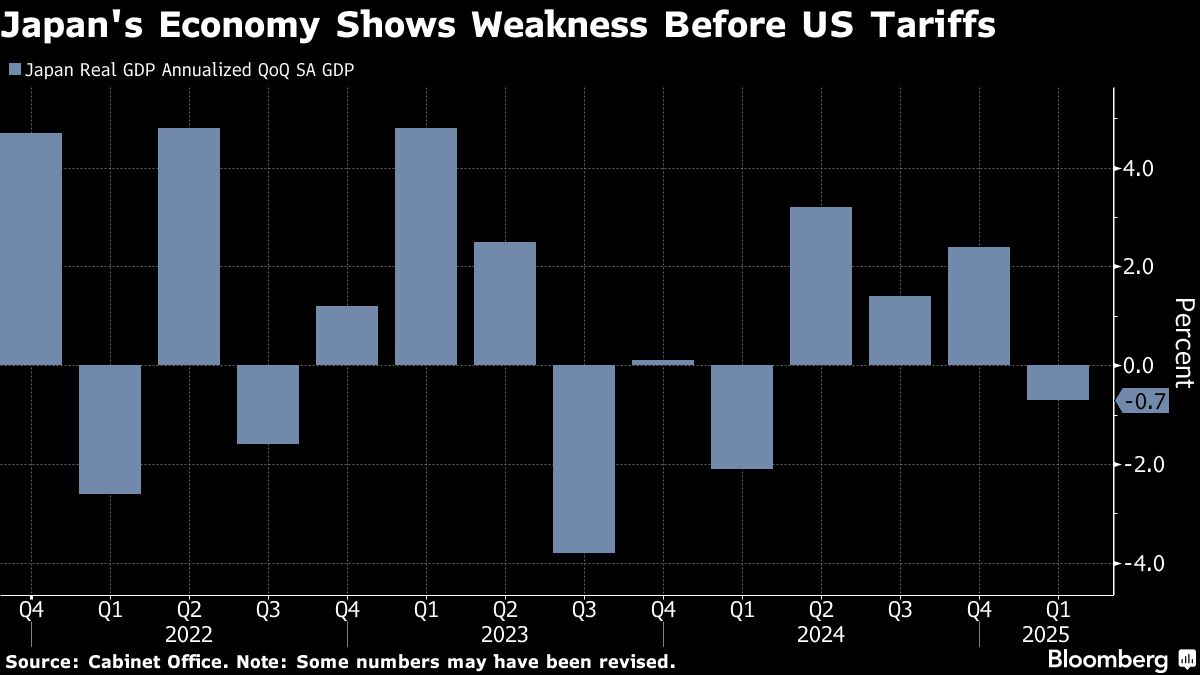
Japan's economy shrank for the first time in a year, illustrating its vulnerability even before sustaining the impact of US President Donald Trump's tariff measures.
Gross domestic product adjusted for inflation contracted by 0.7% in the first three months of the year on an annualized basis, according to a report by the Cabinet Office released Friday. The result was slightly weaker than a median economist estimate that it would shrink 0.3% and leaves the economy at risk of falling into a technical recession this quarter depending on the hit from the US levies.
A drop in exports and a jump in imports resulted in net trade weighing on the economy in the first three months of the year following a hefty boost in the previous quarter. Consumer spending, which accounts for roughly half of the economy, was largely flat. Consumption has stayed below its pre-pandemic level as inflation saps purchasing power.
The first contraction under Prime Minister Shigeru Ishiba adds to concerns about the resilience of the economy before the bulk of Trump's tariffs came into effect in the current quarter. The weakness in the economy further supports the case that the Bank of Japan should pause its rate hikes while it monitors the potential impact of the levies after having halved its growth forecast for this year earlier this month.
The contraction is also likely to fuel ongoing political debate over the need for tax cuts or cash handouts ahead of an upper house election this summer. Ishiba's approval rating remains under pressure in local polls, hitting the lowest level of his premiership this month.
“This shows how easily Japan's economy can fall into contraction because its growth potential is low,” said Taro Saito, head of economic research at NLI Research Institute, flagging a high risk that the economy will shrink again this quarter. “While there's no tangible impact of the US tariffs in this data, that will kick in from this quarter. Exports will go down and capital spending will slow because of concerns for outlook.”
The cost of living has been rising well above the BOJ's 2% target this year, led by a jump in food inflation. The price of rice, the nation's staple food, continued to surge in March, increasing 92% from a year earlier. That's forced some public schools to cut the number of lunches featuring the grain to two per week from three, according to public broadcaster NHK.
While households await cooler inflation and a rise in real wages, Honda Motor Co. this week slashed its profit forecast for this fiscal year due to the US duties. That followed a reduction by Toyota Motor Corp. Those are concerning signals for policymakers as Japan's largest businesses have set the tone for wage talks that resulted in the biggest increases in three decades in the last two years.
What Bloomberg Economics Says...
“On one hand, a slack economy argues for the central bank to keep policy stimulative. On the other, part of the weakness stems from sluggish private consumption — a sign rising costs of living continue to make consumers cautious. That suggests the BOJ needs to pare stimulus to avoid stagflation risks.”
— Taro Kimura, economist
The first salvo of US tariff measures came in March, when Trump imposed a 25% duty on imports of steel and aluminum. The same rate was applied to autos in April, along with a universal tariff of 10% on Japanese goods that will rise to 24% in a couple of months barring a trade deal.
Japan has shown little progress in trade talks despite Treasury Secretary Scott Bessent's suggestion last month that negotiations with the country would take priority. While Washington has landed an agreement with the UK and agreed on a temporary truce with China, Commerce Secretary Howard Lutnick earlier this month said that “an enormous amount of time” would be needed to reach a deal with Tokyo.
Japan follows the US in registering negative growth in the first quarter. With its potential growth rate projected at around 0.6%, the lowest among Group of Seven nations, Japan's economy has seen at least one quarterly contraction in every year since the pandemic.

-
Midterm Rally Lasted A Day. The Hard Reality Of A Divided US May Last Two Years | Opinion

Between a contested AI boom, a debt ceiling that arrives in 2027 and a president with every incentive to act alone, the next two years may prove more volatile than the first day's rally suggests.
-
Blue Wave Will Derail the AI Trade but Won't Dismantle the AI Era | Unhedged Position
The Democrats' sweep of the US Congress will see politics collide with economic forces both over the long and short term.
-
It's Time To Take The GST Council's Bet On Trust Global
Payment records can prove India's services exports, and clear, proportionate rules can bring foreign digital sellers into the tax net.
-
Opinion | India at 38: From Innovation Overperformer to Innovation Powerhouse
India now has 453 VC-backed deep science startups, 18 of them late-stage, after 117 percent growth since 2020. Laurus Labs, at USD 9.3 billion, is the most valuable deep science company in any middle-income economy outside China.
-
Navigating Energy Crossroads: S Jaishankar's Call For Diversified Supply Chains At G20 Ministerial Meeting
As geopolitical fault lines continue to test maritime trade routes and commodity flows, Jaishankar's message remains pertinent: true economic resilience requires open markets, protected transit lines, and a genuine commitment to multilateral cooperation rather than coercion.
-
Indians Are Travelling, But Not Every Journey Is A Holiday | The Week In Whys
Pilgrims, patients and working women are the real travellers, and the system hasn't quite caught up with them.
-
Getting To Work Costs Women More | The Reason Why
It is not just about women paying more than men. It is about women paying much more in cities than in villages.
-
AI Bias In Investing Cannot Be Eliminated, But It Can Be Governed
Framing is a particularly important example as identical financial information presented in terms of gains rather than losses can lead an LLM to reach a different assessment.
-
Joining The Dots | Dark Skies, Steady Diya: Why Hope Holds This Diwali
With war, a weak rupee and foreign outflows weighing on sentiment, policymakers at the NDTV World Summit and market veterans at NDTV Profit Ignite: Diwali Edition offered the same advice: stay invested and filter out the noise.









