India To Introduce Virtual ID For Aadhaar To Strengthen Privacy
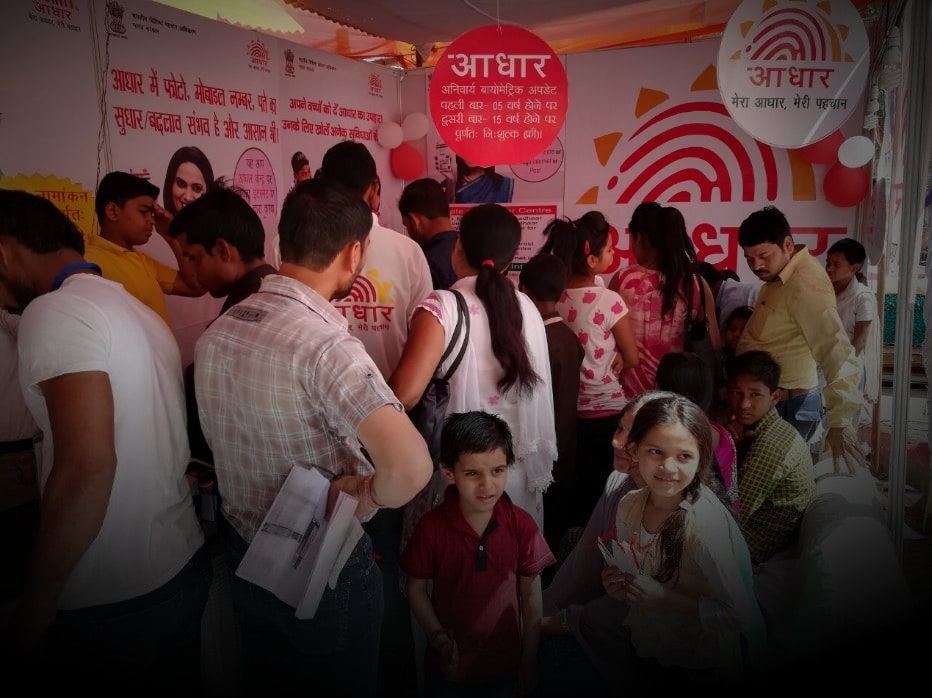
The government will introduce a virtual identification number for Aadhaar to help strengthen privacy following several instances of data leaks.
The additional layer of security is meant to help Aadhaar users avoid sharing their unique identification number at the time of authentication to avail various services and welfare schemes, UIDAI said in a circular seen by BloombergQuint. The virtual ID will be an optional feature and users will be allowed to provide Aadhaar for verification.
The Aadhaar-issuing body, Unique Identification Authority of India, will also introduce limited know-your-customer rules to eliminate the need for agencies to store the biometric ID. Migration to the new system will start from June 1, it added.
Virtual IDs should be made mandatory and the UIDAI should itself generate these codes instead of having the user do it, said Pranesh Prakash, policy director at the Center for Internet Security, which has published reports on the security flaws in the world's largest database.
This takes into account concerns of third-party databases being combined without the consent of the individual but fails to address issues of government surveillance, exclusion and cybersecurity, he added.
The move comes barely a week after The Tribune, a Chandigarh-based newspaper, reported that it could access the Aadhaar database by paying Rs 500, raising privacy concerns. Petitions challenging the validity of Aadhaar and the government's decision to make it mandatory for everything from bank accounts to mobile services are pending in the Supreme Court.
As of now, citizens are required to share their Aadhaar number for authentication to avail certain services. With the introduction of the virtual ID that would change.
It would be a randomly generated 16-digit number that'd be digitally linked to a person's Aadhaar number. This ID would be temporary and revocable. There can be only one active and valid virtual ID for an Aadhaar number at any given point in time. Aadhaar holders will be able to use the virtual ID whenever authentication is required.
Virtual ID, by design being temporary, cannot be used by agencies for duplication.UIDAI Circular
Only Aadhaar holders themselves can generate a virtual ID and set a minimum validity period for that after which it will have to be replaced by a new one. The virtual IDs can be changed through UIDAI's portal, at an Aadhaar enrolment centre or using the mAadhaar mobile application, the circular said.
Who Can Store Your Aadhaar Data?
The UIDAI will limit the number of agencies that can access and store your Aadhaar number. For this purpose, it will divide the agencies that seek to use Aadhaar authentication for services into two categories—global and local.
Global authentication agencies will be allowed to "securely" store the Aadhaar number, while local agencies won't. The latter would be the ones that'd use the virtual IDs and a unique token for authentication.
The Aadhaar-issuing body has not clearly defined what would classify as a global agency. It has only said that it will "from time to time" evaluate authentication agencies "based on the laws governing them and categorise them" as global agencies. Any authentication agency that is not classified as global would be local.
How will the #Aadhaar Virtual ID work? @nsd308 & @aayush_a6 explain. https://t.co/jwhR7Mr9td pic.twitter.com/WjhGSTdWlI
January 10, 2018Also Read: FIR Against Tribune Journalist: Is The Government Shooting The Messenger?
Transition To New System
UIDAI has told all agencies that use Aadhaar authentication to update their applications and processes for accepting virtual IDs instead of the Aadhaar number and allow authentication using the UID token. This has to be done by June 1.
If an agency fails to migrate to the new system by then, their authentication services "may be discontinued" and a penalty may be imposed, UIDAI said.
UIDAI will release the updated tools and protocols required for building the authentication software by March 1. All authentication agencies would also receive technical documents, workshops and training session to ensure smooth implementation.
Watch this discussion with Nikhil Kumar of iSPIRT Foundation and Cyber Law Advocate Pawan Duggal.
Also Read: Benefits Of Aadhaar Unclear: RBI Researchers

-
Navigating Energy Crossroads: S Jaishankar's Call For Diversified Supply Chains At G20 Ministerial Meeting

As geopolitical fault lines continue to test maritime trade routes and commodity flows, Jaishankar's message remains pertinent: true economic resilience requires open markets, protected transit lines, and a genuine commitment to multilateral cooperation rather than coercion.
-
Indians Are Travelling, But Not Every Journey Is A Holiday | The Week In Whys
Pilgrims, patients and working women are the real travellers, and the system hasn't quite caught up with them.
-
Getting To Work Costs Women More | The Reason Why
It is not just about women paying more than men. It is about women paying much more in cities than in villages.
-
AI Bias In Investing Cannot Be Eliminated, But It Can Be Governed
Framing is a particularly important example as identical financial information presented in terms of gains rather than losses can lead an LLM to reach a different assessment.
-
Joining The Dots | Dark Skies, Steady Diya: Why Hope Holds This Diwali
With war, a weak rupee and foreign outflows weighing on sentiment, policymakers at the NDTV World Summit and market veterans at NDTV Profit Ignite: Diwali Edition offered the same advice: stay invested and filter out the noise.
-
The Curious Case of Equitas Small Finance Bank And A CEO Who Quit For Stock
PN Vasudevan believes persistent investor concerns over a perceived conflict of interest had become a governance overhang on Equitas Small Finance Bank's stock, even as the lender improved profitability and asset quality.
-
Talking Points This Week: AI Cash Burn, A Tiger Comeback And An India That Still Finds Its Own Path
India is not immune to higher oil or tighter global liquidity, yet its earnings base is broader, its domestic policy levers are still available.
-
Foreign Investors Own Half Of HDFC Bank and ICICI Bank. An LTCG Cut Could Matter Most Here
Foreign portfolio investors have US$115 billion parked in HDFC Bank, ICICI Bank. If the government cuts long-term capital gains tax, Jefferies says returning foreign money could land here first.
-
'Never Seen This Level Of Negativity': Sandeep Tandon Says The Next Rally May Be Closer Than You Think
Veteran investor Sandeep Tandon says foreign selling is easing, large-caps are due a comeback and mid-caps are crowded, while he turns positive on gold, power and pharma this Diwali.










