India’s Blowout GDP Based on Data Distortion That Masks Slowdown

(Bloomberg) --
India's surge in economic growth to above 8% last quarter was distorted by a single category, economists said, suggesting the strong numbers may not be repeated as other signs point to slowing momentum.
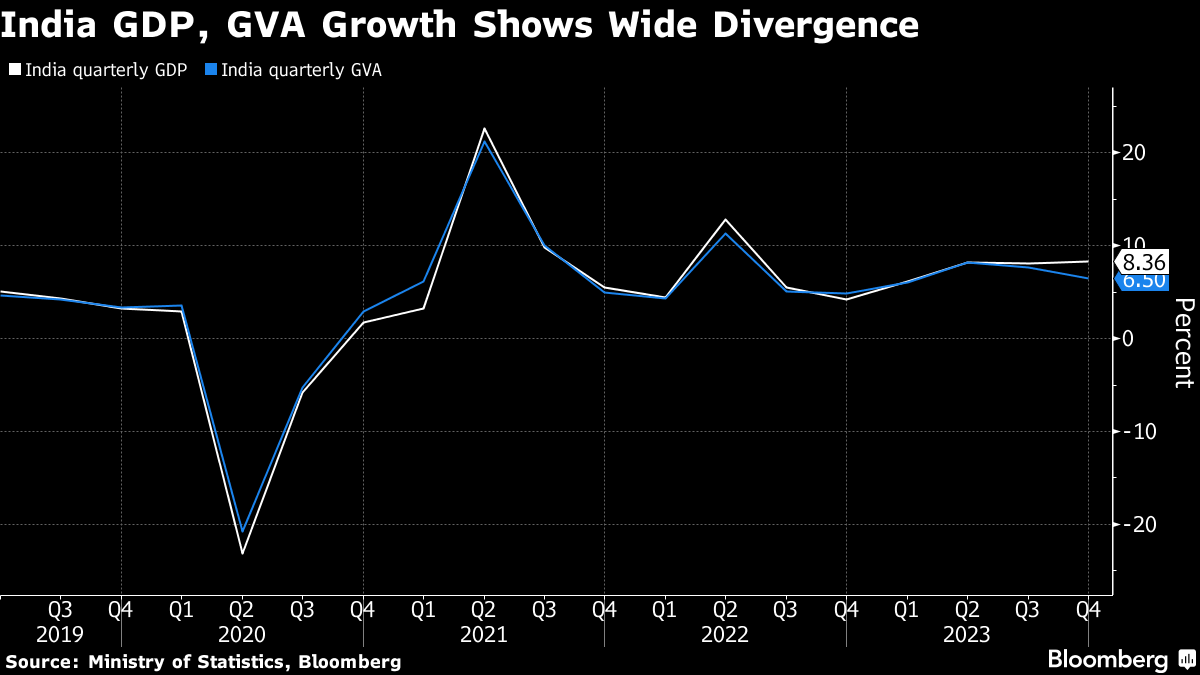
Gross domestic product rose 8.4% in the final three months of 2023 compared with a year ago, the Statistics Ministry said Thursday, beating all forecasts in a Bloomberg survey. Economists said an unexpected drop in government subsidies was the main reason for the surge, giving an artificial boost to the net indirect tax category used to calculate GDP.
A more representative figure of economic activity that strips out those one-off items rose by 6.5%, growth that was more in line with expectations and showed a slowdown from the previous quarter.
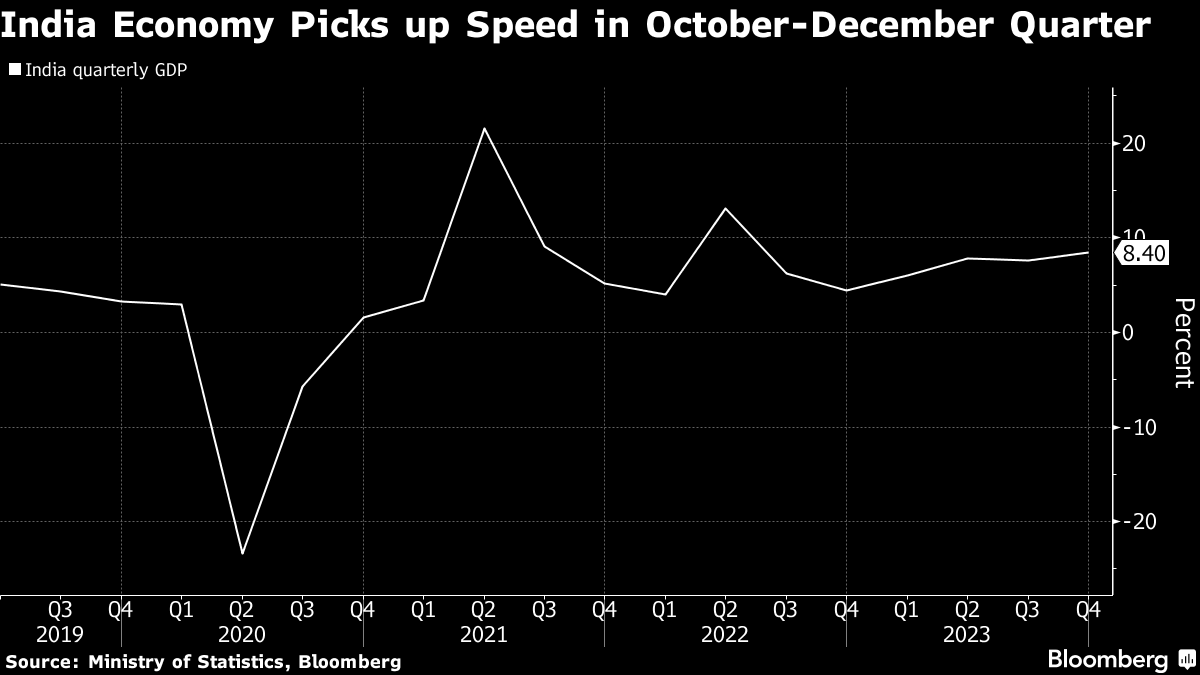
“The extraordinary GDP surprise in the fourth quarter of 2023 was due to transient factors and growth is expected to slow,” Dhiraj Nim and Sanjay Mathur, economists at Australia & New Zealand Banking Corp., wrote in a note. “But it is unlikely to slow alarmingly.”
Financial markets were fairly upbeat on the data, with stocks in India surging the most in nearly a month. The benchmark BSE Sensex index was on pace for a record close, while the rupee gained.
The surprise data comes just weeks before India heads to elections, with Prime Minister Narendra Modi seeking to extend his decade in power. The government also upgraded its growth projection for the current fiscal year through March to 7.6% from 7.3%, keeping India on track to be the world's fastest-growing major economy.
The distortion in the GDP data sets up a debate over whether the Reserve Bank of India will stay on guard as it tries to bring inflation down to its 4% target. The central bank has kept interest rates unchanged and stuck to a relatively hawkish policy stance for several months, although some policy committee members argue that keeping borrowing costs too high could stifle economic growth.
What Bloomberg Economics Says...
We pushed back our base case for a rate cut to August from June after the Feb 22. release of the RBI's meeting minutes. But we now believe the optimal policy response for the central bank would be to start easing as soon as April.
Abhishek Gupta, India economist
For the full report, click here
The GDP figures were distorted by the category for net indirect taxes, which is calculated by subtracting subsidies from indirect taxes. Indirect taxes grew just 0.7% from a year earlier, but subsidies plunged almost 54%. That pushed up the year-on-year growth rate in the indirect tax category, according to economists including Garima Kapoor of Elara Securities India Ltd.
The government's bill for fertilizer subsidies, for example, plunged about 70% last quarter from a year earlier, largely due to falling prices, according to Bloomberg calculations.
Economists said gross value added, which excludes net indirect taxes, was a better measure of underlying momentum in the economy.
The beat on GDP spurred economists to upgrade their growth forecasts for the coming fiscal year beginning in April. Barclays Plc raised its projection to 7% from 6.5%, while Citigroup Inc. hiked it to 6.8% from 6.5%. Deutsche Bank upgraded its estimate by 20 basis point to 6.5%.
“The revisions in the recent growth data show India is already an 8% growth economy and accelerating, which sets it apart from the rest of the world,” said Rahul Bajoria, an economist at Barclays. “Investment numbers suggest an ongoing pickup in capex momentum.”
V Anantha Nageswaran, India's chief economic adviser, said strong domestic demand and private investments will continue to drive growth. “The Indian economy is ticking many boxes in the right manner,” he told reporters in New Delhi on Thursday.
--With assistance from Vrishti Beniwal.
(Updates with additional details. An earlier version of the story corrected the definition of GVA.)
More stories like this are available on bloomberg.com
©2024 Bloomberg L.P.

-
Love, Sex Aur Dhokha: The Audacious Plot To Spy On Jensen Huang

A Taipei dinner, a Singapore chip buyer and a suspected Chinese asset: inside the alleged spy operation that got close to NVIDIA's Jensen Huang.
-
Talking Points This Week: Tech Nerves, FII Buying, And A Faraway Banking Shock
The global markets are not shining this Diwali. The exception in the large markets is, India.
-
Midterm Rally Lasted A Day. The Hard Reality Of A Divided US May Last Two Years | Opinion
Between a contested AI boom, a debt ceiling that arrives in 2027 and a president with every incentive to act alone, the next two years may prove more volatile than the first day's rally suggests.
-
Blue Wave Will Derail the AI Trade but Won't Dismantle the AI Era | Unhedged Position
The Democrats' sweep of the US Congress will see politics collide with economic forces both over the long and short term.
-
It's Time To Take The GST Council's Bet On Trust Global
Payment records can prove India's services exports, and clear, proportionate rules can bring foreign digital sellers into the tax net.
-
Opinion | India at 38: From Innovation Overperformer to Innovation Powerhouse
India now has 453 VC-backed deep science startups, 18 of them late-stage, after 117 percent growth since 2020. Laurus Labs, at USD 9.3 billion, is the most valuable deep science company in any middle-income economy outside China.
-
Navigating Energy Crossroads: S Jaishankar's Call For Diversified Supply Chains At G20 Ministerial Meeting
As geopolitical fault lines continue to test maritime trade routes and commodity flows, Jaishankar's message remains pertinent: true economic resilience requires open markets, protected transit lines, and a genuine commitment to multilateral cooperation rather than coercion.
-
Indians Are Travelling, But Not Every Journey Is A Holiday | The Week In Whys
Pilgrims, patients and working women are the real travellers, and the system hasn't quite caught up with them.
-
Getting To Work Costs Women More | The Reason Why
It is not just about women paying more than men. It is about women paying much more in cities than in villages.









