India Dominates Wigs Market Globally — Nikhil Kamath Explains The Booming Economy

Hair fall may be a growing worry for many, but for India, it is a lucrative opportunity — thanks to its thriving 'Black Gold' economy.
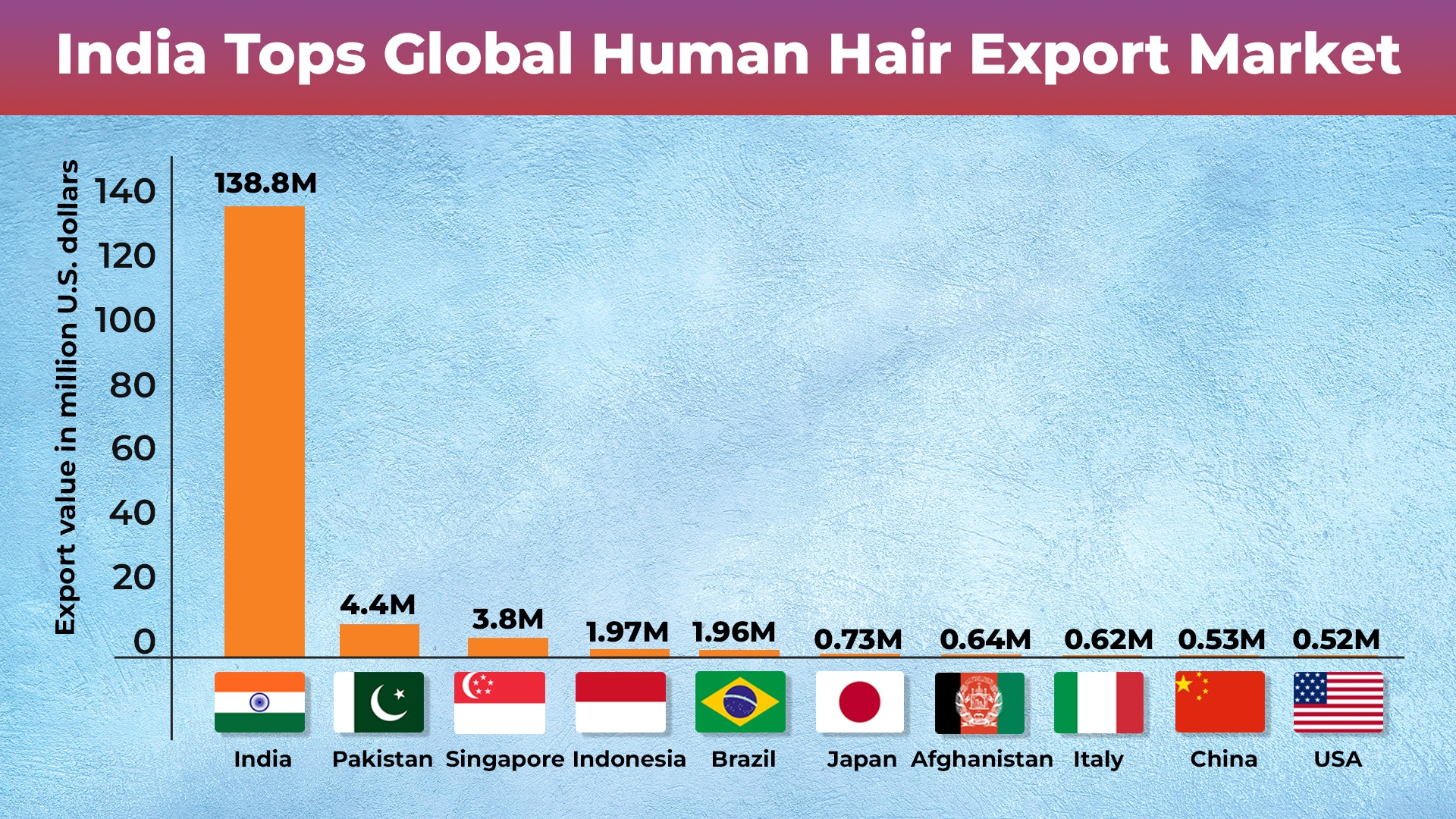
India has mastered the art of turning tresses into treasure, leading the global market with a jaw-dropping $138 million in hair exports, out of a $157 million global total, according to data from the Imarc Group, Ministry of Commerce & Industry, Statista and StartupTalky.
The global wig sector is a whopping $4 billion industry, which is poised to grow at a compound annual growth rate of 7.9% from 2024 to 2031, with India leading in human hair exports.
Zerodha co-founder Nikhil Kamath shared the interesting data of India's hair industry on his X profile on Wednesday.
"The world wigs out... thanks to India," Kamath said. "I'm guessing the odds of succeeding here in entrepreneurship are likely higher compared to stamping AI on a bunch of random things."
The world wigs out...thanks to India,
November 27, 2024
The fact that we need to export more and import less is a given. Looking at uncool ideas and not the flavour of the season makes sense in so many places. I'm guessing the odds of succeeding here in entrepreneurship are likely higher compared… pic.twitter.com/mhM8GQxewGIndia's Growth In Hair Wig Sector
Accounting for 88% of the global hair exports, the country generates a staggering $550 million annually from hair and related products, according to the data.
India's hair wig sector is set to grow at a CAGR of 15% — double the global average. Over 120 countries import wigs and hair products from India, while the e-commerce segment sees a 20% annual growth. Employing over 1 million people, the industry is not just thriving — it is transforming global hair-care dynamics.
(Source: NDTV Profit)
What Has Led To Surge In Hair-Related Products?
Over 40% of individuals experiencing hair loss opt for wigs or hairpieces. In fact, more than 53% doctors prescribed wigs, according to the data from the International Society of Hair Restoration Surgery, Cognitive Market Research and Statista 2020.
Around 2 billion people worldwide experience hair loss, with one in three Indian men showing signs of baldness. Surprisingly, half of these men are under 25. Poor gut health accounts for 37% of hair loss, while 30% of Indian youth with hair loss report irregular sleep patterns.
Additionally, 13% of young Indians are facing hair loss due to significant weight changes, highlighting the growing link between lifestyle factors and hair health.
Studies reveal that 60% of the Indian youth with hair loss have a genetic predisposition. Whether due to genetics or lifestyle, hair loss is worsening over time, fuelling the growth of the global wig industry.
Why Is The World Obsessed With Indian Hair?
Indian hair is popular due to its thickness, fine texture, dark colour, wavy structure and its compatibility with European hair types. Another reason behind the popularity is its abundant supply — that makes Indian hair economical.
"The most desired hair in the market is ling and chemically untreated hair labelled 'virgin hair' and 'remy hair' whose cuticles are aligned from root to tip," Emma Tarlo, a British anthropologist, cities in her book Entanglement: The Secret Lives of Hair. "The hair that comes from Indian temples and comb waste meet the criteria of virgin hair if they are chemically untreated."
India procures hair from two sources — tonsuring and combing.
Tonsuring, a sacred practice at temples like Tirumala Venkateswara, generates Rs 33 crore annually, with over 500 tonnes of hair from 12 million devotees. Remy hair from ritual can fetch up to Rs 33,000 per kilogramme, with wigs priced between $1,000 and $3,000.
Interestingly, most of India's hair comes from non-remy hair gathered from barber shops and the combs of long-haired women in villages and households. This comb hair makes up the bulk of hair sold, contributing significantly to the global market.
India supplies these raw materials to countries like China, who further process and manufacture wigs for the end markets in the US, Europe and Africa.
Talk about making every strand count!

-
Love, Sex Aur Dhokha: The Audacious Plot To Spy On Jensen Huang

A Taipei dinner, a Singapore chip buyer and a suspected Chinese asset: inside the alleged spy operation that got close to NVIDIA's Jensen Huang.
-
Ten Things I Learnt This Samvat
Patience can be a trap. Cheap stocks can stay cheap. Leverage can wipe you out. What did Samvat 2082 teach us? Niraj Shah writes on 10 lessons from the year gone by.
-
Talking Points This Week: Tech Nerves, FII Buying, And A Faraway Banking Shock
The global markets are not shining this Diwali. The exception in the large markets is, India.
-
Midterm Rally Lasted A Day. The Hard Reality Of A Divided US May Last Two Years | Opinion
Between a contested AI boom, a debt ceiling that arrives in 2027 and a president with every incentive to act alone, the next two years may prove more volatile than the first day's rally suggests.
-
Blue Wave Will Derail the AI Trade but Won't Dismantle the AI Era | Unhedged Position
The Democrats' sweep of the US Congress will see politics collide with economic forces both over the long and short term.
-
It's Time To Take The GST Council's Bet On Trust Global
Payment records can prove India's services exports, and clear, proportionate rules can bring foreign digital sellers into the tax net.
-
Opinion | India at 38: From Innovation Overperformer to Innovation Powerhouse
India now has 453 VC-backed deep science startups, 18 of them late-stage, after 117 percent growth since 2020. Laurus Labs, at USD 9.3 billion, is the most valuable deep science company in any middle-income economy outside China.
-
Navigating Energy Crossroads: S Jaishankar's Call For Diversified Supply Chains At G20 Ministerial Meeting
As geopolitical fault lines continue to test maritime trade routes and commodity flows, Jaishankar's message remains pertinent: true economic resilience requires open markets, protected transit lines, and a genuine commitment to multilateral cooperation rather than coercion.
-
Indians Are Travelling, But Not Every Journey Is A Holiday | The Week In Whys
Pilgrims, patients and working women are the real travellers, and the system hasn't quite caught up with them.









