GST Countdown: Change In Return Filing Dates Won’t Impact Availment Of Credit, Experts Say

In what comes as a big relief for taxpayers and the Goods and Services Tax (GST) Network, the GST Council has eased the timeline for filing tax returns under the new indirect tax regime by a month.
For the month of July and August, businesses will have to file taxes on the basis of a simple return, Form GSTR-3B, consisting of a summary of outward and inward supplies. Earlier, the deadline for filing details of goods and services supplied i.e. GSTR-1 was August 10 and for filing details of inward supplies i.e. GSTR-2, it was August 15.
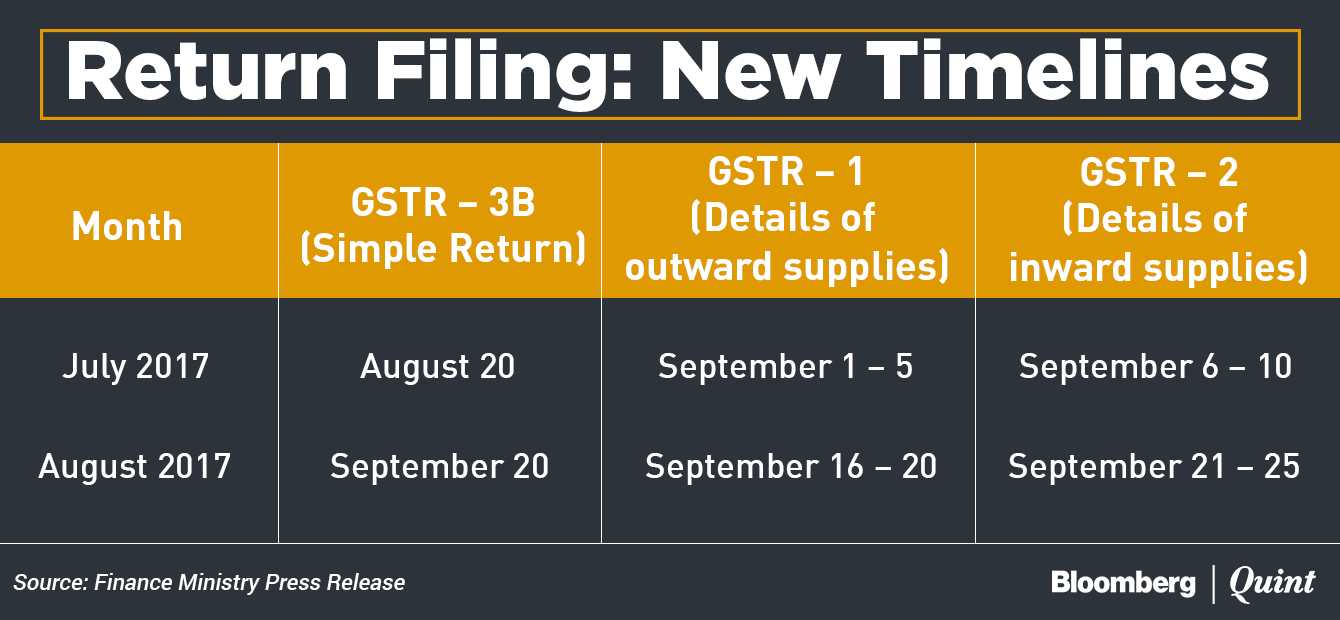
In the interim summary return, businesses will have to file only their total purchases and sales and the net tax liability, Pratik Jain, an indirect tax partner at consultancy firm PwC explained.
The relaxation givenis in terms of filing invoice-level details which was earlier due on August 10.That has now been moved to September 10. This would mean that the wholematching would also not apply before that because once you file the invoice-levelreturn, only then can the purchaser match.Pratik Jain, Partner- Indirect Tax, PwC
Sunil Gabhawalla of chartered accountancy firm SB Gabhawalla & Co. pointed out that the apprehension regarding delay in input tax credit as a result of the new timeline is misplaced.
The credit has tobe claimed on a self-declaration basis and reconciliation follows the claim ofthe credit. Many people are afraid that without reconciliation, I may not getcredit. The way it works is, on the first day, you are given a provisionalcredit and you are expected to reconcile within a period of two months. If youare able to reconcile within a period of two months, life moves smoothly. Ifyou are unable to reconcile, they will take it back from you by way of areversal.Sunil Gabhawalla, Head, SB Gabhawalla & Co.
Jigar Doshi, a partner at SKP Group concurred with this view and said that one can draw from the experience of implementation of the negative service tax list, where in the initial period assessees were allowed to take cenvat credit as against their payment liabilities without filling returns.
It is highly probable that the benefit of GST credit on inward supplies will be allowed against the payment of GST liability for the first two months (interim period). Any late fee or penalty for short payment/erroneous claims in the interim period is likely to be condoned, as announced by the government.Jigar Doshi, Partner - Indirect Tax, SKP Group
While there's relief on the return filing front, it's imperative for businesses, especially retail organisations, to be up and running with their point-of-sale systems, Gabhawalla added. He said that on the midnight of June 30, businesses should be able to prepare GST-compliant invoices with correct calculations. In September, he added, a detailed line level upload will have to be done on the Goods and Services Tax Network.
Doshi added said that while the deferment of GSTR-1 and GSTR-2 for the interim period is a welcome move, conducting compliance for two months (i.e. July and August) along with the rush of filing GST TRAN-1 for transitional credit in the month of September may become a challenge for many organisations.

-
Ten Things I Learnt This Samvat

Patience can be a trap. Cheap stocks can stay cheap. Leverage can wipe you out. What did Samvat 2082 teach us? Niraj Shah writes on 10 lessons from the year gone by.
-
Talking Points This Week: Tech Nerves, FII Buying, And A Faraway Banking Shock
The global markets are not shining this Diwali. The exception in the large markets is, India.
-
Midterm Rally Lasted A Day. The Hard Reality Of A Divided US May Last Two Years | Opinion
Between a contested AI boom, a debt ceiling that arrives in 2027 and a president with every incentive to act alone, the next two years may prove more volatile than the first day's rally suggests.
-
Blue Wave Will Derail the AI Trade but Won't Dismantle the AI Era | Unhedged Position
The Democrats' sweep of the US Congress will see politics collide with economic forces both over the long and short term.
-
It's Time To Take The GST Council's Bet On Trust Global
Payment records can prove India's services exports, and clear, proportionate rules can bring foreign digital sellers into the tax net.
-
Opinion | India at 38: From Innovation Overperformer to Innovation Powerhouse
India now has 453 VC-backed deep science startups, 18 of them late-stage, after 117 percent growth since 2020. Laurus Labs, at USD 9.3 billion, is the most valuable deep science company in any middle-income economy outside China.
-
Navigating Energy Crossroads: S Jaishankar's Call For Diversified Supply Chains At G20 Ministerial Meeting
As geopolitical fault lines continue to test maritime trade routes and commodity flows, Jaishankar's message remains pertinent: true economic resilience requires open markets, protected transit lines, and a genuine commitment to multilateral cooperation rather than coercion.
-
Indians Are Travelling, But Not Every Journey Is A Holiday | The Week In Whys
Pilgrims, patients and working women are the real travellers, and the system hasn't quite caught up with them.
-
Getting To Work Costs Women More | The Reason Why
It is not just about women paying more than men. It is about women paying much more in cities than in villages.









