Getting To Work Costs Women More | The Reason Why
It is not just about women paying more than men. It is about women paying much more in cities than in villages.

You may have heard this story countless times. Your parents or relatives left their village for a city in search of a better job. The opportunities are bigger, but so are the costs. Rent is high, so people often live far from work. Then, longer commutes become part of life, and so do the costs.
But there is a hidden commuting cost, especially for women. It is not just about women paying more than men. It is about women paying much more in cities than in villages.
The average monthly cost of getting to work jumps from Rs. 307 in rural areas to Rs. 884 in cities. That is nearly three times. For men, the cost rises from Rs. 674 to Rs. 1,076, just a 1.6-fold increase.
In my earlier article, The Hidden Cost of Moving to a City, I explored what Indians spend getting to work using data from the Ministry of Statistics and Programme Implementation's Household Travel Survey 2025–26. That was the second part of the series. In this final part, I look at how commuting costs differ for men and women, and what that reveals about women's access to jobs.
Women Start & Finish Early
Across India, most people leave for work between 8 am and 10 am. But village life is different. In most states, they start early, especially women. For instance, in rural Uttar Pradesh, Bihar, and Tripura, around half of working women leave between 6 am and 8 am, a much higher share than men. A similar pattern appears in other states too, though the gap is smaller. Job types, shift timings, or household routines could be driving this pattern.
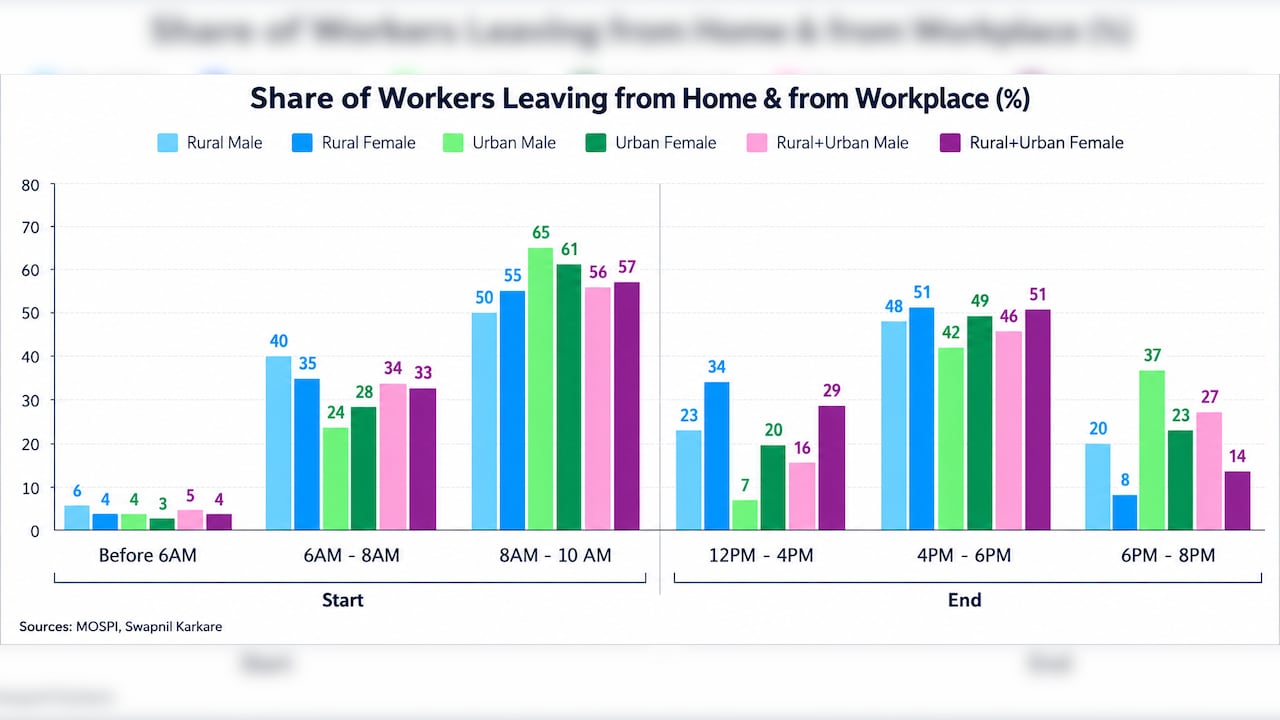
The difference doesn't end here. Women return home earlier than men, too.
Nearly 80% of women leave work before 6 pm, compared with 62% of men. Women are also far more likely to leave between noon and 4 pm. In cities, they are almost three times as likely as men to do so. Men, meanwhile, are much more likely to leave work after 6 pm.
For women, leaving the workplace doesn't necessarily mean the workday is over. They may still need to pick up children, run household errands or care for family members, which could help explain why many leave work earlier. As the Udaiti Foundation points out, women often have to plan their commute around these responsibilities, making their daily journeys more complicated than simply getting from home to work and back. Yet transport systems, whether public or company-run, rarely account for these patterns.
Also Read | Why The 'Domestic Travel Boom' Isn't What You Think: Where We Are Really Going | The Reason Why
The Rural Walking Trap
Let's look at another key factor.
Across rural India, around 65% of working women in the sample walk to their workplaces, compared to around one-fourth of urban women. When women migrate to cities, they cannot walk to work as often as they do in villages. That means their travel costs rise.
In Madhya Pradesh, Bihar, and Jharkhand, more than 80% of rural female workers walked to their workplaces. Average monthly commute costs in these states ranged between Rs. 75 and Rs. 180. In urban areas, the walking share falls closer to 40-50%. However, the average monthly expenditure rises to Rs. 630-730. That's almost a 9-10x jump.
These averages include all modes of transport, from walking and cycling to cars and public transport. As discussed in the previous part, walking and cycling can pull down the average because they involve little or no travel expenditure. Even after excluding walkers and cyclists, the gap remains larger for women compared to men.
Also, we need to understand that this data compares different groups of women, not the same women before and after moving. But if women from villages move to a city, they may incur much higher travel costs.
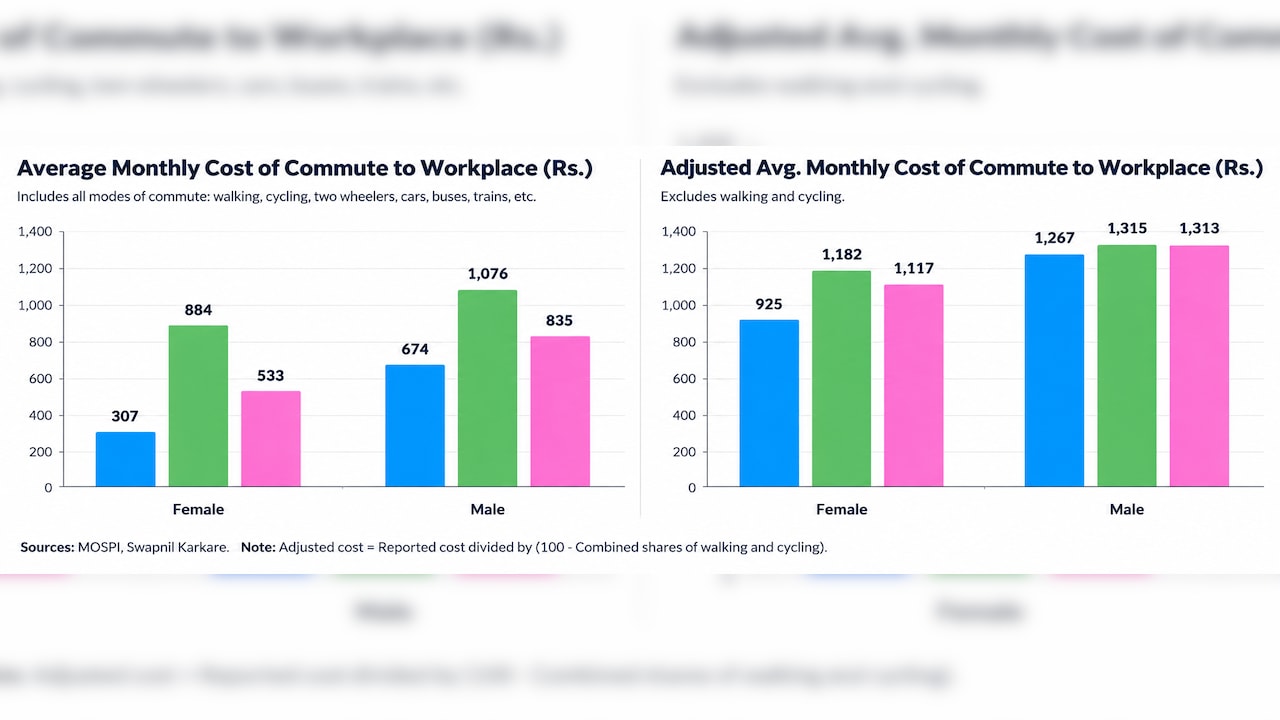
The figures also suggest that many rural women work close enough to walk or cycle. That can be an advantage when jobs are nearby, saving both time and money. But if opportunities within walking distance are limited, transport becomes much more important. Yet transport is only one part of the story. Many factors, including household responsibilities and social norms, impact a woman's decision.
Why Does Transport Access Matter?
Research suggests that better transport can help women access more job opportunities. A study by Lei Lei, Sonalde Desai and Reeve Vanneman found that villages with better roads and more frequent bus services tended to have higher levels of women's non-farm employment. The impact was stronger for women than for men.
The same link between mobility and employment appears in cities. Udaiti Foundation's white paper, Bridging Gendered Gaps in First and Last Mile Connectivity Across Indian Cities, cites evidence from Delhi showing that when residents were relocated farther from transport, female unemployment rose by 27%, compared with 5% for men. The findings underline how the distance between home and transport can affect women's access to jobs.
This is one reason many states have subsidised public transport for women. The idea is not to lower travel expenses. But to make a broader change for women by reducing at least one barrier to reaching work.
Of course, cheaper transport alone does not create jobs. What matters is whether women can actually use it. Udaiti Foundation suggests looking at the entire journey, rather than just the stretch between two transit points. This means coordinating the transport system with the infrastructure around it. Frequent services, good first- and last-mile connectivity, affordable fares and safety all matter. So do well-lit streets, well-maintained footpaths, police patrolling and safe public spaces. Together, these determine whether women can make the journey to work easily and safely.
Ultimately, even a better-paying job may not feel worth it if getting there is too difficult, expensive or unsafe.
Also Read | Indians Stay With Family, Not In Hotels | The Reason Why
Final Take
For women, commuting involves more than the income and travel costs. Other factors influence which jobs they are willing to take, how far they can travel and how easily they can balance work with other responsibilities.
The data suggest that many women already organise their working day around household responsibilities and travel constraints. So, even if women spend less on commuting than men, the time, effort and mental load of managing work, travel and responsibilities at home can make the daily commute far more taxing.
The government cannot remove all the barriers women face in the labour market in the short run. But it can make better transportation policies. Better access puts more jobs within women's reach. Governments and businesses must think about it actively to help women stay in the workforce.
Disclaimer: The views expressed in this article are solely those of the author and do not necessarily reflect the opinion of NDTV Profit or its affiliates. Readers are advised to conduct their own research or consult a qualified professional before making any investment or business decisions. NDTV Profit does not guarantee the accuracy, completeness, or reliability of the information presented in this article.
-
AI Bias In Investing Cannot Be Eliminated, But It Can Be Governed

Framing is a particularly important example as identical financial information presented in terms of gains rather than losses can lead an LLM to reach a different assessment.
-
Joining The Dots | Dark Skies, Steady Diya: Why Hope Holds This Diwali
With war, a weak rupee and foreign outflows weighing on sentiment, policymakers at the NDTV World Summit and market veterans at NDTV Profit Ignite: Diwali Edition offered the same advice: stay invested and filter out the noise.
-
The Curious Case of Equitas Small Finance Bank And A CEO Who Quit For Stock
PN Vasudevan believes persistent investor concerns over a perceived conflict of interest had become a governance overhang on Equitas Small Finance Bank's stock, even as the lender improved profitability and asset quality.
-
Talking Points This Week: AI Cash Burn, A Tiger Comeback And An India That Still Finds Its Own Path
India is not immune to higher oil or tighter global liquidity, yet its earnings base is broader, its domestic policy levers are still available.
-
Foreign Investors Own Half Of HDFC Bank and ICICI Bank. An LTCG Cut Could Matter Most Here
Foreign portfolio investors have US$115 billion parked in HDFC Bank, ICICI Bank. If the government cuts long-term capital gains tax, Jefferies says returning foreign money could land here first.
-
'Never Seen This Level Of Negativity': Sandeep Tandon Says The Next Rally May Be Closer Than You Think
Veteran investor Sandeep Tandon says foreign selling is easing, large-caps are due a comeback and mid-caps are crowded, while he turns positive on gold, power and pharma this Diwali.
-
Indians Stay With Family, Not In Hotels | The Reason Why
India still lacks enough clean, reliable and affordable hotels for budget-conscious travellers.
-
The Economic Imperative: Analysing The Material Driving Force Behind India-Canada Strategic Reset
This economic complementarity is further reinforced by deep institutional investment ties and talent mobility, which form the bedrock of the bilateral framework.
-
Medicine Pricing: Where Must Profit Stop?
India must confront excessive margins, hidden incentives and regulatory gaps that threaten the integrity of medicine.
-
Why Amazon And Flipkart Are Struggling To Beat Meesho In India's Smaller Cities
With 274 million users and lowest-cost logistics, Meesho is defending its value commerce crown against giants like Amazon and Flipkart.










