FM Nirmala Sitharaman Suggests Labour Skilling As Countries Balance Green Priorities
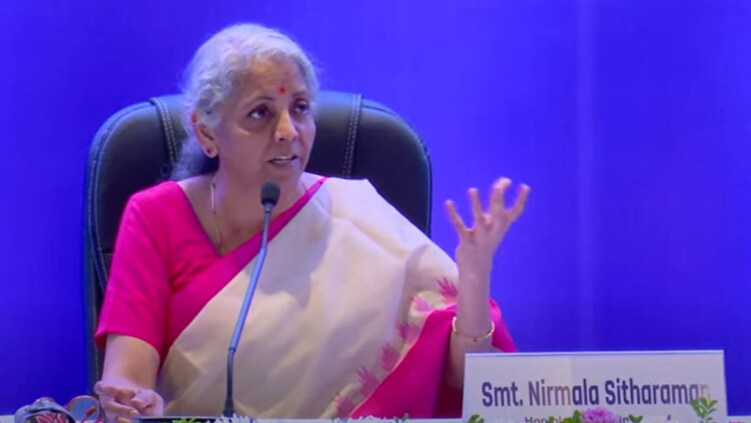
Finance Minister Nirmala Sitharaman stressed the importance of balancing green priorities and manufacturing efficiencies with labour skills as countries around the world look to achieve bolder climate targets.
To counter the fear of technology taking over human jobs, it would require designing layers of the economy that are labour-intensive and providing labourers with the skills to match them, Sitharaman said.
The Finance Minister was speaking at the 56th Annual Meeting of the Asian Development Bank, where she participated in a central bank governor's seminar on policies to support Asia's rebound.
In line with global sentiments, the Asian Development Bank has announced $100 billion from 2019–2030 for its developing member countries to deliver climate financing, which would come up to $8.3 billion in each of the 12 years.
"We have to focus on labour-intensive industries and provide skill development. Industries are resetting themselves in the Web 3.0 era. Governments, together with industry, will have to bring in the skillsets required for a technology-driven society," she said.
Sitharaman also listed out the four 'I's essential for long-term sustainable growth:
Infrastructure: To create more jobs, in-situ jobs, and trigger core industries.
Investment: For infrastructure from both the government and private players.
Innovation: Innovative thoughts for addressing local problems.
Inclusivity: To keep those who don't fit in the above sections included in the scheme of things.
Voice Of Emerging Markets, Not Heard At Par
Sitharaman said the discussion about how to tackle food and fertiliser insecurity must take place at the WTO.
This comes at a time when India has been pushing for the trade body to review its long-standing agreement to meet evolving needs. India was also recently ruled against in the matter of technology tariffs on ICT products in a WTO dispute settlement report.
There have been global north-south politics and a few grievances, particularly on the export of agricultural products and general trade, she said. " ... the voice of the south and emerging markets is not heard at par with the voice of the developed countries," she said.
Highlighting the matter of subsidies for agriculture and food and fertiliser insecurity, she said that given the context of Covid and the Russia-Ukraine war, "and legitimately with all of us feeling very sensitive about food and fertiliser security ... it will all have to be talked again at the WTO with a rather open mind."
While the minister acknowledged that the WTO is trying to deal with the situation, she said that the sooner a solution is found, the better it is for global food security.
Interest Rate Synchronisation
In a post-pandemic economy, Sitharaman said that short-term measures become more important, as until recovery is complete, it will not be possible to aim for a high growth trajectory.
"... central banks make sure of the synchronisation of interest rate management, but synchronisation is never conducive. Each country's uniqueness and peculiarities will have to be understood. In India, MSMEs will have to be supported as you manage interest rates," she said.
She highlighted that until the excess liquidity in the economy is sucked out, inflation control will largely depend on the tool of interest rate management.
The Finance Minister also prescribed greater digital integration of economies and the democratisation of entrepreneurial skills.
"We saw a globalisation phase; now there is going to be a re-globalisation phase. We are not going back on globalisation. We need to re-energise globalisation with slightly different terminologies," she said.
Recently, India's UPI and Singapore's PayNow were integrated to enable faster remittances between the two countries.
Repatriations have helped economies sustain themselves and are becoming more expensive, emphasising the need for simplified cross-border transactions.
"... unless countries and their systems talk with each other's digital platforms, the benefits of technology in making life easy for citizens will never be achieved."
Sitharaman is leading the Indian delegation at the 56th Annual General Meeting of the Board of Governors of the Asian Development Bank, including investor and other bilateral and associated meetings, in Incheon, the Republic of Korea, from May 2–5.

-
Ten Things I Learnt This Samvat

Patience can be a trap. Cheap stocks can stay cheap. Leverage can wipe you out. What did Samvat 2082 teach us? Niraj Shah writes on 10 lessons from the year gone by.
-
Talking Points This Week: Tech Nerves, FII Buying, And A Faraway Banking Shock
The global markets are not shining this Diwali. The exception in the large markets is, India.
-
Midterm Rally Lasted A Day. The Hard Reality Of A Divided US May Last Two Years | Opinion
Between a contested AI boom, a debt ceiling that arrives in 2027 and a president with every incentive to act alone, the next two years may prove more volatile than the first day's rally suggests.
-
Blue Wave Will Derail the AI Trade but Won't Dismantle the AI Era | Unhedged Position
The Democrats' sweep of the US Congress will see politics collide with economic forces both over the long and short term.
-
It's Time To Take The GST Council's Bet On Trust Global
Payment records can prove India's services exports, and clear, proportionate rules can bring foreign digital sellers into the tax net.
-
Opinion | India at 38: From Innovation Overperformer to Innovation Powerhouse
India now has 453 VC-backed deep science startups, 18 of them late-stage, after 117 percent growth since 2020. Laurus Labs, at USD 9.3 billion, is the most valuable deep science company in any middle-income economy outside China.
-
Navigating Energy Crossroads: S Jaishankar's Call For Diversified Supply Chains At G20 Ministerial Meeting
As geopolitical fault lines continue to test maritime trade routes and commodity flows, Jaishankar's message remains pertinent: true economic resilience requires open markets, protected transit lines, and a genuine commitment to multilateral cooperation rather than coercion.
-
Indians Are Travelling, But Not Every Journey Is A Holiday | The Week In Whys
Pilgrims, patients and working women are the real travellers, and the system hasn't quite caught up with them.
-
Getting To Work Costs Women More | The Reason Why
It is not just about women paying more than men. It is about women paying much more in cities than in villages.









