Finance Ministry Examines Issues In Converting GSTN To Government Company
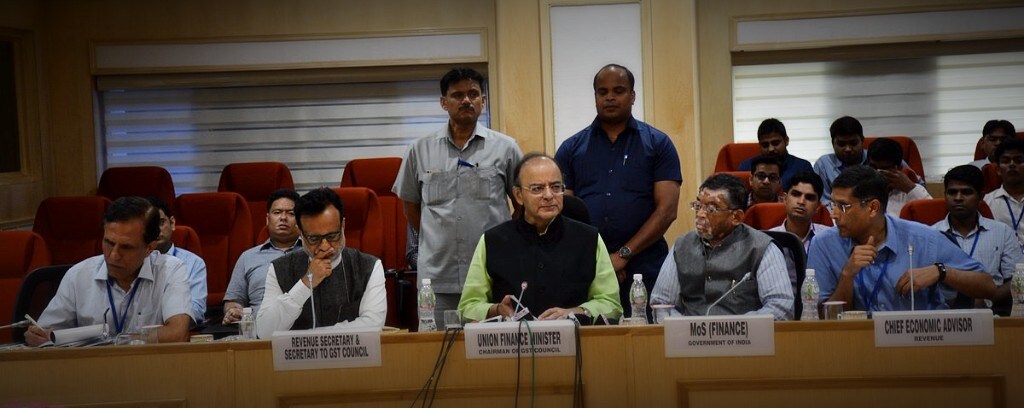
The finance ministry is examining various issues including overhaul of procurement procedures and the salary structure of employees as part of the proposal to convert Goods and Services Tax Network into a government company.
These two issues, along with other transitional and operational nuances, would be placed before the Union Cabinet for consideration once the GST Council clears the proposal of turning GSTN into a majority or fully-owned government entity, a person familiar with the matter told PTI.
Also Read: Taxpayers Can Now Check GST History Of Their Suppliers, Says GSTN CEO
Finance Minister Arun Jaitley had earlier this month asked Finance Secretary Hasmukh Adhia to “examine the possibility” of converting GSTN into a majority government company or a 100 percent government company. GSTN provides the information technology backbone for the new indirect tax regime.
Currently, five private financial institutions – Housing Development Finance Corporation Ltd., HDFC Bank Ltd., ICICI Bank Ltd., NSE Strategic Investment Corporation Ltd. and LIC Housing Finance Ltd. – hold 51 percent stake in GSTN, which was incorporated on March 28, 2013, in the erstwhile UPA regime. The remaining 49 percent is with the Centre and states.
The current structure of GSTN where financial institutions hold the majority 51 percent stake gives the entity flexibility in quick procurement through tendering process.
However, turning it into a government entity would mean that procurement – that currently occurs on a real-time basis – will have to be in sync with those of PSUs and state-owned companies, a source said.
Another aspect that would come into play could be the salary structure. Currently, the employee remuneration is at par with those in the private sector, but transforming GSTN to a government entity would change that, the person privy to the development added.
These issues are currently being discussed by the officials within the finance ministry, the source said, adding the ministry is hopeful of a seamless transition given that the GST collections have stabilised over the last nine months and businesses are familiar with the systems.
The government's stake in GSTN was initially kept at 49 percent and incorporated as a private company to “allow adequate flexibility and freedom” to “ensure timely implementation of the IT infrastructure” prior to GST rollout.
The new indirect tax regime, which subsumed over a dozen local taxes, was rolled out on July 1, 2017. Over one crore businesses are registered on the GSTN portal.
GSTN is a Section 8 company under the new Companies Act and hence is a not-for-profit entity.
The source said that there are no hindrances from the private shareholders in selling their stake to the government because GSTN does not give dividend.
The finance ministry is in favour of making GSTN a wholly-owned company with 100 per cent share holding, but a final call would be taken by the GST Council, headed by Jaitley and comprising state counterparts, in its next meeting.
After GST Council's clearance, the proposal will go to the Union Cabinet.

-
Where You Live Shapes How You Get To Work | The Reason Why

Two-wheelers are the most popular way to get to work in India, accounting for nearly 43% of workplace commutes.
-
High US Salaries, No Green Card Certainty: The Financial Calculation Facing Indian H-1B Families
The suspension of PERM processing at eight technology employers does not cancel existing H-1B visas. What it does is force a question many Indian families have been avoiding: is the US salary worth tying your career and family plans to one employer?
-
Unhedged Position: Can India See An Indonesia-Style Time Correction?
The Nifty is trading below levels it first clocked in 2024. Is there, then, as I have suggested in the headline, potential that the current time correction drags on painfully for the next three-five, even ten years?
-
Navigating Friction And Energy Realities: An Analysis Of Marco Rubio's October Visit To India
Occurring at a critical juncture marked by stalled trade negotiations and escalating geopolitical pressures over global energy supplies, the visit offers a profound window into modern US-India relations.
-
India Exports Capital. Why Not Export Trusteeship?
The big question, then, is whether India can build an institution that global borrowers, investors, banks, and lawyers can trust, even without an Indian connection.
-
France's Economy & Politics Are In Crisis | The Reason Why
Let's look at how the French economy and politics evolved under Nicolas Sarkozy, Franois Hollande and Emmanuel Macron.
-
You May Inherit The Business. You Must Earn Its Credibility.
Succession tests the founder's ability to share authority as much as it tests the next generation's readiness to assume it.
-
Signing Deals Is One Thing; Making Them Work Is Another | The Week In Whys
Sometimes, things don't turn out as planned. Indian companies have lost some bids to rivals, some projects won't produce until 2030.
-
FOMC Wall, PERM Suspension, Hospital Stocks | Talking Points This Week
A PERM suspension would directly affect green-card sponsorship rather than H-1B visas, so the near-term earnings impact could remain relatively limited. The key question is whether this marks a new phase in US scrutiny of Indian IT.
-
Everything, Everywhere, All At Once: Dalal Street's Week To Forget | Joining The Dots
Visa curbs, a Starlink spat and cancer drug caps: what connects this week's shocks for Indian markets









