EU, India To Resume FTA Talks With AI, Chips, Clean Energy On Agenda
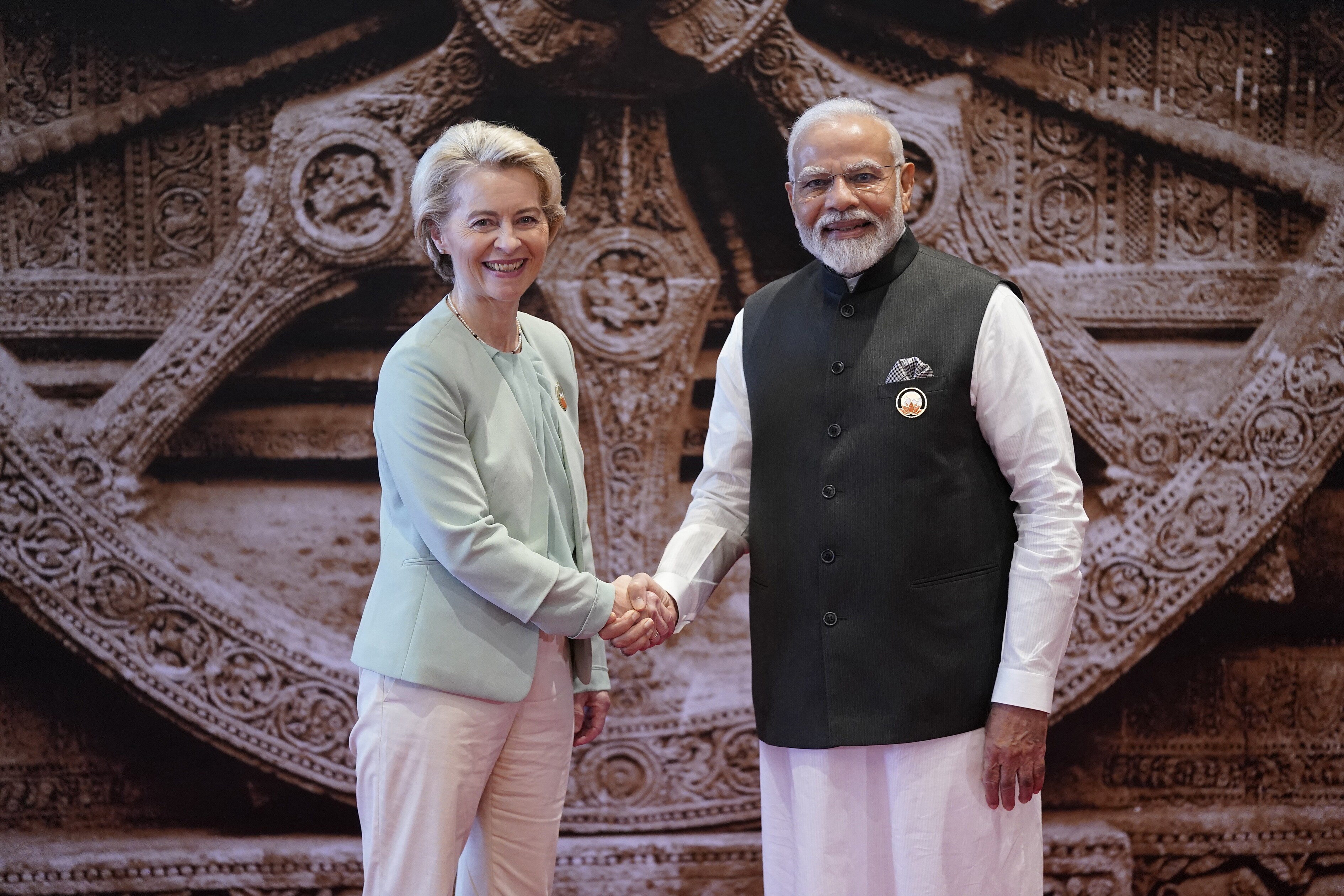
The European Union and India are set to resume talks for a free-trade agreement, as European Commission President Ursula von der Leyen commences her two-day visit to New Delhi on Thursday.
While Leyen will meet with Prime Minister Narendra Modi, India's Commerce Minister Piyush Goyal will hold talks with his counterpart, EU Commissioner for Trade Maros Sefcovic. The talks will largely revolve around negotiations for a free trade agreement, apart from the India-EU Trade and Technology Council.
The talks will deepen engagement "particularly in trade and investments, resilient supply chains, digital technologies, AI, semiconductors, green hydrogen, clean energy, sustainable urbanisation, water management, defence and space," according to India's Ministry of External Affairs.
Lowering tariffs on cars and liquor has been EU's demand, while India has negotiated for concessions for its MSMEs.
The Indian delegation is also likely to bring up concerns around EU's Carbon Border Adjustment Mechanism or CBAM, as well as the region's Deforestation Regulation as a trade barrier. Various leaders, including Goyal and Chief Economic Advisor V Nageswaran, have publicly said that CBAM and EUDR are "trade protection measures garbed in the language of climate and environment".
This is the first ever visit of the EU College of Commissioners together to India and the first visit outside of Europe by the new College of Commissioners that took office in December 2024.
India and the EU entered a 'Strategic Partnership- A Roadmap to 2025' long back in 2004. The two have also been in trade pact negotiations since 2007, with the last round of talks taking place in June 2022.
The EU is India's largest trading partner in goods. Bilateral trade in goods with the EU stood at $135 billion in fiscal 2024, with exports to EU at $76 billion and imports at $59 billion.
Services stood at $53 billion in 2023, comprising Indian exports worth $30 billion and imports worth $23 billion.

-
A New Samvat Wishlist: Inclusive Prosperity And Human Development

India has strengthened its economic foundations through infrastructure, digital access and enterprise. Its next growth chapter must deepen productivity, create better livelihoods and widen participation in prosperity.
-
Love, Sex Aur Dhokha: The Audacious Plot To Spy On Jensen Huang
A Taipei dinner, a Singapore chip buyer and a suspected Chinese asset: inside the alleged spy operation that got close to NVIDIA's Jensen Huang.
-
Ten Things I Learnt This Samvat
Patience can be a trap. Cheap stocks can stay cheap. Leverage can wipe you out. What did Samvat 2082 teach us? Niraj Shah writes on 10 lessons from the year gone by.
-
Talking Points This Week: Tech Nerves, FII Buying, And A Faraway Banking Shock
The global markets are not shining this Diwali. The exception in the large markets is, India.
-
Midterm Rally Lasted A Day. The Hard Reality Of A Divided US May Last Two Years | Opinion
Between a contested AI boom, a debt ceiling that arrives in 2027 and a president with every incentive to act alone, the next two years may prove more volatile than the first day's rally suggests.
-
Blue Wave Will Derail the AI Trade but Won't Dismantle the AI Era | Unhedged Position
The Democrats' sweep of the US Congress will see politics collide with economic forces both over the long and short term.
-
It's Time To Take The GST Council's Bet On Trust Global
Payment records can prove India's services exports, and clear, proportionate rules can bring foreign digital sellers into the tax net.
-
Opinion | India at 38: From Innovation Overperformer to Innovation Powerhouse
India now has 453 VC-backed deep science startups, 18 of them late-stage, after 117 percent growth since 2020. Laurus Labs, at USD 9.3 billion, is the most valuable deep science company in any middle-income economy outside China.
-
Navigating Energy Crossroads: S Jaishankar's Call For Diversified Supply Chains At G20 Ministerial Meeting
As geopolitical fault lines continue to test maritime trade routes and commodity flows, Jaishankar's message remains pertinent: true economic resilience requires open markets, protected transit lines, and a genuine commitment to multilateral cooperation rather than coercion.









