Budget 2017: The Jobs Data Vacuum
A major difficulty faced by observers of economic policies in India is the absence of up-to-date data on employment. Consider, for instance, demonetisation. We will start getting some estimates of what impact it has had on output or GDP within a few weeks. But there are no similar estimates on how the growth of employment in India responds to policy changes.
The most important source of data on employment in India is the employment and unemployment surveys conducted by the National Sample Survey Organization (NSSO).
These are household surveys employing fairly large samples and are usually conducted every five years. The latest such survey was held in 2011-12, and it covered 1,01,724 households across the country. There are, of course, surveys based on relatively small samples conducted by the Labour Bureau and also by the NSSO itself. But these are less representative and less reliable compared to NSSO's surveys using large samples.
Making sense of data on employment in India is not easy.
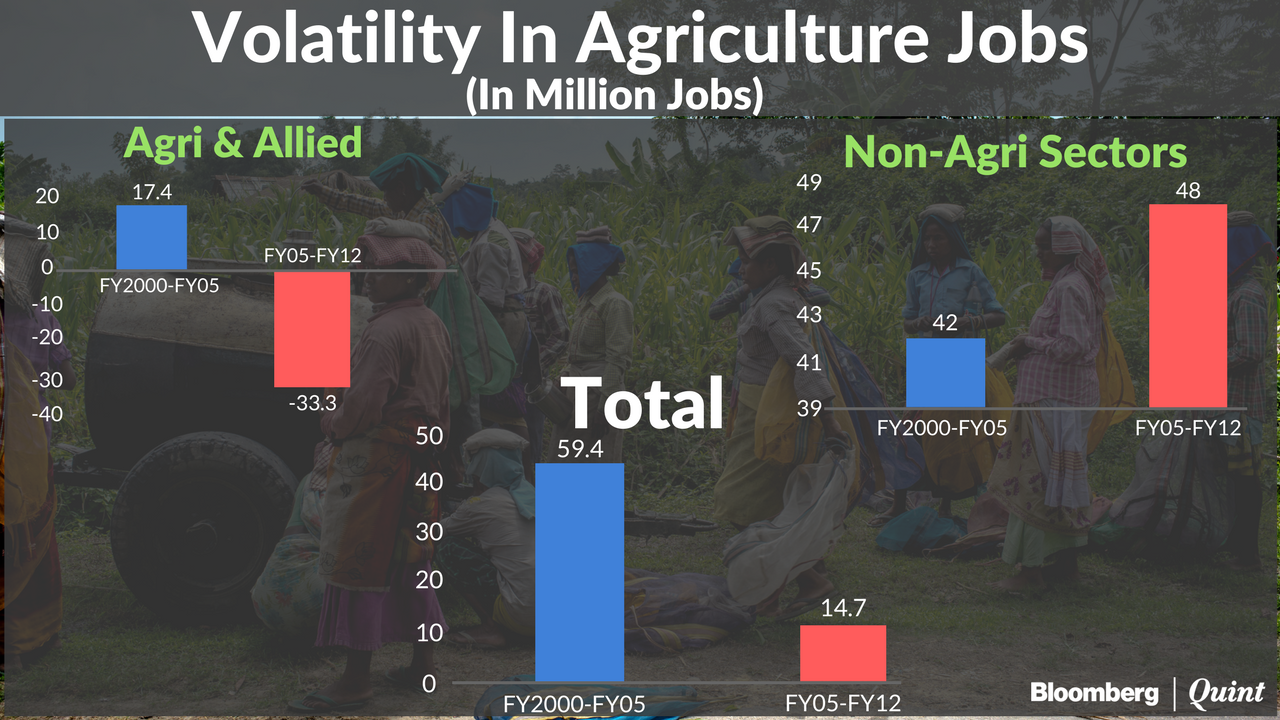
To illustrate, consider the numbers on employment growth in India during the 2000s. NSSO data suggests that overall employment in India increased impressively, by 59.4 million, during the five years between 1999-2000 and 2004-05. However, during the next seven years, that is, between 2004-05 and 2011-12, overall employment in India increased by only 14.7 million.
It will be tempting to conclude from the above that the Indian economy's ability to generate jobs reduced drastically during the second half of the 2000s. In fact, in a recent article, S. Gurumurthy attributed the slow growth of employment in India after 2004-05 to the policies followed by the United Progressive Alliance government at the centre.
Volatility In Agriculture Jobs
The problem with such a conclusion, however, is that it is based on an analysis of the growth of overall employment, which is the sum of employment generated in agriculture and the non-agricultural sectors. Arthur Lewis, who won the Nobel Prize for his work in the area of development economics, had famously predicted during the 1950s that employment in agriculture would decline with economic progress.
Curiously, however, workers employed in agriculture and allied activities in India increased by 17.4 million during the first half of the 2000s.
In fact, employment in agriculture accounted for almost a third of the overall generation of employment in the country (of 59.4 million) during that period.
On the other hand, between 2004-05 and 2011-12, employment in agriculture and allied activities in India fell by 33.3 million, while employment in the non-agricultural sectors increased by 48.0 million. As a result, overall employment increased only modestly, by 14.7 million, during the seven years after 2004-05.
Why did agricultural employment increase during the first half of the 2000s and fall subsequently? It is pertinent to note here that these changes in employment occurred largely in the case of females. Therefore, one possibility is that these changes simply reflect the ways in which the NSSO investigators defined self-employment of females in agriculture over the various survey rounds.
At the same time, some scholars argue that the increase in employment in agriculture in 2004-05 was indeed real.
It was a case of female members turning to self-employment as a last-ditch effort to support their families, given the general distress in rural areas and the falling household incomes at that time.
By the same token, the argument goes, the withdrawal of female workers from agriculture as seen in the NSSO's 2011-12 survey was partly a reflection of the improvement in conditions in rural India by that time. In fact, for rural India, the second half of the 2000s was characterized by a modest improvement in agricultural growth and the creation of employment by public works programmes, mainly the Mahatma Gandhi National Rural Employment Guarantee Act. There was a clear upturn in rural wages in India during the second half of the 2000s as compared to the first half.
Bias Towards Construction
To summarise, the slowdown in the growth of overall employment in India during the second half of the 2000s is on account of a massive withdrawal of workers from the agricultural sector. The latter is, in turn, an outcome driven largely by some positive changes in rural India, including a significant expansion of enrollment in educational institutions and the opening up of new opportunities, mainly in construction.
At the same time, the slow growth of job opportunities in the manufacturing and services sectors is a continuing concern for the Indian economy. Of the net increase of 48 million new non-agricultural jobs in India between 2004-05 and 2011-12, 24 million or half of the total increase was on account of jobs in the construction sector, which is characterised by low wages and poor working conditions.
Variance In NSSO And Census Data
It is interesting to examine in this context data on employment from another source, the Census of India. Evidence from 2011 census does not point to any shift of India's workforce away from agriculture – in contrast to the findings from the NSSO surveys in this regard. NSSO showed a marked decline in the size of the agricultural workforce and a rise in rural construction jobs after the mid-2000s in States such as Bihar, Uttar Pradesh, Madhya Pradesh, Rajasthan, and Odisha. On the contrary, census data showed that the size of agricultural workers in the marginal category (workers who worked for short periods, between 0 and 6 months) had risen in these very states, between 2001 and 2011.
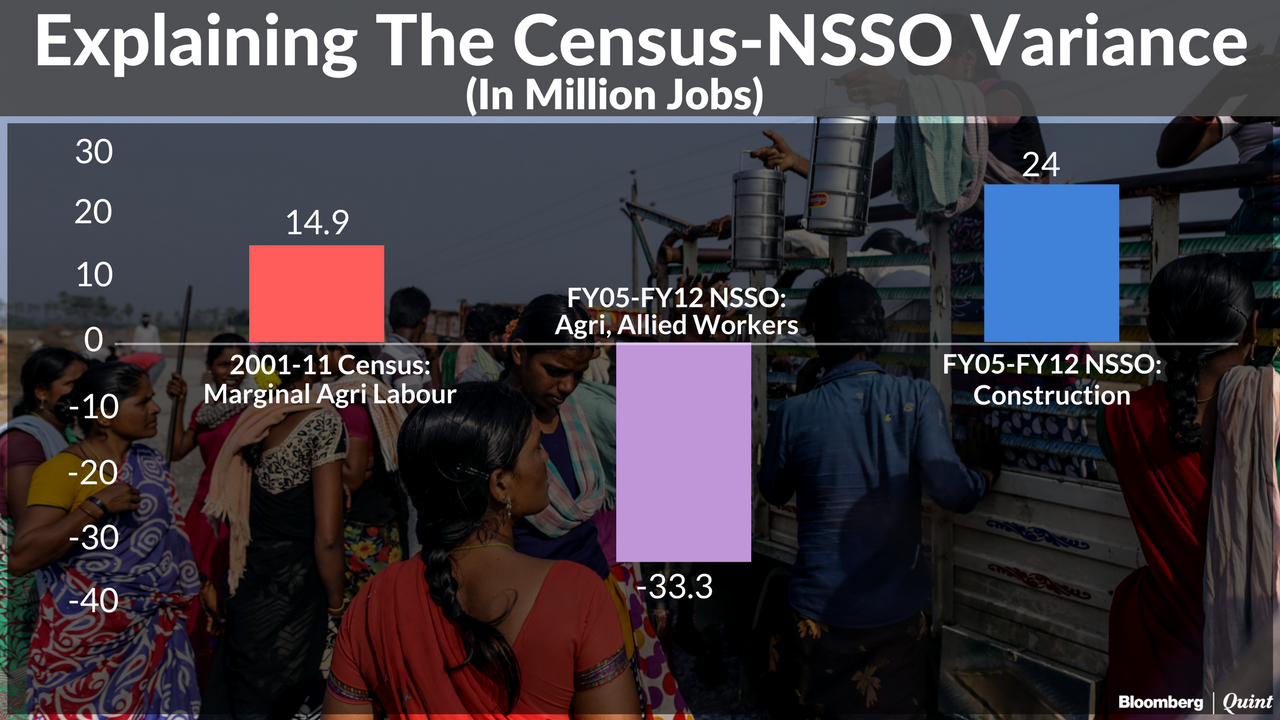
The key to such discrepancies between the findings from the census and NSSO is a large increase in the incidence of short-term migration from rural India in recent times. These migrants work mainly as construction workers in urban areas for a few months of the year, only to return to their villages and engage as agricultural workers for the remaining months. It is possible that the census might have counted some of these workers as marginal agricultural labourers while the NSSO had categorized them in the construction sector.
It is clear that agriculture will soon cease to become an employment option for the young in rural India. Therefore, it is important that sufficient numbers of decent jobs are created in the manufacturing and services sectors to absorb the new entrants to the country's workforce. Until that happens, India's rural labour markets will be in a state of turmoil.
Jayan Jose Thomas teaches economics at the Indian Institute of Technology, Delhi.
The views expressed here are those of the author's and do not necessarily represent the views of BloombergQuint or its editorial team.

-
Midterm Rally Lasted A Day. The Hard Reality Of A Divided US May Last Two Years | Opinion

Between a contested AI boom, a debt ceiling that arrives in 2027 and a president with every incentive to act alone, the next two years may prove more volatile than the first day's rally suggests.
-
Blue Wave Will Derail the AI Trade but Won't Dismantle the AI Era | Unhedged Position
The Democrats' sweep of the US Congress will see politics collide with economic forces both over the long and short term.
-
It's Time To Take The GST Council's Bet On Trust Global
Payment records can prove India's services exports, and clear, proportionate rules can bring foreign digital sellers into the tax net.
-
Opinion | India at 38: From Innovation Overperformer to Innovation Powerhouse
India now has 453 VC-backed deep science startups, 18 of them late-stage, after 117 percent growth since 2020. Laurus Labs, at USD 9.3 billion, is the most valuable deep science company in any middle-income economy outside China.
-
Navigating Energy Crossroads: S Jaishankar's Call For Diversified Supply Chains At G20 Ministerial Meeting
As geopolitical fault lines continue to test maritime trade routes and commodity flows, Jaishankar's message remains pertinent: true economic resilience requires open markets, protected transit lines, and a genuine commitment to multilateral cooperation rather than coercion.
-
Indians Are Travelling, But Not Every Journey Is A Holiday | The Week In Whys
Pilgrims, patients and working women are the real travellers, and the system hasn't quite caught up with them.
-
Getting To Work Costs Women More | The Reason Why
It is not just about women paying more than men. It is about women paying much more in cities than in villages.
-
AI Bias In Investing Cannot Be Eliminated, But It Can Be Governed
Framing is a particularly important example as identical financial information presented in terms of gains rather than losses can lead an LLM to reach a different assessment.
-
Joining The Dots | Dark Skies, Steady Diya: Why Hope Holds This Diwali
With war, a weak rupee and foreign outflows weighing on sentiment, policymakers at the NDTV World Summit and market veterans at NDTV Profit Ignite: Diwali Edition offered the same advice: stay invested and filter out the noise.









