Base Metals Index Repeats Worst Weekly Rout Of The Year
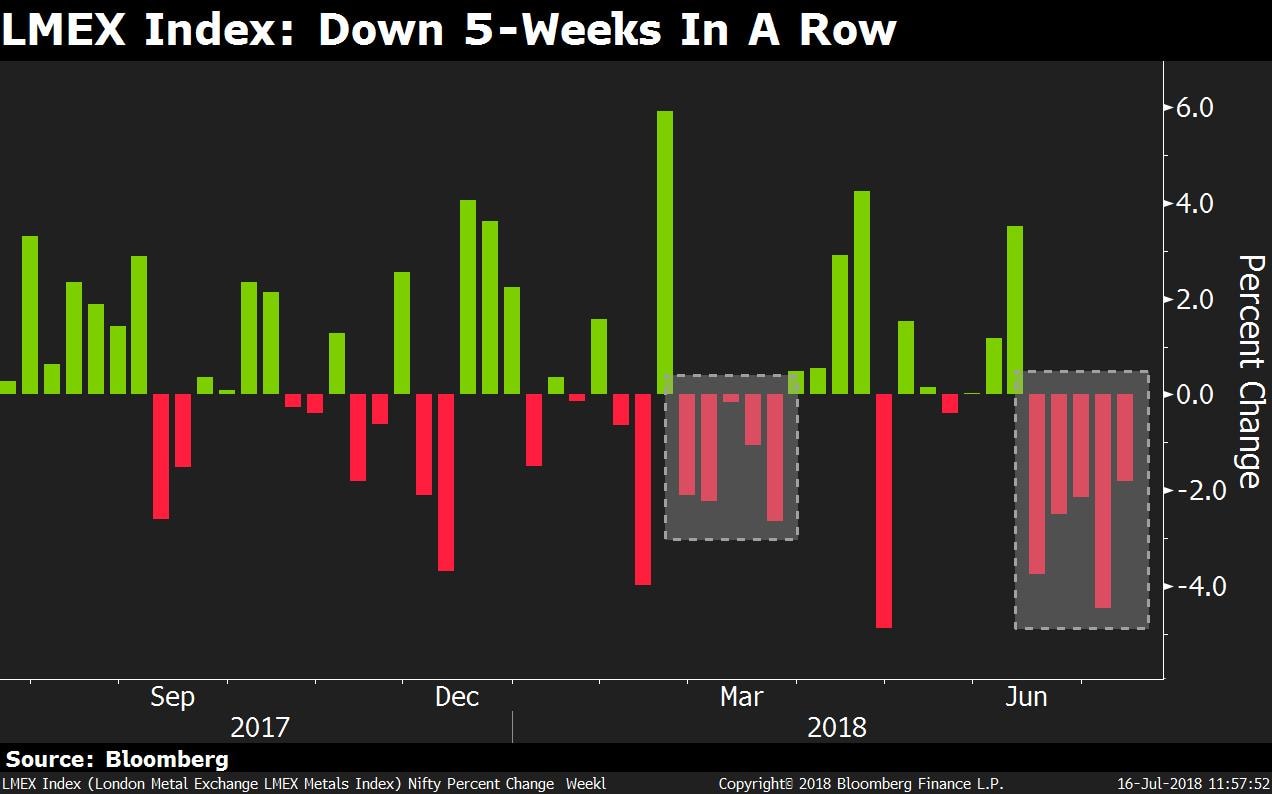
The base metals index of the London Metal Exchange repeated its worst weekly rout this year.
The index declined for five weeks in a row, equaling its longest losing streak since March this year. The gauge comprising six metals that has dropped over 12 percent so far this year hasn't had a five-week losing streak since 2015.
All but one metal, nickel, declined this year, with zinc — that saw a 20 percent drop — being the worst-hit. Nickel was also the best performer, gaining 10 percent in the same period.
Long positions are witnessing liquidation and fresh selling has emerged in anticipation of rising trade tension, said Robin Bhar, head of metals research at Societe Generale, in a recent research report. He has a risk-off view on metals along with a neutral rating for the base metals. A full-blown trade war only has a 20 percent likelihood, he said, adding: “A potential trade war would be painful and have negative implications for metals.”
Andy Blamey, associate editorial director of EMEA Nonferrous Metals & Analytics at S&P Global Platts shares his outlook on the base metals with BloombergQuint:
Copper
Copper is the most “China-sensitive” of the major base metals and therefore the most prone to negative sentiment due to the escalating US-China trade dispute. Supportive factors for copper include ongoing and forthcoming labor talks at many major mining operations, with the potential for supply disruptions as a result. Copper and zinc have seen significant short positions build in the futures market as speculative players bet against the market in the near term.
Aluminum
Aluminum prices spiked earlier in the year due to the U.S.' imposition of import tariffs and sanctions.
Nickel
The metal made strong gains in recent months, driven by expectations of a surge in the demand for nickel units in electric-vehicle batteries. While analysts agree EV demand will be a game-changer, the gains for now are more potential than actual, with the stainless-steel industry remaining by far the largest end-use sector. Macroeconomic jitters that have affected base metals have prompted some long liquidation in nickel, driving prices lower.

-
Talking Points This Week: Tech Nerves, FII Buying, And A Faraway Banking Shock

The global markets are not shining this Diwali. The exception in the large markets is, India.
-
Midterm Rally Lasted A Day. The Hard Reality Of A Divided US May Last Two Years | Opinion
Between a contested AI boom, a debt ceiling that arrives in 2027 and a president with every incentive to act alone, the next two years may prove more volatile than the first day's rally suggests.
-
Blue Wave Will Derail the AI Trade but Won't Dismantle the AI Era | Unhedged Position
The Democrats' sweep of the US Congress will see politics collide with economic forces both over the long and short term.
-
It's Time To Take The GST Council's Bet On Trust Global
Payment records can prove India's services exports, and clear, proportionate rules can bring foreign digital sellers into the tax net.
-
Opinion | India at 38: From Innovation Overperformer to Innovation Powerhouse
India now has 453 VC-backed deep science startups, 18 of them late-stage, after 117 percent growth since 2020. Laurus Labs, at USD 9.3 billion, is the most valuable deep science company in any middle-income economy outside China.
-
Navigating Energy Crossroads: S Jaishankar's Call For Diversified Supply Chains At G20 Ministerial Meeting
As geopolitical fault lines continue to test maritime trade routes and commodity flows, Jaishankar's message remains pertinent: true economic resilience requires open markets, protected transit lines, and a genuine commitment to multilateral cooperation rather than coercion.
-
Indians Are Travelling, But Not Every Journey Is A Holiday | The Week In Whys
Pilgrims, patients and working women are the real travellers, and the system hasn't quite caught up with them.
-
Getting To Work Costs Women More | The Reason Why
It is not just about women paying more than men. It is about women paying much more in cities than in villages.
-
AI Bias In Investing Cannot Be Eliminated, But It Can Be Governed
Framing is a particularly important example as identical financial information presented in terms of gains rather than losses can lead an LLM to reach a different assessment.









