A GST Problem That Threatens Domestic Cash Transfer Services
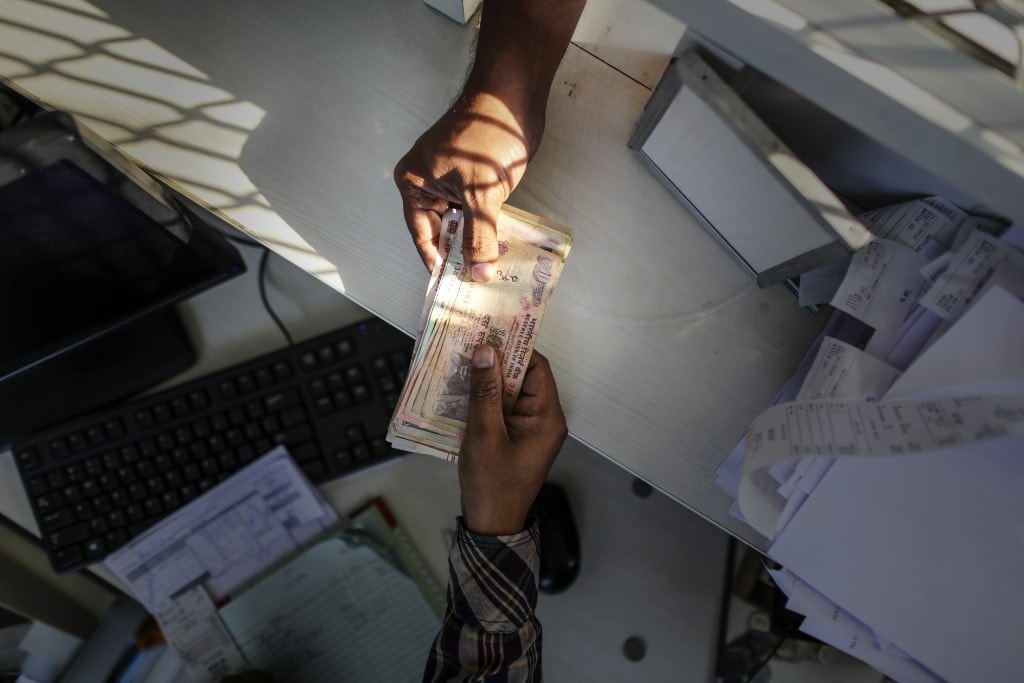
A slew of goods and services tax demands have been made on banks to pay GST on the fees charged by their banking correspondents for cash transfer services, according to four persons aware of the development. This threatens the domestic remittances business of many banks, according to these four officials. It, however, does not impact other functions like credit, loan applications etc that are also part of a business correspondent's remit.
Axis Bank has shut its domestic money transfer operations — the mechanism to transfer money for non-account holders via banking correspondents — after it was asked to pay about Rs 10 crore of GST, according to two officials handing the case but who didn't want to be named. The private lender refused to comment on the matter.
ICICI Bank, Yes Bank and RBL Bank are considering to restructure or shut similar operations, said the two officials quoted above. While ICICI Bank declined to comment, Yes Bank and RBL Bank did not respond to emails seeking comment.
Domestic money transfer operations are used by those unable to access conventional banking services. They can go to a Customer Service Point, say a kirana shop or a medical store to remit funds, for which the CSP will charge a fee. CSPs process the transaction with the help of banking correspondents contracted by banks and enable the remittance of funds to the designated bank account. The customer pays a service fee to the CSP, who in turns pays a fee to the BC, who shares some of it with the bank.
Such a service is most commonly used by migrant labourers to transfer wages to their families based in rural areas, said a banker who preferred not be named. About Rs 5,000-6,000 crore remittances take place a month with an average ticket size of Rs 4,000, he added.
The GST Demand
Based on industry standards, the total service fee charged by CSPs, BCs and banks put together ranges from 1-1.5 percent, said the banker.
So for instance, a labourer transfers Rs 10,000 to his family using the domestic transfer service. The CSP collects a Rs 100 service fee. He keeps Rs 50 and passes the remaining to the BC. The BC keeps Rs 35 and the remaining Rs 15 is paid to the bank as its service fee.
Under the GST regime, the bank pays tax on the Rs 15 it gets as service fee, and BCs are also to pay GST on their portion of the service fee. But CSPs such as kirana stores are exempt from GST if their annual turnover is below Rs 20 lakh, and hence are not liable to pay GST.
It is this untaxed portion of the fee that the taxman wants to cover for fear of lost tax revenue.
Hence, tax authorities have asked banks to pay GST on the entire service fee, that's the full Rs 100 as per the illustration, for transactions done in the last five years.
These demands have been made in meetings with banks and not via formal notices, said two people handling tax cases for these banks. An email sent to the finance ministry spokesperson seeking confirmation of the tax department's position did not elicit a response.
The GST demand has raised two issues, say experts.
One, if banks pay on behalf of the entire chain of service providers how do they recover the tax from them. While the intention of the government is to tax the full value chain in money deposit services in hands of banks rather than small intermediaries, the precise contractual arrangement would need to be examined between banks, BCs and end customers, said Krishan Arora, a partner at consultancy Grant Thornton.
The other issue is that of potential double taxation. Banks are unnecessarily burdened if they are asked to pay tax on the entire service fee, ignoring the tax paid by the BC, said Sumit Lunker, an indirect tax partner at consultancy PwC India.
The government needs to ensure that such taxability on account services provided by BCs should not result in undue and double taxation in hands of banks and BCs making such arrangements unviable, Arora told BloombergQuint.
Unsustainable For Banks
Cash transfers is a thin margin business, and it's unfair to pay tax on income that is not the bank's own, said the banker quoted earlier.
Besides this, if banks decide to wind down or scale down the service it would impact the income of 6.4 lakh banking correspondents and CSPs, who earn an extra Rs 4,000-5,000 every month providing this service, according to data shared by the Banking Correspondent Federation of India.
This could shut down the domestic transfer business, and it would be a big setback for the government and RBI as the intent here is financial inclusion, said Lunker.
Arora agreed. This may be against the overall spirit of financial inclusion and digital India initiatives of government aiming to provide such services to the masses, he said.

-
Opinion | India at 38: From Innovation Overperformer to Innovation Powerhouse

India now has 453 VC-backed deep science startups, 18 of them late-stage, after 117 percent growth since 2020. Laurus Labs, at USD 9.3 billion, is the most valuable deep science company in any middle-income economy outside China.
-
Navigating Energy Crossroads: S Jaishankar's Call For Diversified Supply Chains At G20 Ministerial Meeting
As geopolitical fault lines continue to test maritime trade routes and commodity flows, Jaishankar's message remains pertinent: true economic resilience requires open markets, protected transit lines, and a genuine commitment to multilateral cooperation rather than coercion.
-
Indians Are Travelling, But Not Every Journey Is A Holiday | The Week In Whys
Pilgrims, patients and working women are the real travellers, and the system hasn't quite caught up with them.
-
Getting To Work Costs Women More | The Reason Why
It is not just about women paying more than men. It is about women paying much more in cities than in villages.
-
AI Bias In Investing Cannot Be Eliminated, But It Can Be Governed
Framing is a particularly important example as identical financial information presented in terms of gains rather than losses can lead an LLM to reach a different assessment.
-
Joining The Dots | Dark Skies, Steady Diya: Why Hope Holds This Diwali
With war, a weak rupee and foreign outflows weighing on sentiment, policymakers at the NDTV World Summit and market veterans at NDTV Profit Ignite: Diwali Edition offered the same advice: stay invested and filter out the noise.
-
The Curious Case of Equitas Small Finance Bank And A CEO Who Quit For Stock
PN Vasudevan believes persistent investor concerns over a perceived conflict of interest had become a governance overhang on Equitas Small Finance Bank's stock, even as the lender improved profitability and asset quality.
-
Talking Points This Week: AI Cash Burn, A Tiger Comeback And An India That Still Finds Its Own Path
India is not immune to higher oil or tighter global liquidity, yet its earnings base is broader, its domestic policy levers are still available.
-
Foreign Investors Own Half Of HDFC Bank and ICICI Bank. An LTCG Cut Could Matter Most Here
Foreign portfolio investors have US$115 billion parked in HDFC Bank, ICICI Bank. If the government cuts long-term capital gains tax, Jefferies says returning foreign money could land here first.










