Ethereum Finishes Long-Awaited Energy-Saving ‘Merge’ Upgrade

(Bloomberg) -- Ethereum has completed a key revamp of its blockchain network, marking the crypto world's most-ambitious software upgrade to date.
Called the Merge, the upgrade completed in the early hours of Thursday, said Ethereum co-founder Vitalik Buterin in a Twitter post.
The change replaced power-hungry computers that were used to order transactions on the network with a more energy-efficient setup using piles of the network's native token, Ether, placed in special, so-called staking wallets. As a result, Ethereum's energy consumption will decline by an estimated 99%.
Such an upheaval had never been attempted in crypto before, let alone on Ethereum, home to about 3,500 active decentralized apps, ranging from exchanges to games and handling billions of dollars worth of crypto. In the works for years, the Merge doesn't change the end-user experience on Ethereum, but it's a key stepping stone to more upgrades that will make the network faster and cheaper, and should further increase its stature and usage.
“This is the first step in Ethereum's big journey toward being a very mature system,” Buterin said during an online Merge viewing party-- essentially a public video call where developers tracked live progress on the switch. “And there's steps left to go. We still have to scale, we have to fix privacy. To me the Merge symbolizes the difference between an early stage Ethereum and the Ethereum we've always wanted.”
As it became clear the transition had worked, developers who had worked on the the project for months started congratulating each other on the call. Watched by more than 41,000 people at peak, the viewing party featured content ranging from dry technical explanations of what the Merge would entail, to the performance of a Merge-themed song. Lyrics included: “Carbon footprint is all gone. That's why we are singing the Merge song.”
The Merge also changed properties of Ether, making it more akin to yield-bearing securities. Staked Ether will generate a return, expected to be around 5.2% after the Merge, according to tracker Staking Rewards. Coupled with an expected net decrease in Ether token supply soon after the update, that should make the coin more attractive to investors.
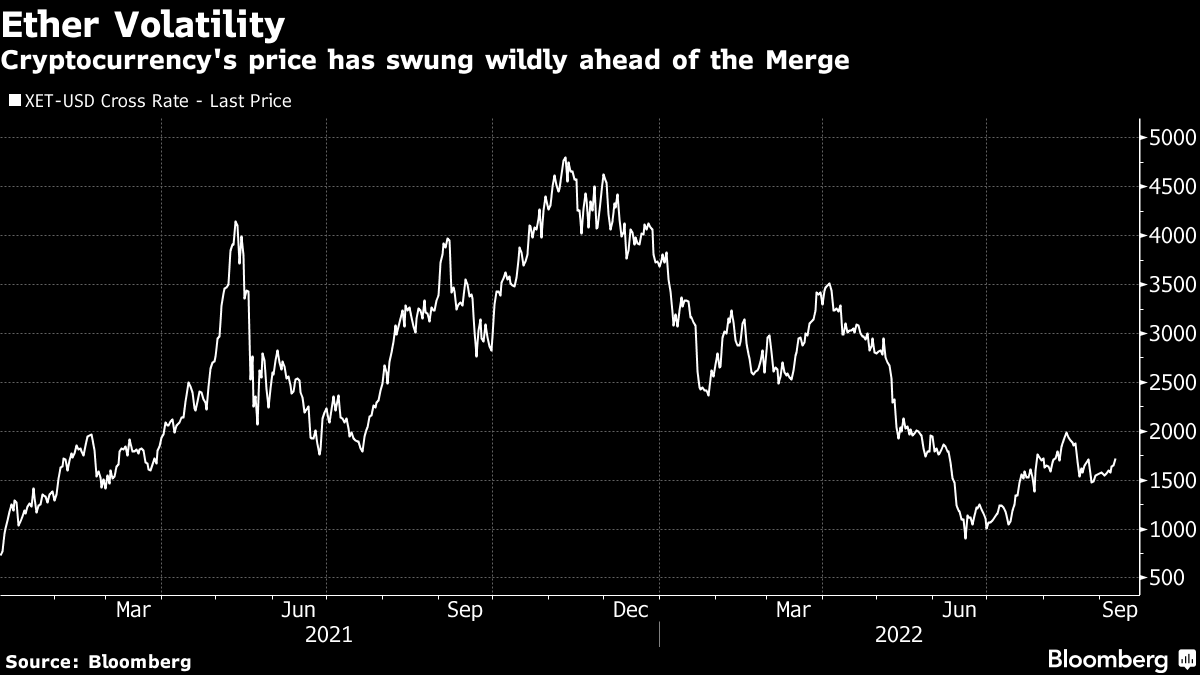
Ether was down 1.2% to $1,584 following the merge. The token has surged more than fivefold in 2021, outperforming Bitcoin by a wide margin, in part on optimism over the Merge. Both cryptocurrencies have struggled since hitting record highs in November, with Ether down more than 50% this year.
The software upgrade is called the Merge because the existing Ethereum blockchain will combine with a parallel network that's been running for almost two years to test the proof-of-stake concept. Overall, the upgrade has been under consideration for over seven years.
Even though completed, the Merge could be followed by days or even weeks of hiccups, based on what happened after some prior Ethereum software updates. Worried about bugs and hacks, crypto exchanges like Coinbase Global Inc. paused Ethereum-related withdrawals and deposits around the time of the software upgrade. Crypto lender Aave had suspended Ether borrowing in advance of the Merge.
Adding to the concern is the likely creation of copies of Ethereum that still use power-hungry computers called miners. These forks, such as EthereumPOW, create their own copies of Ether coins given to all holders of mainstream Ether. The tokens may have some value. But the existence of several versions of Ether -- each running on a different chain -- could create confusion and give rise to attacks and scams. So can copies of other tokens running on forked chains.
While all apps and wallets currently on Ethereum have been replicated on the forked chains, most apps are likely to be broken, as key players -- USDC stablecoin issuer Circle and oracle provider Chainlink among them -- have said they won't support the forked versions. Whether the forked chains can stay viable in the long run remains to be seen.
Large teams of Ethereum developers from all over the world have worked on the Merge for years. In late 2020, they debuted Beacon Chain, a parallel network that was testing the ordering transactions via staked coins, or a system called proof of stake. In the Merge, Beacon was merged with the main Ethereum network, using miners, and made Beacon Ethereum's way of testing the ordering of network transactions.
(Updates first paragraph and prices.)
More stories like this are available on bloomberg.com
©2022 Bloomberg L.P.

-
Love, Sex Aur Dhokha: The Audacious Plot To Spy On Jensen Huang

A Taipei dinner, a Singapore chip buyer and a suspected Chinese asset: inside the alleged spy operation that got close to NVIDIA's Jensen Huang.
-
Ten Things I Learnt This Samvat
Patience can be a trap. Cheap stocks can stay cheap. Leverage can wipe you out. What did Samvat 2082 teach us? Niraj Shah writes on 10 lessons from the year gone by.
-
Talking Points This Week: Tech Nerves, FII Buying, And A Faraway Banking Shock
The global markets are not shining this Diwali. The exception in the large markets is, India.
-
Midterm Rally Lasted A Day. The Hard Reality Of A Divided US May Last Two Years | Opinion
Between a contested AI boom, a debt ceiling that arrives in 2027 and a president with every incentive to act alone, the next two years may prove more volatile than the first day's rally suggests.
-
Blue Wave Will Derail the AI Trade but Won't Dismantle the AI Era | Unhedged Position
The Democrats' sweep of the US Congress will see politics collide with economic forces both over the long and short term.
-
It's Time To Take The GST Council's Bet On Trust Global
Payment records can prove India's services exports, and clear, proportionate rules can bring foreign digital sellers into the tax net.
-
Opinion | India at 38: From Innovation Overperformer to Innovation Powerhouse
India now has 453 VC-backed deep science startups, 18 of them late-stage, after 117 percent growth since 2020. Laurus Labs, at USD 9.3 billion, is the most valuable deep science company in any middle-income economy outside China.
-
Navigating Energy Crossroads: S Jaishankar's Call For Diversified Supply Chains At G20 Ministerial Meeting
As geopolitical fault lines continue to test maritime trade routes and commodity flows, Jaishankar's message remains pertinent: true economic resilience requires open markets, protected transit lines, and a genuine commitment to multilateral cooperation rather than coercion.
-
Indians Are Travelling, But Not Every Journey Is A Holiday | The Week In Whys
Pilgrims, patients and working women are the real travellers, and the system hasn't quite caught up with them.









