Capital-Hungry Yes Bank Has Another Pain Point
When a former Yes Bank Ltd. executive started selling his stake in September, the lender's top managers watched for any sign that the resulting drop in share price would trigger a rush to withdraw deposits.
The stock sales came as customers of a regional lender -- Punjab & Maharashtra Co-operative Bank Ltd. -- were lining up outside its branches to withdraw their money following an alleged management fraud. Rampant speculation online about broader contagion forced the central bank to issue rare statements assuring the public of the safety of the financial system.
Yes Bank's loss of mom-and-pop deposits in September was manageable in the end, though it pointed to a risk for the lender whose peers HDFC Bank Ltd. and ICICI Bank Ltd. drew more savings from customers during that period. India's fourth-largest private lender has had a tumultuous 2019 with a new chief executive unable to raise the capital needed to bolster ratios that stand just above a regulatory minimum and quell analyst questions about its stability.
"It is now a vicious circle where a lack of capital is increasing concerns on the bank's bad loans, creating uncertainty among investors and depositors, which is adding to the withdrawal of low cost and retail term deposits," said Ravikant Anand Bhat, an analyst at IndiaNivesh Securities Ltd.
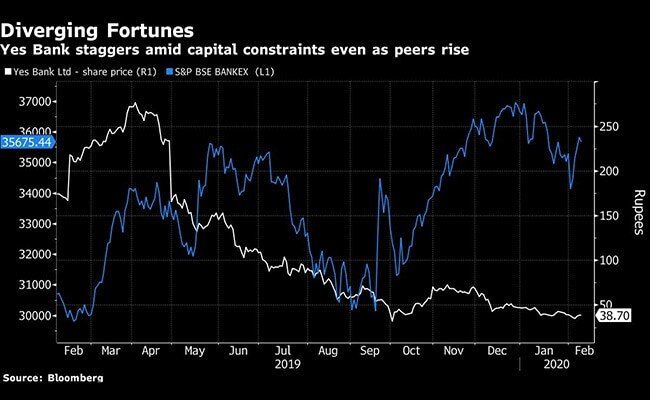
The lender's share price tanked 74 per cent last year as soured debt mounted given its exposure to shadow banks entangled in a prolonged crunch in the local credit market. The plunge has continued this year, with shares dropping about another 22 per cent even as a benchmark index remained little changed.
Yes is due to report results for the December quarter, which will show whether deposits eroded further in the last three months of 2019. Mr Bhat expects total deposits to decline another 20 per cent, after they dropped 7.3 per cent from June to Rs 2.1 lakh crore ($29 billion) as of September 30.
A Yes Bank spokesman declined to comment ahead of its earnings update. The lender issued a statement last month assuring customers about its liquidity and stability and said it is making every effort "to financially strengthen the bank further."
Chief Executive Officer Ravneet Gill said in October that the lender was shedding high-cost wholesale deposits in favor of trying to retain cheaper and more stable retail funds. In the September quarter, it saw outflows from both buckets at the same time as its loan book also contracted. Last June, to bolster Yes Bank's capital buffer, Mr Gill said he planned to raise $1.2 billion over 18 months. The lender raised about $275 million through a share sale to institutional investors in August, but hasn't managed to tap investors for a follow-on preferential offering since then.
The bank's board in November disclosed the names of several potential investors, though it has since rejected most of those. It's now looking to raise capital through other routes including another institutional share sale, for which it got shareholders' approval last week.
Moody's Investors Service cut Yes Bank's credit ratings in December and last month placed them under review. The credit assessor said the review of the lender's deposit rating reflects that its "standalone viability is getting increasingly challenged by its slowness in raising new capital."
The Moody's team led by Senior Credit Officer Alka Anbarasu said faith in the lender would be restored by a fresh cash injection or a "regulatory led resolution," as authorities seek to ensure stability in the banking system and protect depositors and creditors.
Deposit Insurance
One sign of official concern about the stability of deposits in the wider banking system came in a February 1 budget speech by Finance Minister Nirmala Sitharaman, who announced that insurance cover for individual bank deposits would rise five-fold to Rs 500,000. The minister assured lawmakers that savers' money is safe in banks. The measure is effective from February 4 and would benefit 92 per cent of Indian deposit accounts and about 28 per cent of all deposits by value, according to Citigroup Inc.
Depositors had swarmed PMC's branches last year after the Reserve Bank of India took the rare step of limiting withdrawals following reports that an insolvent developer had accounted for 73 per cent of the regional lender's total loan book. However, the RBI has since relaxed its caps on withdrawals from PMC, easing fears among depositors.
Still, S&P Global Ratings has warned that the credit profile of individual Indian lenders could deteriorate sharply in the event of "outsized exposure to weak entities, huge market or operational losses, or significant deposit withdrawals if the depositors lost confidence in the bank." S&P doesn't rate Yes Bank.
Other large private-sector banks continue to add deposits, according to the results published so far for the December quarter. HDFC Bank, ICICI Bank and Axis Bank Ltd. saw low-cost retail deposits rise between 14 per cent and 22 per cent.
For Yes Bank, the threat to its deposit base is likely to recede if it can bolster its capital ratios, IndiaNivesh's Mr Bhat said.
Risk Buffers
Even without a cash infusion, Yes Bank can manage its capital needs by restricting further lending. "The approach won't, however, address concerns among investors and depositors as without stronger risk buffers it can't absorb any sudden rise in bad loans," said Diksha Gera, Bloomberg Intelligence's Singapore-based banking analyst.
Yes Bank's total exposure to shadow lenders and developers -- both caught up in a funding crunch since late 2018 -- was 11.5 per cent as of September end, filings show. A Credit Suisse Group AG note in April marked Yes Bank out as the lender with the largest proportion of outstanding loans to large stressed borrowers, including Anil Ambani group companies, Essel Group, Dewan Housing Finance Corp. and Infrastructure Leasing & Financial Services Ltd.
Sourabh Jain, a Mumbai-based entrepreneur, was one of those who withdrew money from Yes Bank last year after observing the deposit outflow at PMC and a 34 per cent drop in Yes Bank's share price over just two days to October 1.
"I withdrew my money in October as I was worried about a PMC-like run on Yes Bank after its inability to raise capital and sharp fall in share prices," said Mr Jain, 42, who had been a depositor with the bank for four years. "I was not sure if the government will do anything to save the bank."

-
Ten Things I Learnt This Samvat

Patience can be a trap. Cheap stocks can stay cheap. Leverage can wipe you out. What did Samvat 2082 teach us? Niraj Shah writes on 10 lessons from the year gone by.
-
Talking Points This Week: Tech Nerves, FII Buying, And A Faraway Banking Shock
The global markets are not shining this Diwali. The exception in the large markets is, India.
-
Midterm Rally Lasted A Day. The Hard Reality Of A Divided US May Last Two Years | Opinion
Between a contested AI boom, a debt ceiling that arrives in 2027 and a president with every incentive to act alone, the next two years may prove more volatile than the first day's rally suggests.
-
Blue Wave Will Derail the AI Trade but Won't Dismantle the AI Era | Unhedged Position
The Democrats' sweep of the US Congress will see politics collide with economic forces both over the long and short term.
-
It's Time To Take The GST Council's Bet On Trust Global
Payment records can prove India's services exports, and clear, proportionate rules can bring foreign digital sellers into the tax net.
-
Opinion | India at 38: From Innovation Overperformer to Innovation Powerhouse
India now has 453 VC-backed deep science startups, 18 of them late-stage, after 117 percent growth since 2020. Laurus Labs, at USD 9.3 billion, is the most valuable deep science company in any middle-income economy outside China.
-
Navigating Energy Crossroads: S Jaishankar's Call For Diversified Supply Chains At G20 Ministerial Meeting
As geopolitical fault lines continue to test maritime trade routes and commodity flows, Jaishankar's message remains pertinent: true economic resilience requires open markets, protected transit lines, and a genuine commitment to multilateral cooperation rather than coercion.
-
Indians Are Travelling, But Not Every Journey Is A Holiday | The Week In Whys
Pilgrims, patients and working women are the real travellers, and the system hasn't quite caught up with them.
-
Getting To Work Costs Women More | The Reason Why
It is not just about women paying more than men. It is about women paying much more in cities than in villages.









