This Is World's Best-Performing IPO In 2021, Raised $1.3 Billion

South Korean biopharmaceutical firm SK Bioscience Co. is the top gainer among initial public offerings that raised more than $1 billion this year, leading a ranking dominated by listings from that country.
SK Bioscience's shares are up about 262% since they started trading in Seoul in the first quarter, the most among the 94 major offerings since January, according to data compiled by Bloomberg. The IPO raised $1.3 billion for the firm, which is a local Covid-19 vaccine-production partner with AstraZeneca Plc.
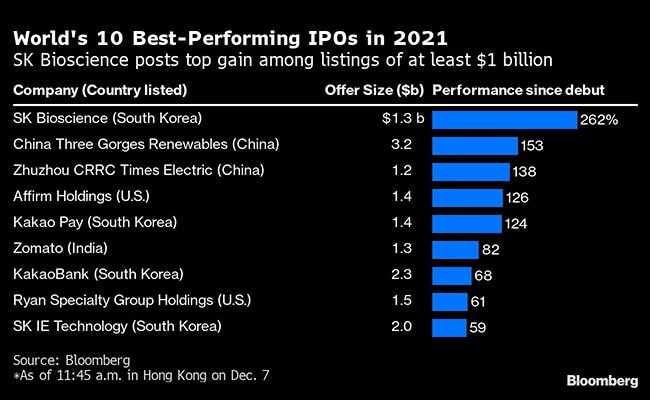
The company was the first among five Korean firms that raised more than $1 billion each through new-share offers this year, with several tech-related names also surging in their trading debuts. Most of those deals were buoyed by strong participation by retail investors. Ballooning valuations made regulators step up scrutiny as the year progressed.
SK Bioscience also outperformed two major listings in Shanghai, China Three Gorges Renewables Group and Zhuzhou CRRC Times Electric Co., which are each up more than 140%. Several other Korean names appear within the 10 top performers globally for the year, including Kakao Pay Corp., KakaoBank Corp. and SK IE Technology Co., giving the country more representation in the ranking than any market.
Shares of SK Bioscience surged to a record high in August after local media reported that the company would start shipping 1.1 million doses at that time. The company also got a boost from the inclusion in indexes tracked by MSCI Inc. in the same month.
But part of those stellar gains have already faded, with the stock retreating about 16% since the start of December. It is among an array of Asian health-care shares that dropped on Tuesday, following a slump in U.S. biotech companies, as investors reacted to reports suggesting cases of the omicron variant have been relatively mild.
The health-care firm has eight buy recommendations and no sell or hold calls among analysts tracked by Bloomberg.

-
Ten Things I Learnt This Samvat

Patience can be a trap. Cheap stocks can stay cheap. Leverage can wipe you out. What did Samvat 2082 teach us? Niraj Shah writes on 10 lessons from the year gone by.
-
Talking Points This Week: Tech Nerves, FII Buying, And A Faraway Banking Shock
The global markets are not shining this Diwali. The exception in the large markets is, India.
-
Midterm Rally Lasted A Day. The Hard Reality Of A Divided US May Last Two Years | Opinion
Between a contested AI boom, a debt ceiling that arrives in 2027 and a president with every incentive to act alone, the next two years may prove more volatile than the first day's rally suggests.
-
Blue Wave Will Derail the AI Trade but Won't Dismantle the AI Era | Unhedged Position
The Democrats' sweep of the US Congress will see politics collide with economic forces both over the long and short term.
-
It's Time To Take The GST Council's Bet On Trust Global
Payment records can prove India's services exports, and clear, proportionate rules can bring foreign digital sellers into the tax net.
-
Opinion | India at 38: From Innovation Overperformer to Innovation Powerhouse
India now has 453 VC-backed deep science startups, 18 of them late-stage, after 117 percent growth since 2020. Laurus Labs, at USD 9.3 billion, is the most valuable deep science company in any middle-income economy outside China.
-
Navigating Energy Crossroads: S Jaishankar's Call For Diversified Supply Chains At G20 Ministerial Meeting
As geopolitical fault lines continue to test maritime trade routes and commodity flows, Jaishankar's message remains pertinent: true economic resilience requires open markets, protected transit lines, and a genuine commitment to multilateral cooperation rather than coercion.
-
Indians Are Travelling, But Not Every Journey Is A Holiday | The Week In Whys
Pilgrims, patients and working women are the real travellers, and the system hasn't quite caught up with them.
-
Getting To Work Costs Women More | The Reason Why
It is not just about women paying more than men. It is about women paying much more in cities than in villages.









