Global Market Sentiment Sapped By COVID-19 Surge, US Stimulus Stalemate
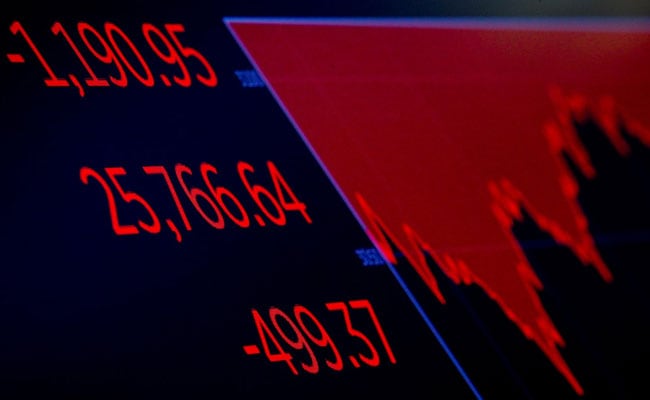
World shares slid to a two-week low on Thursday, and oil steadied after another heavy fall, as a surge in global COVID-19 cases and fractious US stimulus talks kept financial markets cautious.
Europe's early equity falls were their fourth in a row, while a disappointing German consumer morale survey also meant it was the first dip of the week for the high-flying euro.
The continent has seen the number of coronavirus cases surge to a record high, with Spain becoming the first Western European country to exceed 1 million infections, and France, Britain and Italy all setting record increases recently.
Bond market caution also ushered sensitive Italian government debt yields higher ahead of a 30-year bond sale there, as traders drifted back into uber-safe German Bunds.
"In the summer we were in the eye of the storm, I think," said Rabobank strategist Piotr Matys, likening the drop in COVID-19 cases to the lull that occurs in the middle of hurricanes.
"Some governments assumed the worst was over... but now the invisible enemy is hitting even harder and I am worried about the fragile economic recovery."
Sentiment was also being buffeted after US President Donald Trump accused rival Democrats on Wednesday of being unwilling to craft an acceptable compromise on fresh stimulus, following reports of progress earlier in the day.
It remains unclear whether negotiations will continue ahead of the US presidential and congressional elections on November 3.
"We still think that this deal will remain elusive in the sense that this amount that we are talking about, $1.88 trillion, that's about 9 per cent of GDP, said Carlos Casanova, a senior economist at Union Bancaire Privee (UBP) in Hong Kong.
Speaker Nancy Pelosi's package is even higher at around 10 per cent of GDP.
"Even if both sides do manage to reach an agreement, given the tight deadline ahead of the election it's unlikely that something like that would be able to go through the Senate smoothly," said Casanova.
In the currency markets, the dollar was a modest 0.1 per cent higher against the yen at 104.66, while the euro's dip saw it notch down 0.12 per cent to $1.1847.
But against a basket of major peers the dollar appeared relatively unaffected by setbacks to stimulus talks, steadying after touching a seven-week low to trade slightly higher at 92.736.
Overnight, MSCI's broadest index of Asia-Pacific shares outside Japan had slipped 0.3 per cent, while the Nikkei closed 0.7 per cent lower.
Election Looming
Uncertainty over the passage of a bill to stimulate a pandemic-ravaged economy comes as the United States also faces a new wave of COVID-19 cases.
Nearly two-thirds of US states were in a danger zone of coronavirus spread and six, including election battleground Wisconsin, reported a record one-day increase in COVID-19 deaths on Wednesday.
Wall Street's three major averages closed lower on Wednesday after a choppy trading session, and futures markets pointed to another subdued start later.
"The focus is absolutely on how a decisive win in this election can unlock fiscal stimulus," JP Morgan Asset Management global market strategist Hugh Gimber said, cautioning however that investors needed to treat next month's US vote carefully.
The yield on benchmark US 10-year Treasury notes ticked down to 0.8092 per cent, from a US close of 0.816 per cent on Wednesday.
In commodity markets, oil prices steadied after sharp losses on Wednesday, when higher US gasoline inventories pointed to deteriorating fuel demand again.
US West Texas Intermediate (WTI) crude futures hovered near $40 a barrel and Brent crude futures were 0.3 per cent higher at $41.85.
Gold eased as the dollar edged up, with spot gold down 0.4 per cent at 1,916 per ounce.

-
Where You Live Shapes How You Get To Work | The Reason Why

Two-wheelers are the most popular way to get to work in India, accounting for nearly 43% of workplace commutes.
-
High US Salaries, No Green Card Certainty: The Financial Calculation Facing Indian H-1B Families
The suspension of PERM processing at eight technology employers does not cancel existing H-1B visas. What it does is force a question many Indian families have been avoiding: is the US salary worth tying your career and family plans to one employer?
-
Unhedged Position: Can India See An Indonesia-Style Time Correction?
The Nifty is trading below levels it first clocked in 2024. Is there, then, as I have suggested in the headline, potential that the current time correction drags on painfully for the next three-five, even ten years?
-
Navigating Friction And Energy Realities: An Analysis Of Marco Rubio's October Visit To India
Occurring at a critical juncture marked by stalled trade negotiations and escalating geopolitical pressures over global energy supplies, the visit offers a profound window into modern US-India relations.
-
India Exports Capital. Why Not Export Trusteeship?
The big question, then, is whether India can build an institution that global borrowers, investors, banks, and lawyers can trust, even without an Indian connection.
-
France's Economy & Politics Are In Crisis | The Reason Why
Let's look at how the French economy and politics evolved under Nicolas Sarkozy, Franois Hollande and Emmanuel Macron.
-
You May Inherit The Business. You Must Earn Its Credibility.
Succession tests the founder's ability to share authority as much as it tests the next generation's readiness to assume it.
-
Signing Deals Is One Thing; Making Them Work Is Another | The Week In Whys
Sometimes, things don't turn out as planned. Indian companies have lost some bids to rivals, some projects won't produce until 2030.
-
FOMC Wall, PERM Suspension, Hospital Stocks | Talking Points This Week
A PERM suspension would directly affect green-card sponsorship rather than H-1B visas, so the near-term earnings impact could remain relatively limited. The key question is whether this marks a new phase in US scrutiny of Indian IT.
-
Everything, Everywhere, All At Once: Dalal Street's Week To Forget | Joining The Dots
Visa curbs, a Starlink spat and cancer drug caps: what connects this week's shocks for Indian markets









