World Leaders Flag Global Recession Risks At Davos
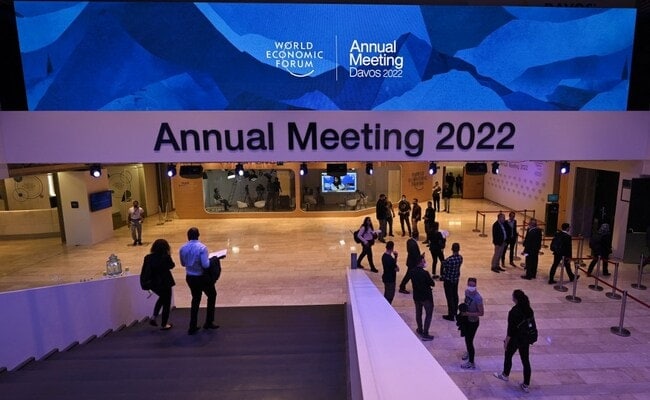
Multiple threats to the global economy topped the worries of the world's well-heeled at the annual Davos think-fest, with some flagging the risk of a worldwide recession.
Political and business leaders gathering for the World Economic Forum (WEF) meet against a backdrop of inflation at its highest level in a generation in major economies including the United States, Britain and Europe.
These price rises have undermined consumer confidence and shaken the world's financial markets, prompting central banks including the U.S. Federal Reserve to raise interest rates.
Meanwhile, the repercussions on oil and food markets of Russia's invasion of Ukraine in February - which Moscow describes as a "special military operation" - and COVID-19 lockdowns in China with no clear end have compounded the gloom.
"We have at least four crises, which are interwoven. We have high inflation ... we have an energy crisis... we have food poverty, and we have a climate crisis. And we can't solve the problems if we concentrate on only one of the crises," German Vice Chancellor Robert Habeck said during the annual meeting on Monday.
"But if none of the problems are solved, I'm really afraid we're running into a global recession with tremendous effect .. on global stability,"Mr Habeck said during a WEF panel discussion.
The International Monetary Fund (IMF) last month cut its global growth outlook for the second time this year, citing the war in Ukraine and singling out inflation as a "clear and present danger" for many countries.
IMF Managing Director Kristalina Georgieva, speaking in Davos on Monday, said the war, tighter financial conditions and price shocks - for food in particular - have clearly "darkened" the outlook in the month since, though she is not yet expecting a recession.
Asked at a panel whether she expected a recession, Georgieva said: "No, not at this point. It doesn't mean it is out of the question."
TIPPING POINT
European Central Bank (ECB) President Christine Lagarde, due to speak in Davos on Tuesday, has warned that growth and inflation are on opposing paths, as mounting price pressures curb economic activity and devastate household purchasing power.
"The Russia-Ukraine war may well prove to be a tipping point for hyper-globalisation," she said in a blog post on Monday.
"That could lead to supply chains becoming less efficient for a while and, during the transition, create more persistent cost pressures for the economy," Ms Lagarde added.
Still, she essentially promised rate hikes in both July and September to put a brake on inflation, even if rising borrowing costs are bound to weigh on growth.
"We knew, all knew from Day One that this war was bad economic news. Less growth and more inflation," French policymaker Francois Villeroy de Galhau said. "This is the price we accepted together to pay to protect our values ... It was worth paying this price."
"I would play down the idea of a short-term trade off between inflation and growth," he said. "In the short run, our priority is clearly ... fighting inflation."
While the economic drag from the Ukraine crisis is being most keenly felt in Europe, it is the U.S. economy that is experiencing the greatest price pressures.
The Consumer Price Index shot from near zero two years ago to a 40-year high of 8.5 per cent in March. The Fed responded earlier this month with its largest rate hike in 22 years, and Chair Jerome Powell has signalled increases of a similar magnitude - half a percentage point - at its next two meetings at least.
The higher rates and expectations for more, though, have yet to weaken consumer spending and a red-hot US job market.
"We're not seeing it materialize in our business yet," Marriott International Inc Chief Executive Anthony Capuano said of the threat of recession, adding: "There continues to be pent-up demand."
Harvard University economist Jason Furman, head of the Council of Economic Advisers under former President Barack Obama, said his baseline probability for a recession in any year is 15%. Now "I'm a little bit higher that 15," he said, citing the strength of household balance sheets and expectations for more people to return to the workforce in coming months.
Looking beyond that, however, he said he was concerned the Fed may need to lift rates higher than most officials and forecasters currently expect. "But that's more like a year and a half, two and a half years from now."
Key emerging markets, including China, are still expected to see growth this year, even if at a slower pace than previously estimated.
Marcos Troyjo, president of the New Development Bank set up by Brazil, Russia, India, China and South Africa, said his bank still expects "robust growth" this year in China, India and Brazil.

-
Opinion | India at 38: From Innovation Overperformer to Innovation Powerhouse

India now has 453 VC-backed deep science startups, 18 of them late-stage, after 117 percent growth since 2020. Laurus Labs, at USD 9.3 billion, is the most valuable deep science company in any middle-income economy outside China.
-
Navigating Energy Crossroads: S Jaishankar's Call For Diversified Supply Chains At G20 Ministerial Meeting
As geopolitical fault lines continue to test maritime trade routes and commodity flows, Jaishankar's message remains pertinent: true economic resilience requires open markets, protected transit lines, and a genuine commitment to multilateral cooperation rather than coercion.
-
Indians Are Travelling, But Not Every Journey Is A Holiday | The Week In Whys
Pilgrims, patients and working women are the real travellers, and the system hasn't quite caught up with them.
-
Getting To Work Costs Women More | The Reason Why
It is not just about women paying more than men. It is about women paying much more in cities than in villages.
-
AI Bias In Investing Cannot Be Eliminated, But It Can Be Governed
Framing is a particularly important example as identical financial information presented in terms of gains rather than losses can lead an LLM to reach a different assessment.
-
Joining The Dots | Dark Skies, Steady Diya: Why Hope Holds This Diwali
With war, a weak rupee and foreign outflows weighing on sentiment, policymakers at the NDTV World Summit and market veterans at NDTV Profit Ignite: Diwali Edition offered the same advice: stay invested and filter out the noise.
-
The Curious Case of Equitas Small Finance Bank And A CEO Who Quit For Stock
PN Vasudevan believes persistent investor concerns over a perceived conflict of interest had become a governance overhang on Equitas Small Finance Bank's stock, even as the lender improved profitability and asset quality.
-
Talking Points This Week: AI Cash Burn, A Tiger Comeback And An India That Still Finds Its Own Path
India is not immune to higher oil or tighter global liquidity, yet its earnings base is broader, its domestic policy levers are still available.
-
Foreign Investors Own Half Of HDFC Bank and ICICI Bank. An LTCG Cut Could Matter Most Here
Foreign portfolio investors have US$115 billion parked in HDFC Bank, ICICI Bank. If the government cuts long-term capital gains tax, Jefferies says returning foreign money could land here first.










