With G20 Presidency, Can India Play A Pivotal Role In Ending Ukraine-Russia War?
A few weeks ago, North Korean leader Kim Jong-un threatened to launch a nuclear attack on the United States. He has been repeating such threats since the summer of 2022. While the world's attention is focused on Ukraine and Taiwan, the Korean peninsula has emerged as the third frontier for a global nuclear war.
In November, the Joe Biden administration issued its Nuclear Posture Review, elaborating the American nuclear doctrine. It has described Russia, China, and North Korea as the biggest threats to the American homeland. It has categorically ruled out the ‘No First Use' policy adopted by China and India and affirmed its willingness to launch a pre-emptive nuclear attack.
In a 2019 public opinion poll of American citizens, about one-third of the respondents approved a pre-emptive nuclear strike that would kill a million Koreans. In fact, Carl Brown points out in a post for the Roper Centre that for decades at least 20% of American respondents have supported the first use of nuclear weapons, for preventive or other reasons, without being attacked.
With sections of American public opinion supporting a nuclear war, Russian President Vladimir Putin threatening it and Kim Jong-un following suit, it is no wonder that Antonio Guterres, the UN Secretary General, has proclaimed that the world is one miscalculation away from nuclear annihilation.
Nuclear sabre-rattling by leaders is not happening in a vacuum. Russia and the United States have 2,800 nuclear warheads on hair trigger alert. They can be launched within 10 minutes of an executive decision, with no possibility of recalling a missile.
Artificial intelligence has further complicated the nuclear arms race. Hypersonic missiles which travel at 5 to 25 times the speed of sound without being detected by radars, lethal autonomous weapons which destroy radars, cyber technology which can interfere with early warning systems, and automation have resulted in humans passing the control on deadly weapons to machines and algorithms.
As a result, the risk of a global nuclear war by accident, incident or intent is very real, especially on the background of competitive nationalism.
Time For India To Take Up The 'Vishwaguru' Role
Who can take an initiative to pull the world back from the nuclear brink? India's assumption of chairmanship of G-20, the world's most powerful grouping, has raised expectations from New Delhi.
Recently, S Jaishankar, India's External Affairs Minister, said it is in the interest of states to avoid wars and resolve conflicts. He said that a world without wars was not a Utopian dream, but a pragmatic necessity.
India has already appealed to Russia and Ukraine to end the war. India can take a few more steps to bring the two parties to the negotiating table. India may not be able to resolve the conflict over the Taiwan Strait because of our own problems with China. But India has considerable political capital in Moscow, Paris, and Washington DC to find a diplomatic solution to the Ukraine war.
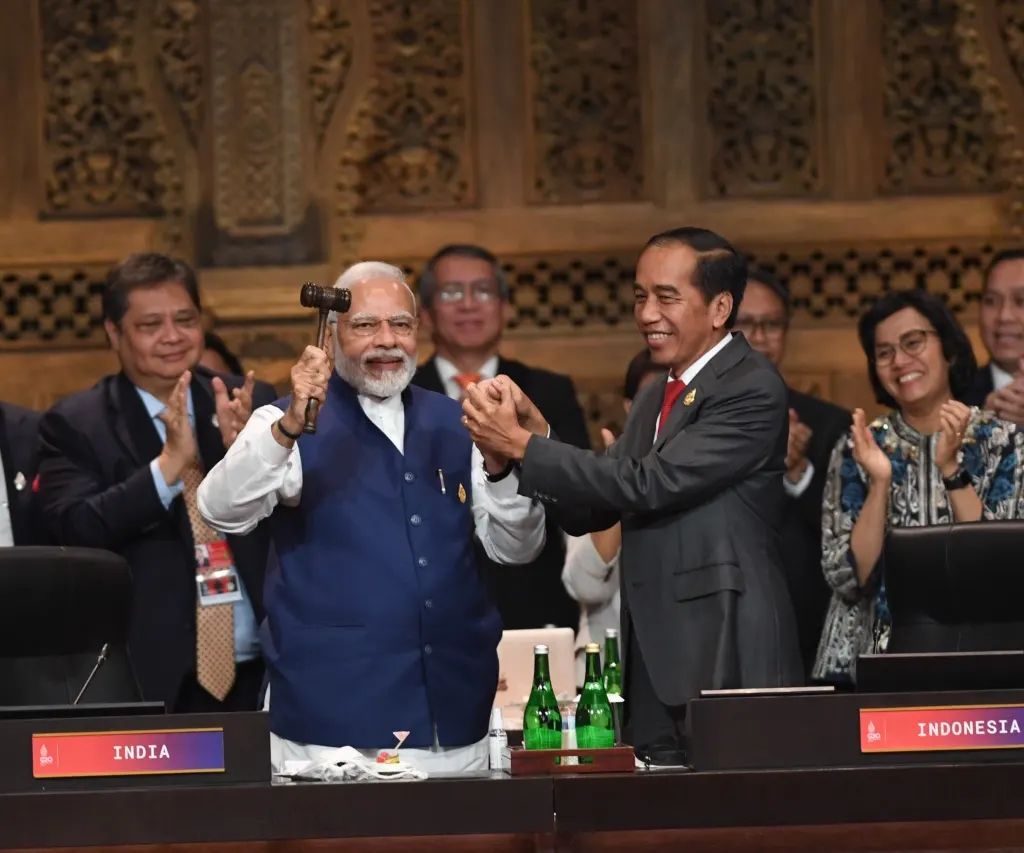
It is imperative for India to work hard for a ceasefire and the commencement of a peace process in Ukraine before the next G-20 summit to be held in September 2023. It will be very embarrassing for India if Putin does not show up at the New Delhi summit, as in the last summit in Bali or if he is insulted by Western leaders on Indian soil. India has a very special relationship with Russia, unlike Indonesia which hosted the Bali summit. India is also an aspirant for a permanent seat in the UN Security Council. If India wants to prevent an awkward drama at the G-20 summit, it must strive to end the Ukraine war as soon as possible.
Russia and Ukraine are on talking terms despite the war. They cooperate on foodgrain trade, coordination of gas flow at the Sudzha metering station, and the exchange of prisoners. The heads of U.S. and Russian intelligence agencies met recently to discuss nuclear risk in Ukraine. Thus, building blocks of peace are available, which India can pick up and construct together into a ceasefire accord and peace process.
If India does not try, some other country such as Turkey will take the initiative. It is time for India to demonstrate its potential of global leadership, the Vishwaguru role that the country is aspiring for.
India also needs to act in the multilateral space to reduce the risk posed by the weapons of mass destruction to the survival of human civilization. It should bring together the international community for preparing a blueprint for the phased elimination of all weapons of mass destruction, including nuclear, chemical, biological and lethal autonomous weapons.
India has the credibility to take a lead to introduce arms control in artificial intelligence in a universal and non-discriminatory framework. The five permanent members of the UN Security Council have a dialogue mechanism on disarmament, but they do not touch upon the risk from new technologies, especially AI and cyber warfare.
It is in India's interest to take a lead for the AI arms control regime in order to prevent reiteration of the discriminatory Non-Proliferation Treaty model. Such initiatives carry diplomatic risks, but the country will be applauded even for trying. If we want a seat at the permanent table in the UN Security Council, diplomatic leadership will help us to obtain it rather than merely demanding it.
Sundeep Waslekar is the President of the international think tank Strategic Foresight Group and author of A World without War: The History, Politics and Resolution of Conflict (HarperCollins India 2022).
The views expressed here are those of the author, and do not necessarily represent the views of BQ Prime or its editorial team.

-
Unhedged Position: Can India See An Indonesia-Style Time Correction?

The Nifty is trading below levels it first clocked in 2024. Is there, then, as I have suggested in the headline, potential that the current time correction drags on painfully for the next three-five, even ten years?
-
Navigating Friction And Energy Realities: An Analysis Of Marco Rubio's October Visit To India
Occurring at a critical juncture marked by stalled trade negotiations and escalating geopolitical pressures over global energy supplies, the visit offers a profound window into modern US-India relations.
-
India Exports Capital. Why Not Export Trusteeship?
The big question, then, is whether India can build an institution that global borrowers, investors, banks, and lawyers can trust, even without an Indian connection.
-
France's Economy & Politics Are In Crisis | The Reason Why
Let's look at how the French economy and politics evolved under Nicolas Sarkozy, Franois Hollande and Emmanuel Macron.
-
You May Inherit The Business. You Must Earn Its Credibility.
Succession tests the founder's ability to share authority as much as it tests the next generation's readiness to assume it.
-
Signing Deals Is One Thing; Making Them Work Is Another | The Week In Whys
Sometimes, things don't turn out as planned. Indian companies have lost some bids to rivals, some projects won't produce until 2030.
-
FOMC Wall, PERM Suspension, Hospital Stocks | Talking Points This Week
A PERM suspension would directly affect green-card sponsorship rather than H-1B visas, so the near-term earnings impact could remain relatively limited. The key question is whether this marks a new phase in US scrutiny of Indian IT.
-
Everything, Everywhere, All At Once: Dalal Street's Week To Forget | Joining The Dots
Visa curbs, a Starlink spat and cancer drug caps: what connects this week's shocks for Indian markets
-
India Is Going Abroad For Critical Minerals. But It May Take Years To Pay Off | The Reason Why
Although India's steps are in the right direction, they remain modest compared with India's growing dependence.
-
When Everyone Has AI, What Gives You An Edge?
India's young workforce is entering an uncertain world of work where powerful AI tools are becoming widely accessible. The advantage will belong to those who combine deep expertise with digital fluency, and the distinctly human capabilities that technology cannot manufacture.









